Vanisa Dhiru, “Kia Ora Modi”, the 2021 campaign against academic freedom, and the questions Rakesh Naidoo’s candidacy must answer.
Here we scrutinise the words and actions of his partner Vanisa Dhiru. How creating a public myth about the self for the white (and to some extend Māori) gaze conceals how she too disseminates Hindutva. (Again, confirming organisational diffusion.)
In July 2022, Stuff introduced Vanisa Dhiru to its readers as a human rights and community advocate who would “always fight for the underdog.” In July 2026, Dhiru went on LinkedIn to celebrate the address Narendra Modi gave to his diaspora at Auckland’s Spark Arena, tagging the post #KiaOraModi. Between those two moments sits a third, from September 2021, when Indian Newslink circulated a Hindu Youth New Zealand press release declaring Professor Mohan J Dutta’s scholarship “outright Hindu hatred” and tagged a list of community figures on the post. Dhiru’s name is on that list.
Hindutva expert Professor Mohan J Dutta published a CARE white paper, Cultural Hindutva and Islamophobia. This set off a targeted campaign against him from various local Hindutva organisations and their affiliates. They sent out press releases, petitions and letters to Massey’s Vice-Chancellor with local Indian media also jumping on that bandwagon to bash Professor Dutta while disavowing the existence of Hindutva in Aotearoa. Professor Dutta faced extreme violent and sexual online abuse. The Indian Newslink press release was part of the targeted campaign.
AAPI and Professor Dutta have spent many years documenting how Hindutva organises in Aotearoa. This post builds on that work. Here we analyse three public records, all reproduced below as images, and ask what they mean for a public figure like Vanisa Dhiru whose partner, Superintendent Rakesh Naidoo, led New Zealand Police’s engagement with ethnic communities and now sits at number 13 on Labour’s party list.
The argument is about a pattern in public communication. Dhiru speaks the language of anti-racism and intersectionality with fluency and conviction. That language stops at a border. On one side sit the racisms Indian New Zealanders face from white Aotearoa, which she names. On the other side sit the anti-Muslim violence of the Hindutva project, the caste order that sustains it, and the campaigns its diaspora networks run against scholars who study it. About these, her public record is silent, and her celebration of Modi fills the space where that silence might otherwise have been noticed.
A note on evidence
Precision matters here, both because the people named deserve it and because Hindutva networks have long used any overstatement by their critics to recast criticism as “Hinduphobia.” So here is what the record shows and what it does not.
The Indian Newslink Facebook post (Figure 1) lists names beneath the press release. On Facebook those names are tags, and tags are applied by the account that posts. The published article itself carries no list of signatories; it attributes the statement to Hindu Youth New Zealand and quotes its president, Murali Krishna Magesan. Being tagged therefore tells us that the publisher placed Dhiru inside the circle it wished to address and mobilise. It does not, on its own, show that she wrote, signed or endorsed the release.
What the record does show is that Dhiru’s name was used in a campaign to brand academic research as hatred. And we have not seen a public statement from her distancing herself from that campaign or from the use of her name in it, in the five years since.
In July 2026 Dhiru publicly celebrated Narendra Modi, the political leader the same organisations that abused Professor Dutta serve. We draw conclusions from that record further in this post and we invite her to correct it.
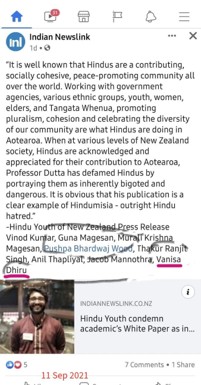
Figure 1. Indian Newslink’s Facebook share of the Hindu Youth New Zealand press release, annotated 11 September 2021, with the names the page tagged beneath it. Vanisa Dhiru’s name is underlined.
The advocate for the underdog
The Stuff profile is worth reading closely, because it sets out the moral vocabulary against which everything else should be measured. The headline promises an advocate who does not want anyone to be the underdog (Figure 2). The introduction tells us that she lives in Wellington with her partner, police superintendent Rakesh Naidoo (Figure 3).
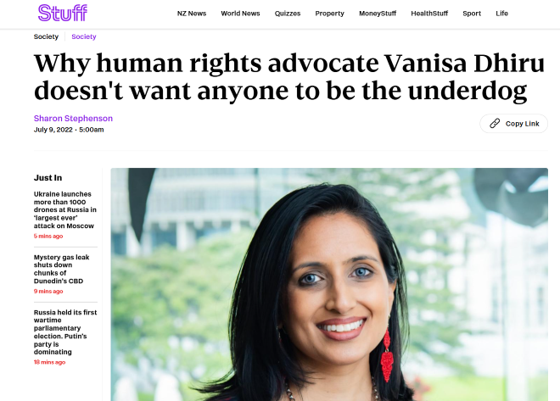
Figure 2. Stuff, 9 July 2022: “Why human rights advocate Vanisa Dhiru doesn’t want anyone to be the underdog” (Sharon Stephenson).
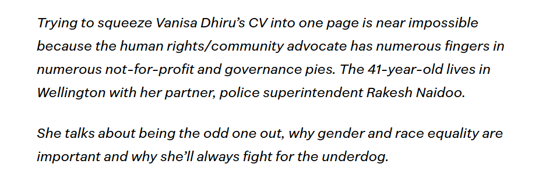
Figure 3. The profile’s introduction, which presents Dhiru as a human rights and community advocate and names her partner as police superintendent Rakesh Naidoo.
In the question-and-answer section (Figure 4), Dhiru describes the discriminatory barriers she has faced as an Indian woman. She says people are more confident calling out injustice, especially online. She praises the Māori community for embracing its culture and says this inspires those “who walk in two worlds.” She says she is “very much at home working at the intersection of race and gender equality,” and adds disability access to her agenda.
These are good commitments on paper and as part of myth building. The trouble lies in how the categories are drawn. “Indian” appears here as a single, injured identity, positioned against white institutional power. Absent from the frame are the hierarchies inside the category: caste, religion, and the majoritarian politics that make Muslim, Christian, Dalit and Adivasi Indians targets. Intersectionality, as Kimberlé Crenshaw developed it, exists precisely to make visible the people who fall through single-axis thinking. An ‘intersectional’ analysis of “Indian” that cannot see an Indian Muslim woman is not quite intersectional is it. (And in Pākeha hagiographies of people of colour, such nuances do not exist either.)
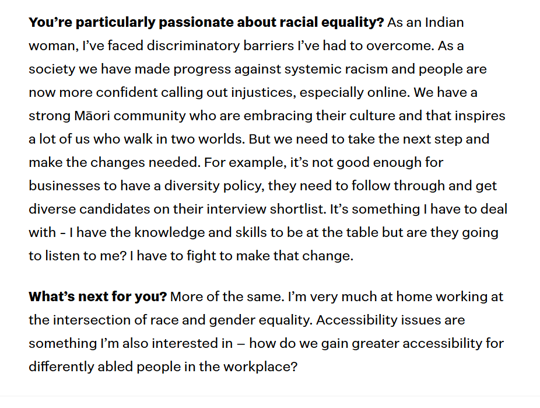
Figure 4. Dhiru on racial equality, systemic racism, Māori culture and “the intersection of race and gender equality.” Stuff, 9 July 2022
Her other roles sharpen the point. Her public biographies list her as a volunteer with the Wellington Interfaith Council. Interfaith work in Aotearoa after 15 March 2019 carries a particular weight. It asks non-Muslim faith leaders to stand with Muslim communities against the ideologies that produce violence against them. That commitment cannot be selective about which ideologies it will name.
September 2021: a name in the circuit
The press release from Hindu Youth New Zealand that Indian Newslink carried on 10 September 2021 accused Professor Dutta’s white paper of “Hinduphobia and Hindumisia,” claiming it portrayed Hindus as “inherently bigoted and dangerous,” and warned that his work was likely to incite violence against Hindus. It also demanded to know why Massey was co-sponsoring the Dismantling Global Hindutva conference, and suggested Hindu students look to other universities. Stuff reported that the Hindu Council of New Zealand issued its own release accusing Professor Dutta of advocating the abolition of Hinduism. The New Zealand Herald reported the trolling and threats that followed. A separate piece in The Indian News placed his photograph beneath a prayer “for those who spread animosity” against Hindus; Professor Dutta complained to the Media Council, and its ruling records the episode.
Hindu Youth New Zealand operates within the orbit of the Hindu Council of New Zealand. The press release itself pictures officials of both bodies together at their national conference and describes their joint work with Māori communities. The Council’s own website carries the title “VHP New Zealand.” The Vishva Hindu Parishad is a member of the Sangh Parivar, the family of organisations led by the RSS. In June 2018 the CIA World Factbook briefly listed the VHP as a “religious militant organisation” before the section was removed later that month. In March 2026 the US Commission on International Religious Freedom recommended, for the first time, targeted sanctions on the RSS for its responsibility for severe violations of religious freedom.12
This is the network that tagged Dhiru. A tag is a small thing, and we underline here what it does and does not prove. But campaigns of this kind work precisely through such small things. They borrow the standing of respected community figures to signal that “the community” stands together, and they count on the silence of those figures to hold that signal in place. Someone with Dhiru’s public profile in human rights, gender equality and interfaith work lends considerable weight by staying quiet. The silence becomes part of the message.
July 2026: Kia Ora Modi
Modi arrived in Auckland on 10 July 2026, the first visit by an Indian prime minister in four decades. The centrepiece was “Kia Ora Modi,” a sold-out diaspora reception at Spark Arena organised by the NZ Bhartiya Diaspora Group and attended by Prime Minister Christopher Luxon. The Overseas Friends of BJP New Zealand promoted the event on X as a historic welcome. The genre is familiar from Houston, Sydney and London: the stadium rally where the diaspora performs its devotion and a leader facing sustained human rights criticism at home collects images of adoration abroad.
Dhiru’s LinkedIn post (Figures 5 and 6), published the following day, is warm and detailed. It opens with “Prime Minister Shri Narendra Modi ji’s address” and lists the five te reo Māori words Modi used: waka, haka, manaakitanga, whānau and kaitiakitanga. She reads each as a bridge between Māori values and Indian tradition. She finds the waka image the most powerful, a shared journey in which partnerships are “not about one nation leading another.” She closes by saying that in a world focused on what divides us, hearing about what connects us was refreshing.
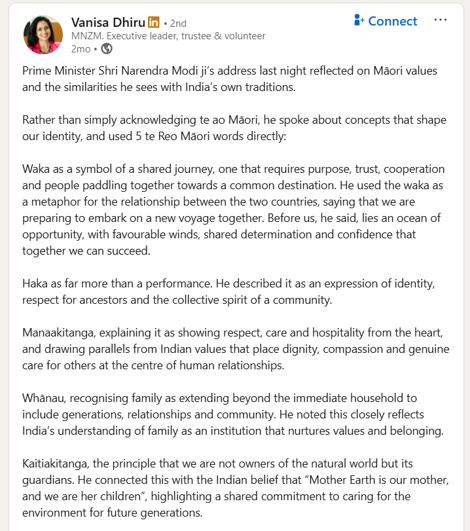
Figure 5. Vanisa Dhiru, LinkedIn, July 2026: the opening of her post on Modi’s Kia Ora Modi address and its use of te reo Māori concepts.
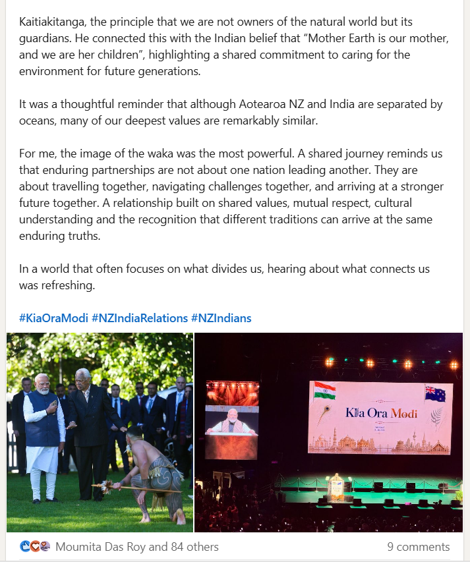
Figure 6. The close of the same post, with the hashtags #KiaOraModi, #NZIndiaRelations and #NZIndians, and photographs of the pōwhiri and the Spark Arena stage.
Read the post against the record of the government Modi leads. Human Rights Watch’s World Report 2026 found that India’s BJP-led government vilified religious minorities in 2025, expelled hundreds of Bengali-speaking Muslims and Rohingya refugees, and that hostile broadcast and social media rhetoric helped fuel Hindu mob attacks on Muslims, including Kashmiri students and workers. HRW’s global essay described an administration that “actively promotes Hindu majoritarianism.” USCIRF recommended India as a Country of Particular Concern for the seventh year running and called for sanctions on the RSS. India’s Ministry of External Affairs rejected the report as biased, which readers can weigh for themselves.
None of this appears in Dhiru’s post. Its subject is values. It speaks of dignity, compassion and care “at the centre of human relationships,” of manaakitanga as hospitality “from the heart.” These words are placed in the mouth of a leader whose party’s rule has been marked, by Human Rights Watch and USCIRF, by the stripping of dignity from Indian Muslims. The post performs a kind of translation. It carries Modi’s speech across into the moral language of Aotearoa while scrubbing out the violence.
There is a second translation at work, and it should trouble anyone committed to Te Tiriti. The waka, the haka and manaakitanga become diplomatic currency. They certify a foreign head of government, and through him a political project, as kin to te ao Māori. In earlier work, we have traced how Hindutva organisations harvest manaakitanga as legitimacy, turning marae relationships into proof of their own benevolence for circulation in the Sangh press. The Kia Ora Modi post extends that circuit to the level of the state visit. Māori concepts are praised; Māori are made into a backdrop. The “shared journey” of the waka is, in the speech, a metaphor for trade and strategic partnership between two governments.
Dhiru praises the idea that partnerships are “not about one nation leading another.” That phrase would mean something if a person also asked about the Muslims being pushed across the Bangladesh border or their homes demolished in the name of law and order or their lynchings in the name of cow (gau mata) protection. Or stealing Adivasi and Dalit land for data centres. From Vanisa Dhiru, who has said nothing about them, the phrase becomes decoration.
Two far rights, one silence
The Modi visit also drew the ugliest anti-Indian racism Aotearoa has seen in some time. Brian Tamaki called for protests against the visit and said, “Let’s purge New Zealand of Hindus, Sikhs and Muslims”; the Race Relations Commissioner called the remarks utterly appalling, and protesters chanted anti-immigration slogans outside Spark Arena. Any critique of Hindutva must refuse that politics completely. Indian New Zealanders were being targeted as a people, and that targeting deserved the solidarity of every New Zealander.
This is exactly why the silence matters. White ethnonationalism and Hindu nationalism feed each other. Each supplies the other with a threatening enemy and a reason to close ranks. Tamaki’s racism makes it easier to cast any criticism of Modi as an attack on Indians. Hindutva’s anti-Muslim rhetoric, meanwhile, rehearses the very logic of purity and purge that Tamaki directed at Hindus, Sikhs and Muslims alike. An anti-racism worth the name stands against both. An anti-racism that sees only the first will always end up, sooner or later, lending its credibility to the second.
Dhiru’s public anti-racism sees the first. Her post about Kia Ora Modi, written in the same week as the Tamaki protests, says that the world often focuses on what divides us. The division she chose to set aside was the one that Muslims in India live with every moment every day.
The candidate
Rakesh Naidoo has built his career in the space where the state meets communities of colour. Born and educated in South Africa, he joined New Zealand Police in 2001 with the stated aim of working with ethnic communities. Most recently he was the national partnerships manager for ethnic, iwi and communities. Indian Newslink credits him with managing the police relationship for Muslim leaders after the Christchurch attacks. In June 2026 Labour placed him at number 13 on its list, the highest-ranked newcomer, as a list-only candidate; at that ranking he is close to certain of a seat. The Police Commissioner later described his position in police as untenable because he had not disclosed his political intentions in time, and a review of that period is under way.
Let us be clear about what we are arguing and what we are not. Vanisa Dhiru’s words are her own. They are not evidence of Rakesh Naidoo’s views, and a partner’s politics should never be used to convict anyone by association. What we are arguing is narrower and, we think, harder to wave away.
Naidoo’s professional authority rests on trust. For two decades he has been the face of police engagement with the communities Hindutva targets: Muslims, Sikhs, Christians from South Asia, Dalit families, and the Hindus who refuse the Sangh’s politics. That trust depends on those communities believing that the gatekeepers of state engagement do not treat Hindutva organisations as neutral representatives of “the Indian community.” Police engagement with ethnic communities runs through community organisations, and in Aotearoa the Hindu Council has long positioned itself as the representative body for Hindus. Whether police relationships over these years treated it as such is a fair question for public accountability.
The stakes rise with the move to Parliament. A list MP ranked this high will be a voice for ethnic communities in the next Labour caucus, possibly in government. He will shape policy on hate speech, social cohesion, transnational repression and the Crown funding of community organisations. USCIRF’s 2026 report urges attention to Indian transnational repression abroad. In Aotearoa, scholars and activists who criticise Hindutva have faced coordinated harassment, including members of AAPI. Voters, and especially the communities whose trust Naidoo has spent a career building, are entitled to know where he stands. Naidoo’s presence at the BAPS Swaminarayan Mandir along with his Labour leader Chris Hipkins, in the same week as BAPS caused female employees at the Eiffel Tower to strike, in the same week that the connection between Modi and BAPS re-emerged, where Indians were reminded about how BAPS had exploited the Dalit labourers who built their temple in New Jersey, where globally the Indian diaspora reiterated that BAPS is an Islamophobic cult makes us wonder whether Naidoo is ignorant about Hindutva or whether he deliberately ignores it because no one will question him. The closeness of the networks in Naidoo’s public and personal life, documented in Figures 1 to 6, make these questions pressing. Only he can answer them.
Questions that deserve answers
To Vanisa Dhiru:
1. Did you consent to your name being tagged on the September 2021 Hindu Youth New Zealand press release, and do you endorse its description of research on Hindutva as “outright Hindu hatred”?
2. As a human rights advocate and a member of the Wellington Interfaith Council, how do you reconcile your public celebration of Modi’s address with the findings of Human Rights Watch and USCIRF on the treatment of Muslims and other minorities under his government?
3. Does your intersectional analysis of “Indian” identity include caste and religion, and if so, where in your public work do Indian Muslim, Dalit and Adivasi women appear?
To Rakesh Naidoo:
4. Do you regard organisations affiliated with the RSS and VHP, including those that identify themselves with the VHP, as appropriate representatives of Hindu New Zealanders in engagement with the state?
5. What is your view of USCIRF’s 2026 recommendation of targeted sanctions on the RSS, and of Human Rights Watch’s findings on anti-Muslim violence in India?
6. Will you state publicly that the 2021 campaign against a Massey University researcher, and campaigns like it, are incompatible with academic freedom and with the safety of those who study Hindutva?
7. As an MP, what would you do about transnational repression and harassment directed at critics of the Indian government living in Aotearoa?
To the Labour Party:
8. What does Labour ask of its candidates about Hindutva, the RSS and the Sangh Parivar, and will it publish a position on Crown engagement with and funding of Sangh-affiliated organisations?
The border and the underdog
Anti-racism in the diaspora carries a temptation. It is easier to speak about the racism we suffer than the racism we inherit, carry and export. The first earns applause and honours from the institutions of the settler state. The second costs friends, community standing and the goodwill of powerful organisations. Many of us have felt that pull. The communities who pay when we give in to it are the ones with the least voice in the room: the Muslim family in Assam, the Dalit worker in Auckland, the dissenting Hindu who is told she is a traitor to her people.
Vanisa Dhiru has said she will always fight for the underdog. The public record reproduced here shows where that fight has stopped so far. The border can be crossed. It takes a sentence, spoken publicly, naming the violence she has so far left out. Rakesh Naidoo, asking New Zealanders to send him to Parliament as a voice for ethnic communities, owes those communities the same sentence, in his own words.
Notes and sources
1. Stephenson, S. (2022, July 9). Why human rights advocate Vanisa Dhiru doesn’t want anyone to be the underdog. Stuff. Screenshots on file with CARE (Figures 2–4).
2. Dhiru, V. (2026, July). LinkedIn post on Prime Minister Modi’s Kia Ora Modi address [#KiaOraModi]. Screenshots on file with CARE (Figures 5–6).
3. Hindu Youth New Zealand. (2021, September 10). Hindu Youth condemn academic’s White Paper as inciteful and explosive [Press release]. Indian Newslink. https://indiannewslink.co.nz/hindu-youth-condemn-academics-white-paper-as-inciteful-and-explosive/ ; Facebook share with tags on file with CARE (Figure 1).
4. Dutta, M. J. (2021). Cultural Hindutva and Islamophobia [CARE White Paper]. Center for Culture-Centered Approach to Research and Evaluation, Massey University.
5. The rise of Hindutva and hate in Aotearoa’s Indian diaspora. (2021, October 2). Stuff. https://www.stuff.co.nz/national/300420720/the-rise-of-hindutva-and-hate-in-aotearoas-indian-diaspora
6. “World of digital hate”: Academic hit by right-wing trolls. (2021, September 9). The New Zealand Herald. https://www.nzherald.co.nz/nz/massey-university-professor-hit-by-right-wing-hindu-trolls/LQQH4V7YFFVXBRWRO3VECGXUW4/
7. Palmer, R. (2026, June 8). Who’s in, who’s out? Labour unveils list for November election. RNZ. https://www.rnz.co.nz/news/politics/597538/who-s-in-who-s-out-labour-unveils-list-for-november-election
8. Global Women NZ. (n.d.). Vanisa Dhiru MNZM [Member profile]. https://globalwomen.org.nz/member/vanisa-dhiru
9. New Zealand Media Council. (2021, December). Mohan Dutta against The Indian News [Ruling]. https://www.mediacouncil.org.nz/rulings/mohan-dutta-against-the-indian-news/
10. Hindu Council of New Zealand. (n.d.). Hindu Council of New Zealand Inc. (HCNZ) – VHP New Zealand [Website home page title]. https://hcnz.org/ (accessed 21 September 2026).
11. The Wire Staff. (2018, June 15). CIA’s World Factbook calls Bajrang Dal, VHP ‘religious militant organisations’. The Wire. https://thewire.in/communalism/cia-world-factbook-bajrang-dal-vhp-religious-militant-organisations ; on the section’s removal by 25 June 2018, see Factly, https://factly.in/older-version-of-cias-world-factbook-listed-bajrang-dal-and-vhp-as-militant-religious-organisation
12. United States Commission on International Religious Freedom. (2026). 2026 annual report. https://www.uscirf.gov/sites/default/files/2026-03/USCIRF_2026_AR_3326_NEW.pdf
13. Prime Minister Modi’s visit to New Zealand. (2026, July 11). Diplomacy & Beyond Plus. https://diplomacybeyond.com/prime-minister-modis-visit-to-new-zealand/
14. ‘Kia Ora Modi’ draws strong response in Auckland. (2026, July 6). The Siasat Daily. https://www.siasat.com/kia-ora-modi-draws-strong-response-in-auckland-3502345/ ; see also MacManus, J. (2026, July 13). The madness and mania behind Narendra Modi’s landmark New Zealand visit. The Spinoff. https://thespinoff.co.nz/politics/13-07-2026/the-madness-and-mania-behind-narendra-modis-landmark-new-zealand-visit
15. Overseas Friends of BJP New Zealand [@OFBJPNZ]. (2026, May 26). Post promoting “Kia Ora Modi” [X]. https://x.com/OFBJPNZ/status/2059224858450706696
16. Human Rights Watch. (2026). India. In World Report 2026. https://www.hrw.org/world-report/2026/country-chapters/india ; and HRW. (2026, February 4). India: Religious minorities, critics unlawfully targeted. https://www.hrw.org/news/2026/02/04/india-religious-minorities-critics-unlawfully-targeted
17. Human Rights Watch. (2026). World Report 2026 [Introductory essay]. https://www.hrw.org/world-report/2026
18. ‘Distorted, selective picture of India’: Govt trashes USCIRF report. (2026, March 17). Business Today. https://www.businesstoday.in/india/story/distorted-selective-picture-of-india-govt-trashes-uscirf-report-calling-for-targeted-sanctions-on-raw-rss-520873-2026-03-17
19. Dutta, M. J. (2026). Performing solidarity, platforming Hindutva: Cultural essentialism, the category “Asian,” and the absence of a power analysis in tauiwi solidarity work in Aotearoa New Zealand [CARE White Paper]. Massey University.
20. Indian PM Narendra Modi faces protesters at Auckland’s Spark Arena. (2026, July 11). The New Zealand Herald. https://www.nzherald.co.nz/nz/protesters-chant-anti-immigration-slogans-as-indian-pm-narendra-modi-visits-aucklands-spark-arena/4O4ZGOBOEVHNXKXB7OC7YKKNKQ/
21. Modi visits New Zealand as trade deal sparks India pushback. (2026, July 10). France 24 (AFP). https://www.france24.com/en/live-news/20260710-modi-visits-new-zealand-as-trade-deal-sparks-india-pushback
22. Labour chooses Rakesh Naidoo high on its Party List. (2026, June 8). Indian Newslink. https://www.indiannewslink.co.nz/labour-chooses-rakesh-naidoo-high-on-its-party-list
23. Labour Party releases election candidate list. (2026, June 8). interest.co.nz. https://www.interest.co.nz/public-policy/138880/labour-unveils-candidate-election-list-party-president-says-it-gives-give-new
24. Rakesh Naidoo told police boss two weeks before his Labour Party candidacy selection. (2026, August 12). RNZ. https://www.rnz.co.nz/news/politics/974040/rakesh-naidoo-told-police-boss-two-weeks-before-his-labour-party-candidacy-selection
25. Crenshaw, K. (1989). Demarginalizing the intersection of race and sex: A Black feminist critique of antidiscrimination doctrine, feminist theory and antiracist politics. University of Chicago Legal Forum, 1989(1), 139–167.
