Anti-Racism With a Border
Vanisa Dhiru, “Kia Ora Modi”, the 2021 campaign against academic freedom, and the questions Rakesh Naidoo’s candidacy must answer.
Here we scrutinise the words and actions of his partner Vanisa Dhiru. How creating a public myth about the self for the white (and to some extend Māori) gaze conceals how she too disseminates Hindutva. (Again, confirming organisational diffusion.)
In July 2022, Stuff introduced Vanisa Dhiru to its readers as a human rights and community advocate who would “always fight for the underdog.” In July 2026, Dhiru went on LinkedIn to celebrate the address Narendra Modi gave to his diaspora at Auckland’s Spark Arena, tagging the post #KiaOraModi. Between those two moments sits a third, from September 2021, when Indian Newslink circulated a Hindu Youth New Zealand press release declaring Professor Mohan J Dutta’s scholarship “outright Hindu hatred” and tagged a list of community figures on the post. Dhiru’s name is on that list.
Hindutva expert Professor Mohan J Dutta published a CARE white paper, Cultural Hindutva and Islamophobia. This set off a targeted campaign against him from various local Hindutva organisations and their affiliates. They sent out press releases, petitions and letters to Massey’s Vice-Chancellor with local Indian media also jumping on that bandwagon to bash Professor Dutta while disavowing the existence of Hindutva in Aotearoa. Professor Dutta faced extreme violent and sexual online abuse. The Indian Newslink press release was part of the targeted campaign.
AAPI and Professor Dutta have spent many years documenting how Hindutva organises in Aotearoa. This post builds on that work. Here we analyse three public records, all reproduced below as images, and ask what they mean for a public figure like Vanisa Dhiru whose partner, Superintendent Rakesh Naidoo, led New Zealand Police’s engagement with ethnic communities and now sits at number 13 on Labour’s party list.
The argument is about a pattern in public communication. Dhiru speaks the language of anti-racism and intersectionality with fluency and conviction. That language stops at a border. On one side sit the racisms Indian New Zealanders face from white Aotearoa, which she names. On the other side sit the anti-Muslim violence of the Hindutva project, the caste order that sustains it, and the campaigns its diaspora networks run against scholars who study it. About these, her public record is silent, and her celebration of Modi fills the space where that silence might otherwise have been noticed.
A note on evidence
Precision matters here, both because the people named deserve it and because Hindutva networks have long used any overstatement by their critics to recast criticism as “Hinduphobia.” So here is what the record shows and what it does not.
The Indian Newslink Facebook post (Figure 1) lists names beneath the press release. On Facebook those names are tags, and tags are applied by the account that posts. The published article itself carries no list of signatories; it attributes the statement to Hindu Youth New Zealand and quotes its president, Murali Krishna Magesan. Being tagged therefore tells us that the publisher placed Dhiru inside the circle it wished to address and mobilise. It does not, on its own, show that she wrote, signed or endorsed the release.
What the record does show is that Dhiru’s name was used in a campaign to brand academic research as hatred. And we have not seen a public statement from her distancing herself from that campaign or from the use of her name in it, in the five years since.
In July 2026 Dhiru publicly celebrated Narendra Modi, the political leader the same organisations that abused Professor Dutta serve. We draw conclusions from that record further in this post and we invite her to correct it.
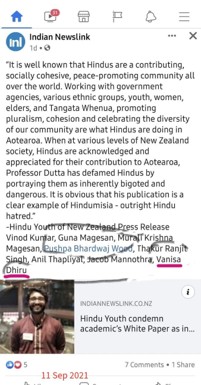
Figure 1. Indian Newslink’s Facebook share of the Hindu Youth New Zealand press release, annotated 11 September 2021, with the names the page tagged beneath it. Vanisa Dhiru’s name is underlined.
The advocate for the underdog
The Stuff profile is worth reading closely, because it sets out the moral vocabulary against which everything else should be measured. The headline promises an advocate who does not want anyone to be the underdog (Figure 2). The introduction tells us that she lives in Wellington with her partner, police superintendent Rakesh Naidoo (Figure 3).
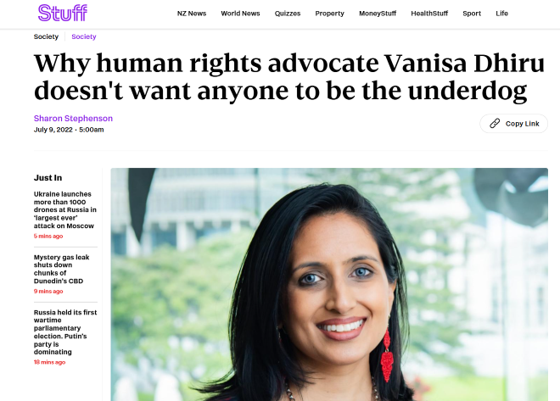
Figure 2. Stuff, 9 July 2022: “Why human rights advocate Vanisa Dhiru doesn’t want anyone to be the underdog” (Sharon Stephenson).
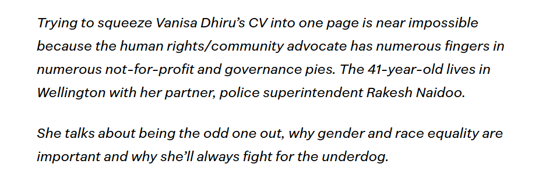
Figure 3. The profile’s introduction, which presents Dhiru as a human rights and community advocate and names her partner as police superintendent Rakesh Naidoo.
In the question-and-answer section (Figure 4), Dhiru describes the discriminatory barriers she has faced as an Indian woman. She says people are more confident calling out injustice, especially online. She praises the Māori community for embracing its culture and says this inspires those “who walk in two worlds.” She says she is “very much at home working at the intersection of race and gender equality,” and adds disability access to her agenda.
These are good commitments on paper and as part of myth building. The trouble lies in how the categories are drawn. “Indian” appears here as a single, injured identity, positioned against white institutional power. Absent from the frame are the hierarchies inside the category: caste, religion, and the majoritarian politics that make Muslim, Christian, Dalit and Adivasi Indians targets. Intersectionality, as Kimberlé Crenshaw developed it, exists precisely to make visible the people who fall through single-axis thinking. An ‘intersectional’ analysis of “Indian” that cannot see an Indian Muslim woman is not quite intersectional is it. (And in Pākeha hagiographies of people of colour, such nuances do not exist either.)
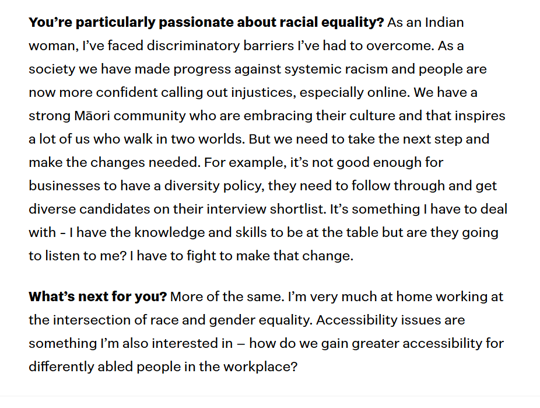
Figure 4. Dhiru on racial equality, systemic racism, Māori culture and “the intersection of race and gender equality.” Stuff, 9 July 2022
Her other roles sharpen the point. Her public biographies list her as a volunteer with the Wellington Interfaith Council. Interfaith work in Aotearoa after 15 March 2019 carries a particular weight. It asks non-Muslim faith leaders to stand with Muslim communities against the ideologies that produce violence against them. That commitment cannot be selective about which ideologies it will name.
September 2021: a name in the circuit
The press release from Hindu Youth New Zealand that Indian Newslink carried on 10 September 2021 accused Professor Dutta’s white paper of “Hinduphobia and Hindumisia,” claiming it portrayed Hindus as “inherently bigoted and dangerous,” and warned that his work was likely to incite violence against Hindus. It also demanded to know why Massey was co-sponsoring the Dismantling Global Hindutva conference, and suggested Hindu students look to other universities. Stuff reported that the Hindu Council of New Zealand issued its own release accusing Professor Dutta of advocating the abolition of Hinduism. The New Zealand Herald reported the trolling and threats that followed. A separate piece in The Indian News placed his photograph beneath a prayer “for those who spread animosity” against Hindus; Professor Dutta complained to the Media Council, and its ruling records the episode.
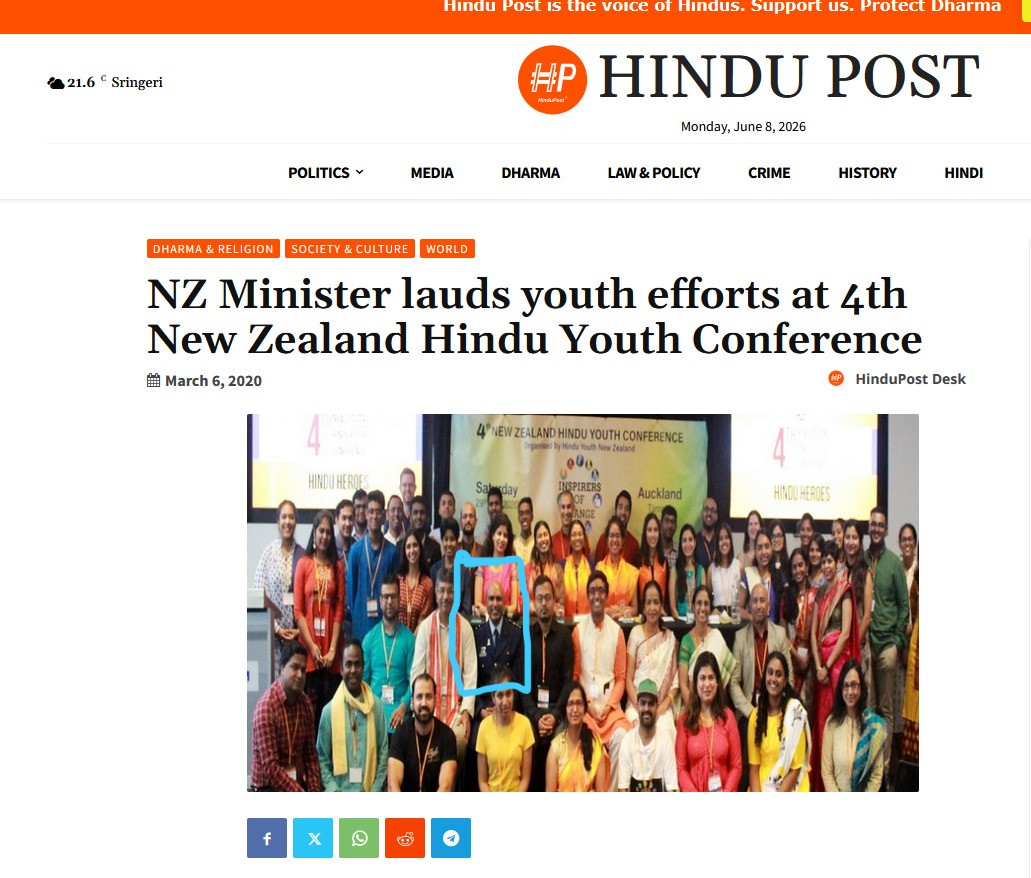
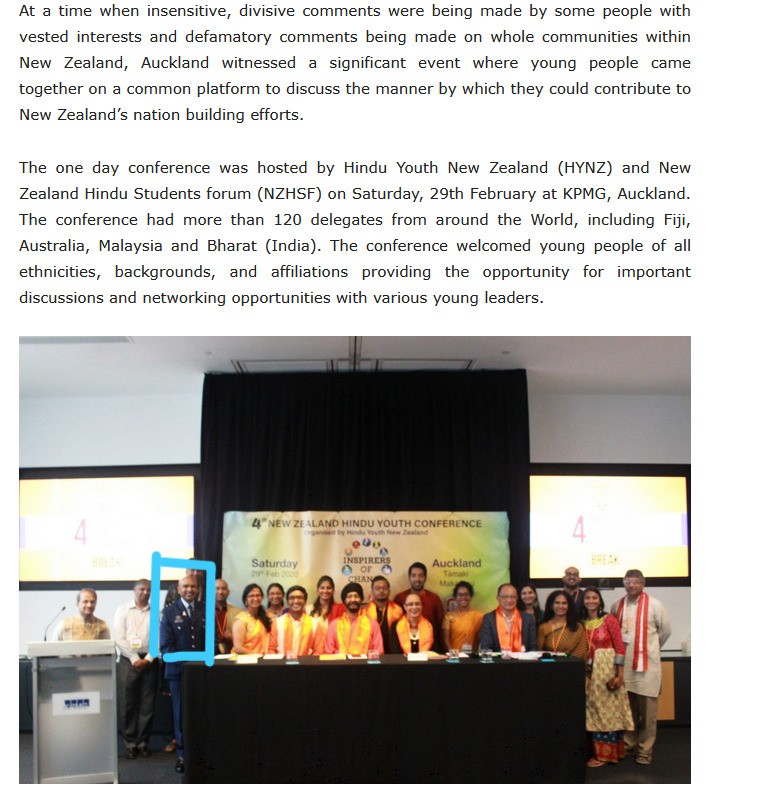
Hindu Youth New Zealand operates within the orbit of the Hindu Council of New Zealand. The press release itself pictures officials of both bodies together at their national conference and describes their joint work with Māori communities. The Council’s own website carries the title “VHP New Zealand.” The Vishva Hindu Parishad is a member of the Sangh Parivar, the family of organisations led by the RSS. In June 2018 the CIA World Factbook briefly listed the VHP as a “religious militant organisation” before the section was removed later that month. In March 2026 the US Commission on International Religious Freedom recommended, for the first time, targeted sanctions on the RSS for its responsibility for severe violations of religious freedom.12
This is the network that tagged Dhiru. A tag is a small thing, and we underline here what it does and does not prove. But campaigns of this kind work precisely through such small things. They borrow the standing of respected community figures to signal that “the community” stands together, and they count on the silence of those figures to hold that signal in place. Someone with Dhiru’s public profile in human rights, gender equality and interfaith work lends considerable weight by staying quiet. The silence becomes part of the message.
July 2026: Kia Ora Modi
Modi arrived in Auckland on 10 July 2026, the first visit by an Indian prime minister in four decades. The centrepiece was “Kia Ora Modi,” a sold-out diaspora reception at Spark Arena organised by the NZ Bhartiya Diaspora Group and attended by Prime Minister Christopher Luxon. The Overseas Friends of BJP New Zealand promoted the event on X as a historic welcome. The genre is familiar from Houston, Sydney and London: the stadium rally where the diaspora performs its devotion and a leader facing sustained human rights criticism at home collects images of adoration abroad.
Dhiru’s LinkedIn post (Figures 5 and 6), published the following day, is warm and detailed. It opens with “Prime Minister Shri Narendra Modi ji’s address” and lists the five te reo Māori words Modi used: waka, haka, manaakitanga, whānau and kaitiakitanga. She reads each as a bridge between Māori values and Indian tradition. She finds the waka image the most powerful, a shared journey in which partnerships are “not about one nation leading another.” She closes by saying that in a world focused on what divides us, hearing about what connects us was refreshing.
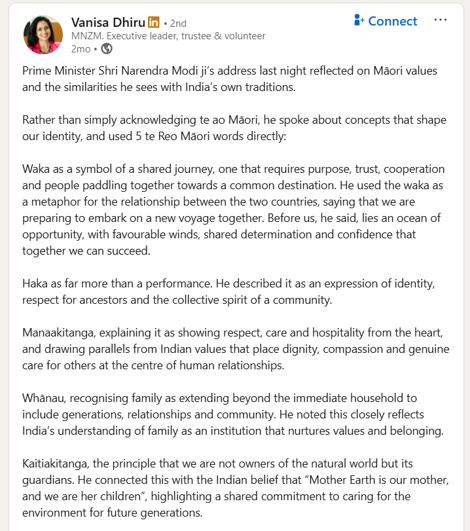
Figure 5. Vanisa Dhiru, LinkedIn, July 2026: the opening of her post on Modi’s Kia Ora Modi address and its use of te reo Māori concepts.
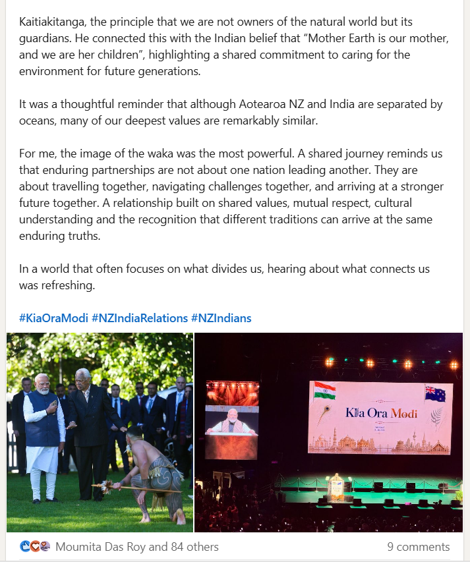
Figure 6. The close of the same post, with the hashtags #KiaOraModi, #NZIndiaRelations and #NZIndians, and photographs of the pōwhiri and the Spark Arena stage.
Read the post against the record of the government Modi leads. Human Rights Watch’s World Report 2026 found that India’s BJP-led government vilified religious minorities in 2025, expelled hundreds of Bengali-speaking Muslims and Rohingya refugees, and that hostile broadcast and social media rhetoric helped fuel Hindu mob attacks on Muslims, including Kashmiri students and workers. HRW’s global essay described an administration that “actively promotes Hindu majoritarianism.” USCIRF recommended India as a Country of Particular Concern for the seventh year running and called for sanctions on the RSS. India’s Ministry of External Affairs rejected the report as biased, which readers can weigh for themselves.
None of this appears in Dhiru’s post. Its subject is values. It speaks of dignity, compassion and care “at the centre of human relationships,” of manaakitanga as hospitality “from the heart.” These words are placed in the mouth of a leader whose party’s rule has been marked, by Human Rights Watch and USCIRF, by the stripping of dignity from Indian Muslims. The post performs a kind of translation. It carries Modi’s speech across into the moral language of Aotearoa while scrubbing out the violence.
There is a second translation at work, and it should trouble anyone committed to Te Tiriti. The waka, the haka and manaakitanga become diplomatic currency. They certify a foreign head of government, and through him a political project, as kin to te ao Māori. In earlier work, we have traced how Hindutva organisations harvest manaakitanga as legitimacy, turning marae relationships into proof of their own benevolence for circulation in the Sangh press. The Kia Ora Modi post extends that circuit to the level of the state visit. Māori concepts are praised; Māori are made into a backdrop. The “shared journey” of the waka is, in the speech, a metaphor for trade and strategic partnership between two governments.
Dhiru praises the idea that partnerships are “not about one nation leading another.” That phrase would mean something if a person also asked about the Muslims being pushed across the Bangladesh border or their homes demolished in the name of law and order or their lynchings in the name of cow (gau mata) protection. Or stealing Adivasi and Dalit land for data centres. From Vanisa Dhiru, who has said nothing about them, the phrase becomes decoration.
Two far rights, one silence
The Modi visit also drew the ugliest anti-Indian racism Aotearoa has seen in some time. Brian Tamaki called for protests against the visit and said, “Let’s purge New Zealand of Hindus, Sikhs and Muslims”; the Race Relations Commissioner called the remarks utterly appalling, and protesters chanted anti-immigration slogans outside Spark Arena. Any critique of Hindutva must refuse that politics completely. Indian New Zealanders were being targeted as a people, and that targeting deserved the solidarity of every New Zealander.
This is exactly why the silence matters. White ethnonationalism and Hindu nationalism feed each other. Each supplies the other with a threatening enemy and a reason to close ranks. Tamaki’s racism makes it easier to cast any criticism of Modi as an attack on Indians. Hindutva’s anti-Muslim rhetoric, meanwhile, rehearses the very logic of purity and purge that Tamaki directed at Hindus, Sikhs and Muslims alike. An anti-racism worth the name stands against both. An anti-racism that sees only the first will always end up, sooner or later, lending its credibility to the second.
Dhiru’s public anti-racism sees the first. Her post about Kia Ora Modi, written in the same week as the Tamaki protests, says that the world often focuses on what divides us. The division she chose to set aside was the one that Muslims in India live with every moment every day.
The candidate
Rakesh Naidoo has built his career in the space where the state meets communities of colour. Born and educated in South Africa, he joined New Zealand Police in 2001 with the stated aim of working with ethnic communities. Most recently he was the national partnerships manager for ethnic, iwi and communities. Indian Newslink credits him with managing the police relationship for Muslim leaders after the Christchurch attacks. In June 2026 Labour placed him at number 13 on its list, the highest-ranked newcomer, as a list-only candidate; at that ranking he is close to certain of a seat. The Police Commissioner later described his position in police as untenable because he had not disclosed his political intentions in time, and a review of that period is under way.
Let us be clear about what we are arguing and what we are not. Vanisa Dhiru’s words are her own. They are not evidence of Rakesh Naidoo’s views, and a partner’s politics should never be used to convict anyone by association. What we are arguing is narrower and, we think, harder to wave away.
Naidoo’s professional authority rests on trust. For two decades he has been the face of police engagement with the communities Hindutva targets: Muslims, Sikhs, Christians from South Asia, Dalit families, and the Hindus who refuse the Sangh’s politics. That trust depends on those communities believing that the gatekeepers of state engagement do not treat Hindutva organisations as neutral representatives of “the Indian community.” Police engagement with ethnic communities runs through community organisations, and in Aotearoa the Hindu Council has long positioned itself as the representative body for Hindus. Whether police relationships over these years treated it as such is a fair question for public accountability.
The stakes rise with the move to Parliament. A list MP ranked this high will be a voice for ethnic communities in the next Labour caucus, possibly in government. He will shape policy on hate speech, social cohesion, transnational repression and the Crown funding of community organisations. USCIRF’s 2026 report urges attention to Indian transnational repression abroad. In Aotearoa, scholars and activists who criticise Hindutva have faced coordinated harassment, including members of AAPI. Voters, and especially the communities whose trust Naidoo has spent a career building, are entitled to know where he stands. Naidoo’s presence at the BAPS Swaminarayan Mandir along with his Labour leader Chris Hipkins, in the same week as BAPS caused female employees at the Eiffel Tower to strike, in the same week that the connection between Modi and BAPS re-emerged, where Indians were reminded about how BAPS had exploited the Dalit labourers who built their temple in New Jersey, where globally the Indian diaspora reiterated that BAPS is an Islamophobic cult makes us wonder whether Naidoo is ignorant about Hindutva or whether he deliberately ignores it because no one will question him. The closeness of the networks in Naidoo’s public and personal life, documented in Figures 1 to 6, make these questions pressing. Only he can answer them.
Questions that deserve answers
To Vanisa Dhiru:
1. Did you consent to your name being tagged on the September 2021 Hindu Youth New Zealand press release, and do you endorse its description of research on Hindutva as “outright Hindu hatred”?
2. As a human rights advocate and a member of the Wellington Interfaith Council, how do you reconcile your public celebration of Modi’s address with the findings of Human Rights Watch and USCIRF on the treatment of Muslims and other minorities under his government?
3. Does your intersectional analysis of “Indian” identity include caste and religion, and if so, where in your public work do Indian Muslim, Dalit and Adivasi women appear?
To Rakesh Naidoo:
4. Do you regard organisations affiliated with the RSS and VHP, including those that identify themselves with the VHP, as appropriate representatives of Hindu New Zealanders in engagement with the state?
5. What is your view of USCIRF’s 2026 recommendation of targeted sanctions on the RSS, and of Human Rights Watch’s findings on anti-Muslim violence in India?
6. Will you state publicly that the 2021 campaign against a Massey University researcher, and campaigns like it, are incompatible with academic freedom and with the safety of those who study Hindutva?
7. As an MP, what would you do about transnational repression and harassment directed at critics of the Indian government living in Aotearoa?
To the Labour Party:
8. What does Labour ask of its candidates about Hindutva, the RSS and the Sangh Parivar, and will it publish a position on Crown engagement with and funding of Sangh-affiliated organisations?
The border and the underdog
Anti-racism in the diaspora carries a temptation. It is easier to speak about the racism we suffer than the racism we inherit, carry and export. The first earns applause and honours from the institutions of the settler state. The second costs friends, community standing and the goodwill of powerful organisations. Many of us have felt that pull. The communities who pay when we give in to it are the ones with the least voice in the room: the Muslim family in Assam, the Dalit worker in Auckland, the dissenting Hindu who is told she is a traitor to her people.
Vanisa Dhiru has said she will always fight for the underdog. The public record reproduced here shows where that fight has stopped so far. The border can be crossed. It takes a sentence, spoken publicly, naming the violence she has so far left out. Rakesh Naidoo, asking New Zealanders to send him to Parliament as a voice for ethnic communities, owes those communities the same sentence, in his own words.
The Data Centre Deluge: Who Pays for the AI Revolution?
The Data Centre Deluge: Who Pays for the AI Revolution?
By Alan john Koshy

Across India and Aotearoa, the unchecked expansion of hyperscale data centres is meeting growing grassroots resistance.
From the streets of Thane and Visakhapatnam to the farmlands of Southland, communities are resisting an infrastructure boom that is imposing immense environmental and social costs on locals.
This is not just a local planning dispute. This is “technofeudalism”, driven by a handful of tech oligarchs with both immense wealth and a quasi-religious zeal for artificial intelligence.
The data centre is the physical manifestation of this new feudalism. Like some insatiable beast from ancient myth, it demands we feed it our precious water, land and energy, while offering almost nothing in return.
The Frontlines: From India to Aotearoa
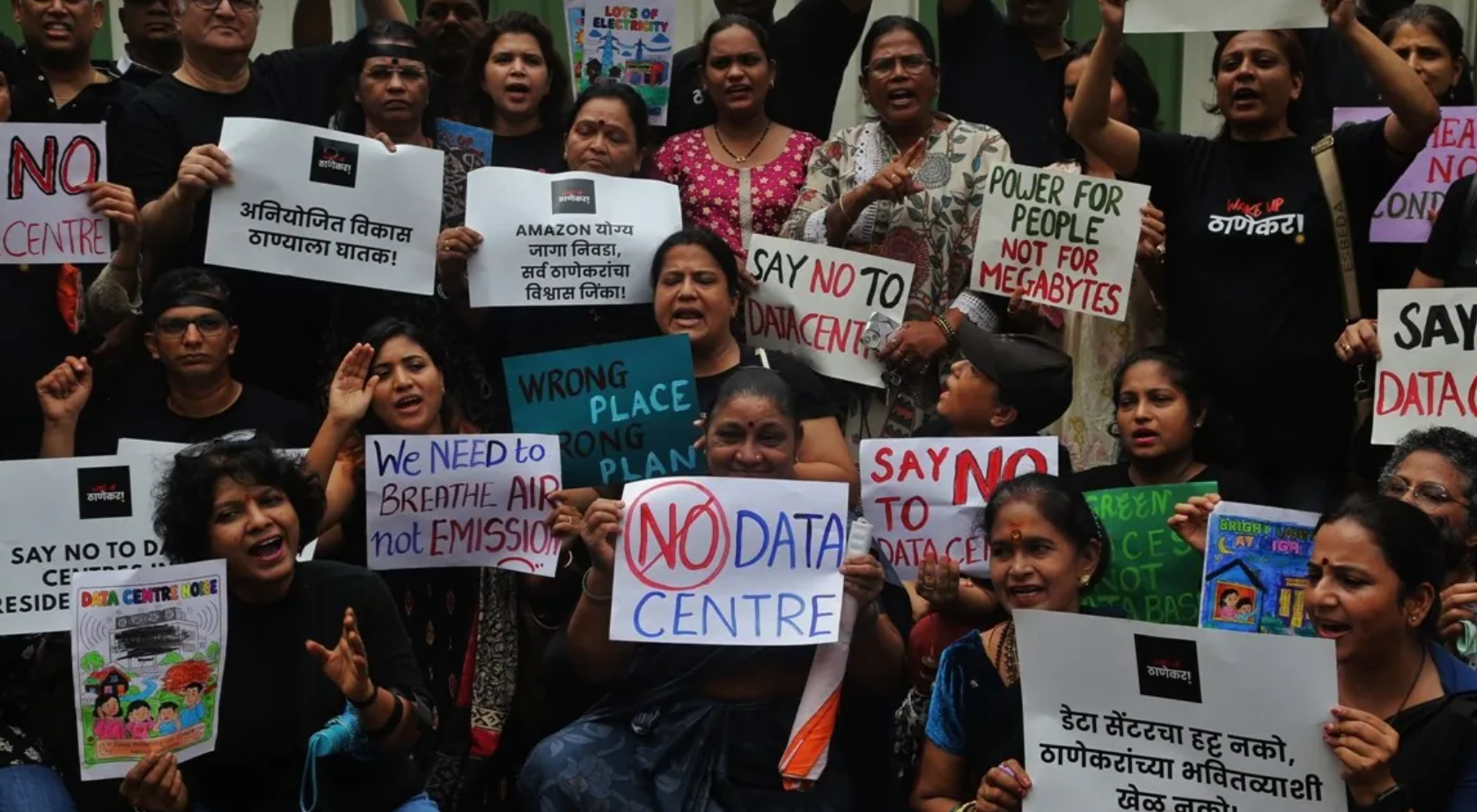
In India, the government’s ambition to become an AI powerhouse is colliding with local reality.
In Thane, just north of Mumbai, locals are protesting a proposed 53-acre Amazon hyperscale data centre in a densely populated residential area, surrounded by housing complexes, schools, and hospitals.
Residents fear it will worsen existing water shortages, with some calculating the centre could require up to 12 million litres of water daily; enough to fill nearly 1,000 swimming pools every week.
Beyond water, residents fear strain on the electricity grid, noise pollution that could reach 90 decibels, and the immense heat emanating from the facility's cooling systems.
Nearly 800 kilometres away in Visakhapatnam, a similar battle is brewing against a proposed US$15 billion Google hyperscale AI complex, in partnership with Adani Group and Bharti Airtel. It is slated to be the tech giant's largest AI hub outside of the United States.
Here, the concerns are amplified by the project's proximity to the Kambalakonda Wildlife Sanctuary, less than a kilometre away, in a city already facing significant water stress.
India's data centre capacity has nearly tripled since 2020, from 520 MW to 1.5 GW, and is projected to hit 4.5-6.5 GW by 2030. Wood Mackenzie forecasts it to hit a whopping 12 GW. Google, Amazon and Microsoft have already pledged a combined US$68 billion for AI-driven projects across India.
In Aotearoa, the Stop Data Centres NZ movement is organising protests, calling for a national framework and a pause on new hyperscale developments. Their petition demands national oversight of effects on water supplies, the electricity grid and productive land.
The planned Datagrid facility in Makarewa, Southland, with its 240-megawatt capacity and heavy groundwater use, has become a key battleground.
The Thirsty Subcontinent

To understand the fury of residents in Thane and Visakhapatnam, one must first grasp the scale of India's water crisis. It is a catastrophe born from a warming planet and decades of unchecked urban expansion.
India is home to 18% of the world's population but has access to a mere 4% of its freshwater. The country is the world's largest groundwater extractor, accounting for over 25% of global withdrawals.
An alarming NITI Aayog report warns that by 2030, 40% of India's population—about 600 million people—may have no access to drinking water.
Chennai ran dry in 2019, becoming India's first "Day Zero" city. Bengaluru once had over 260 lakes; today, only 80 remain. Delhi's 33 million people often survive on thousands of water tankers. Hyderabad, the most groundwater-stressed region, faces a shortfall of 909 million litres a day. Yet Amazon is expanding its data centre there, while Microsoft plans to expand in Pune, where water shortages sparked protests last year.
Nearly 75% of India's data centres are located in regions facing high to extremely high water stress.
Despite this, the union and state governments are offering massive tax holidays and fast-tracked approvals for these water-guzzling facilities, while their citizens struggle to secure their daily water supply.
The Hidden Costs
The environmental and social costs that communities are protesting are staggering:
- Energy and Emissions: The largest data centres use as much electricity as 2 million households combined. This demand is extending the lives of dirty coal and gas-fired power plants, undermining the transition to renewables.
- Water Consumption: If servers overheat, they fail. A single hyperscale data centre can consume millions of gallons of water daily for cooling, often drawing from stressed local supplies. This water is effectively lost forever, evaporating or becoming too contaminated to return to the system.
- Land Use and Displacement: These sprawling, industrial complexes lock vast tracts of land into permanent use, displacing housing, agriculture, and green spaces. Yet even the largest centres often employ fewer than 150 staff, while the AI they power threatens to automate entire industries.
- E-Waste and Toxic Legacy: Servers have a short lifespan, fuelling a global e-waste crisis. Less than a quarter is recycled; much is dumped on developing countries, exposing communities to lead, mercury and cadmium. Cooling systems are laced with PFAS "forever chemicals" that accumulate in soil and water and are linked to cancer, immune suppression, birth defects and high cholesterol.
- Noise: Local communities have compared the constant buzzing of data centres to "lawn mowers running 24 hours a day," seeping through closed windows and eroding quality of life.
These impacts explain why AI data centres are increasingly located in countries like India, Australia, Ireland, Chile and Brazil, regions with weaker environmental regulations or cheaper resources, while the profits flow back to Silicon Valley.
In the US, a Gallup poll found that Americans would rather live next to a nuclear reactor than an AI data centre.
This is environmental colonialism: communities pay the price, tech bros take the profits.
The fight is not against technology itself, but against a system that demands we sacrifice our communities on the altar of corporate profit.
The AI Bubble Could Pop Loudly
The fight against data centres is not just about water, land, and pollution. It's about a financial house of cards that could bring the global economy crashing down.
More than US$200 billion in data centre debt was raised in 2025 alone, with tech companies borrowing at levels that surpass the dot-com era, even after adjusting for inflation.
Much of this involves "off-balance-sheet financing, chip-backed collateral and complicated leasing structures", much like the murky financial engineering that triggered the 2008 crash.
What makes this bubble uniquely dangerous is the circular “closed-loop” financing system that props it up. The entire structure depends on constant capital inflows. If credit conditions tighten or a major player stumbles, the system could topple like dominoes.
When the dot-com bubble burst between 2000 and 2002, the impact was largely limited to stock market losses. But when a credit bubble bursts, assets are sold off at fire-sale prices, and a wave of bankruptcies wrecks the banking industry and the global financial system.
The awkward reality? The companies building AI are not profitable. OpenAI may burn more than US$140 billion before turning profitable, nearly five times more than Amazon, Tesla, and Uber's cumulative early losses combined. An MIT study found that 95% of companies see zero return on their generative-AI investments.
Goldman Sachs warns that US$19 trillion in market value is detached from economic reality. By comparison, the dot-com bubble looks muted.
None of this adds up. The debt is unsustainable, the returns are illusory, and the crash is inevitable. So why is Big Tech ploughing ahead, indifferent to the economic logic? The answer lies not in economics, but in ideology.
The Technofeudal Vision
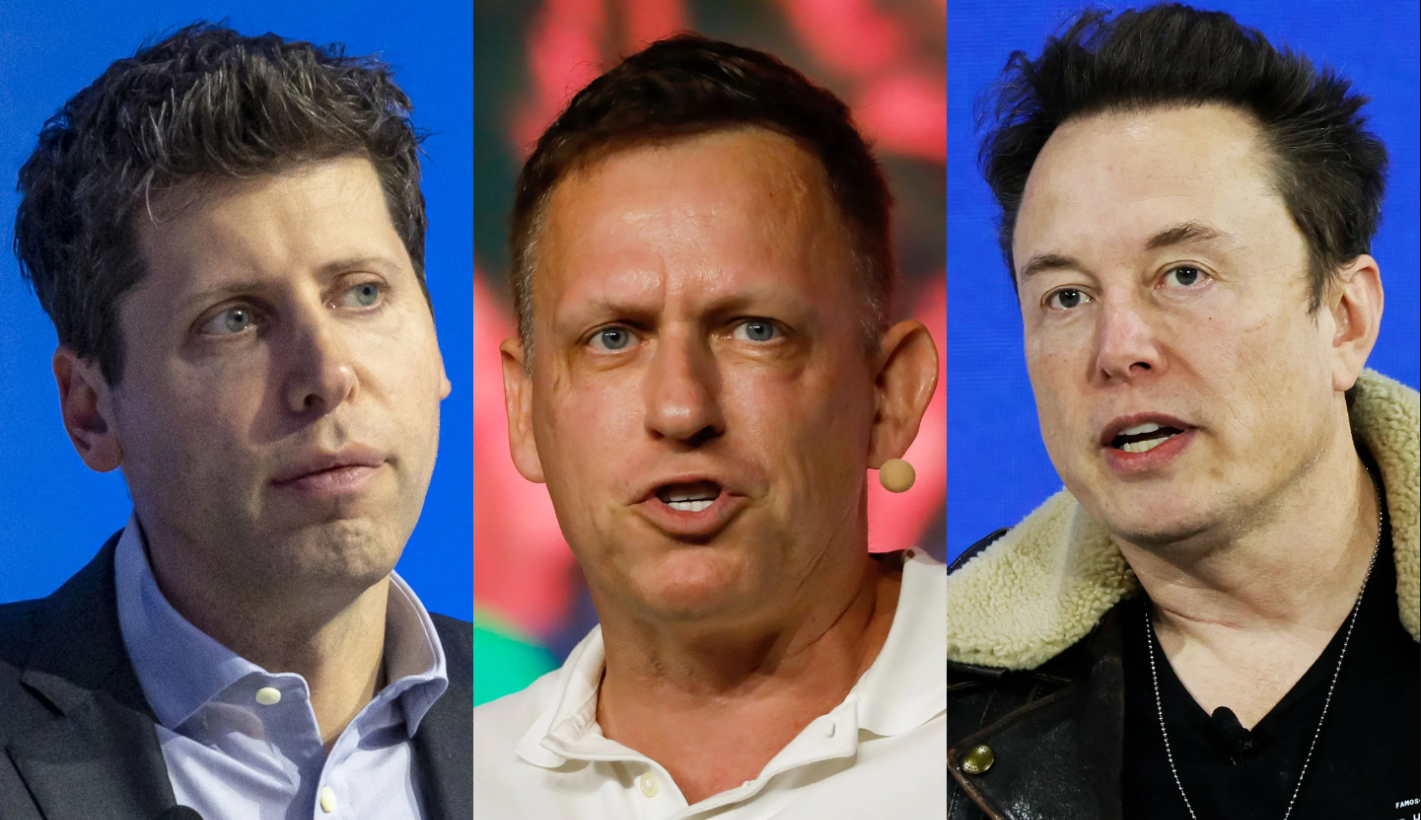
Under technofeudalism, a handful of tech oligarchs control the digital infrastructure on which modern life depends. They extract "cloud rents" from businesses and governments that become dependent on their platforms, creating a new form of digital serfdom.
The data centre is the stronghold from which these lords extract their tribute. Like the castles of old, they are built on land seized from communities and defended by armies of lawyers.
But unlike the old lords, they do not live among the people they rule. They reside in distant mansions and superyachts, accumulating wealth that would make medieval kings blush.
As investigative journalist Whitney Webb has documented, many of these figures hold a "quasi-religious fervour" for artificial general intelligence. They are openly transhumanist, believing humanity's destiny is to merge with AI.
This ideological zeal propels the data centre boom even when the economics make no sense. Computing power is their god, data centres are their cathedrals, and communities are the sacrifice.
Fighting Back: Strategies for Resistance
Across the world, communities are successfully fighting back against the data centre deluge. Their strategies offer a blueprint for resistance:
- Start Early and Get Informed: Research local zoning laws, file Freedom of Information requests to uncover planning applications, and monitor changes in utilities to spot projects before they’re announced.
- Build Broad Coalitions: The fight unites conservatives and progressives, church groups and environmentalists, local businesses and sports clubs.
- Advocate for Strong Local Regulations: Push for ordinances that require community notice and input upfront, rather than allowing data centres “by-right” in any zone. “Special-use permits” force a front-end conversation about air, water, and noise.
- Push for Moratoriums and Frameworks: A moratorium is not a radical demand; it’s a sensible pause to “reboot” and create time for proper regulation. Campaigns in Aotearoa and the U.S. are calling for frameworks to ensure transparency, sustainability, and grid stability.
- Divestment and Boycott: By divesting from big tech products and services as much as possible, we can undermine the demand that justifies the data centre deluge.
We don't need more efficient data centres. We don't need better reporting standards. We don't need to make extraction more palatable. We need to stop building them altogether.
The protests in India, Aotearoa, and across the globe show the resistance has begun.
Alan John Koshy is a freelance writer and supporter of the Aotearoa Alliance of Progressive Indians. He is a former Reuters business journalist and holds a Master's in Economics from the University of Canterbury.
The Scapegoat Economy: How Racism in NZ Is Intentional
The Scapegoat Economy: How Racism in NZ Is Intentional
By Alan John Koshy
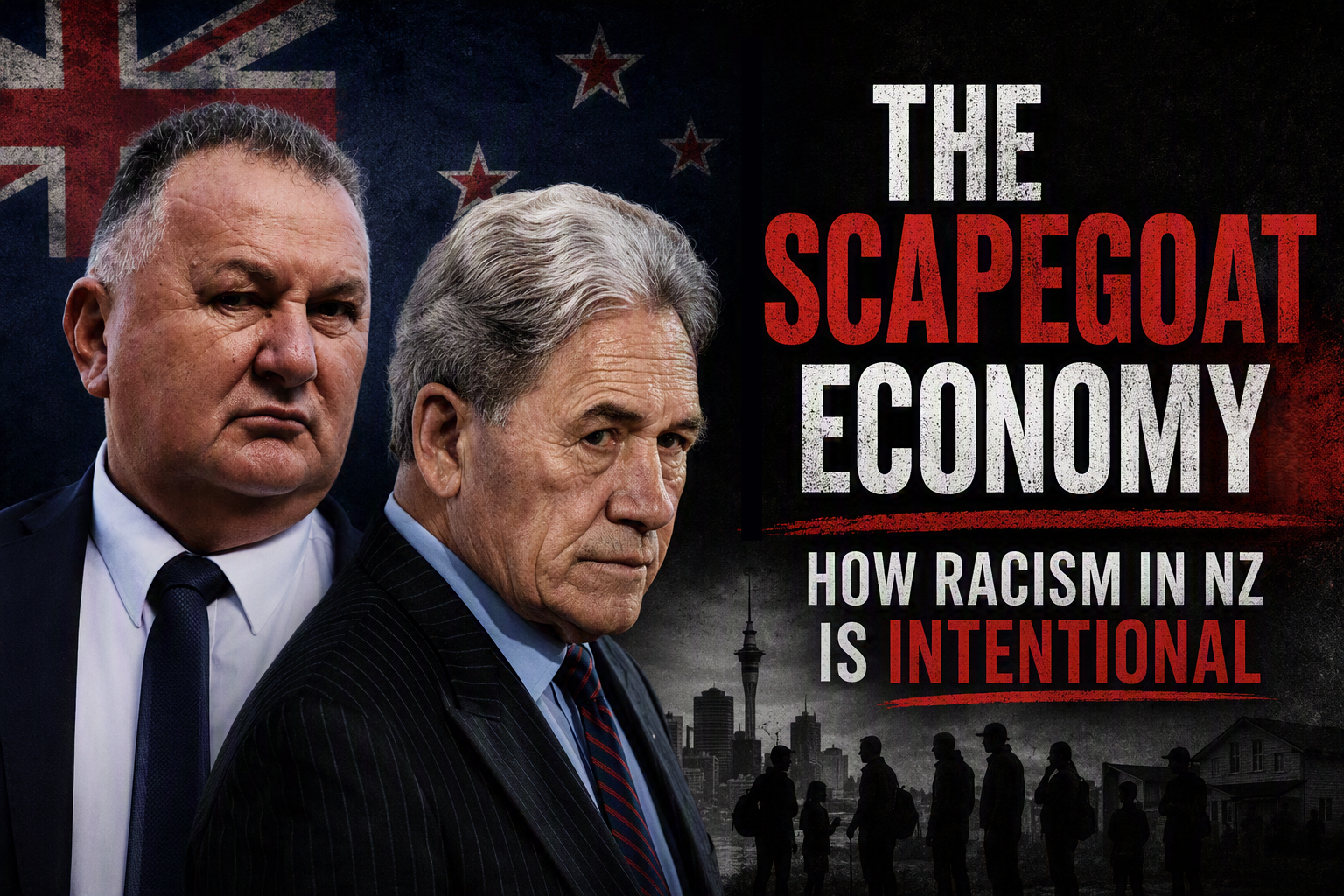
We cannot afford to be distracted by the vitriol. The blatant racism of politicians like Winston Peters and Shane Jones is not an anomaly, nor is it the work of a few "rotten apples."
It is a symptom of a systemic need within capitalism to produce scapegoats, to divert working-class anger away from a failing economic system and toward a fabricated external enemy.
As Dutch sociologist Hein de Haas notes, sowing "suspicion or outright hatred towards migrants” has always been a convenient strategy to divide the working classes. To put it simply, divide and rule.
The Merchants of Hate
The conduct of Winston Peters and his acolyte, Shane Jones, fits this tactic perfectly, especially during periods of economic strain.
In 2024, Jones yelled "send the Mexicans home" at Mexican-born Green MP Ricardo Menéndez March. Earlier this year, he warned that this country would not be "a dumping ground for people trying to come to New Zealand and set up New Delhi," declared "we do not need any more Uber drivers," and capped his anti-Indian rhetoric with criticism that a free trade deal would risk a "butter chicken tsunami."
More recently, Peters, the veteran architect of this political playbook, told Chinese-born Green MP Dr Lawrence Xu-Nan, who has lived in New Zealand for 32 years, to "go back to your own country" multiple times.
As the Union Network of Migrants (UNEMIG) observed, "when language like this comes from the floor of our own Parliament, it gives cover for the same language in workplaces, schools and on the street."
A Decades-Old Lineage of Blame Politics
Winston Peters and Shane Jones belong to a tradition stretching back over half a century. Sir Robert Muldoon from the National Party, Prime Minister from 1975 to 1984, is widely cited as Peters' direct political ancestor, a right-wing populist who promised to lead "a government of the ordinary bloke".
In the 1950s and 1960s, a booming New Zealand had actively encouraged migration from other Pacific nations such as Tonga, Samoa, and Fiji to fill labour shortages.
But by the 1970s, as the OPEC oil price shock and other factors plunged the NZ economy into downturn, these same communities were scapegoated for "taking jobs from New Zealanders."
Muldoon expanded the terrifying Dawn Raids, unleashing police brutality that specifically targeted overstaying Pacific Islander migrants.
Pacific Islanders made up only one-third of overstayers but accounted for 86% of those arrested and prosecuted, while British and American overstayers, who comprised the other third, faced only 5% of prosecutions.
It was during this period that a then 33-year-old Winston Peters first broke into the corridors of power, as a National Party MP for Hunua. He would go on to found New Zealand First in 1993, after being expelled from the National Party for publicly opposing its economic direction.
In true bipartisan tradition, the Dawn Raids policy itself was crafted by a Labour government that preceded Muldoon. Before he joined Peters’ New Zealand First in 2017, Shane Jones was a high-profile MP for the Labour Party.
The Economic Engine of Scapegoating
Over the past 40 years, New Zealand has become a poster child for neoliberal financialisaton, far from any semblance of a real economy.
Investment has been systematically funnelled into property and financial assets, not into the productive enterprise that creates real wealth for the working classes.
The housing market has become a primary vehicle for wealth creation, but this is a "mirage of wealth" backed by massive debt and siphons the wealth of New Zealanders offshore through profits of foreign-owned banks.
In the 1950s, New Zealand was the third richest country in the world by GDP per capita. Today, it languishes in 37th place.
Productivity in the construction sector, the country’s most fundamental economic engine, is the same today as it was in 1985. The result is a housing market so broken that renters now spend nearly 40% of their income on shelter, and homes take 50% longer to build than a decade ago.
The government has run budget deficits for nearly a decade, and a return to surplus is not expected until 2029. Critics have described its fiscal approach as "hold the line and hope for the best."
The recent global energy price shock has laid bare New Zealand's vulnerability. Inflation has surged to a two-year high, driven by imported fuel costs. The Reserve Bank is now considering raising interest rates, which will hit families already stretched by the cost of living.
With an election looming, this is the context in which scapegoating thrives.
No More Scapegoats
In this climate of manufactured crisis, the political demand for a scapegoat is not an anomaly but a predictable survival mechanism for a system that refuses to admit its failures.
Winston Peters is only the latest ambassador of racist rhetoric designed to frame communities as a threat to national identity and resources.
The way forward is not culture wars or migrant-blaming but challenging an economic and political system that funnels wealth to the few while the rest of us fight over scraps.
Perpetuating the model minority and anti-Indian racism
We meant to post this earlier but there were more urgent issues such as the student protests in India and organising solidarity events in Aotearoa (even though Dharmendra Pradhan resigned the day before).
But this korero is always topical.
About how politicians perpetuate the model minority myth, how it is lapped up by our Indian community and how the words out of the mouths of these politicians engender anti-Indian racism.
1992. Los Angeles. Four white Los Angeles Police Department (LAPD) officers beat an African-American man Rodney King. Someone records this incident from a balcony nearby and the videotape is released publicly. The police officers face a criminal trial and are acquitted of all charges. There is widespread anger resulting in violent unrest over six days. One of the worst riots in American history. You can read all about it, there's reams written. But why are we mentioning this here?
Mainstream media discourse during this period stereotyped and positioned Asian-American communities as the model minority. The highly educated, quiet, hard working, tax paying, successful migrants. A term coined by William Petersen in 1966 and used as a tool to 'elevate' Asian-Americans against other communities of colour especially Black communities.
There was already tension between the Korean-American and Black communities in L.A. after a Korean-American businessman shot and killed a young Black woman in 1991. This tension heightened and spilled over after the court verdict in favour of the LAPD officers and many Korean-American businesses were looted/faced arson. No politician intervened to save this 'model minority' or diffuse the anti-Asian racism in 1992 L.A.
Prime Minister Chris Luxon, during his speech at the Kia ora Modi event on 11 July enthusiastically propagated this model minority myth about the Indian community talking to those Indians who attended the event. Here are some screenshots.
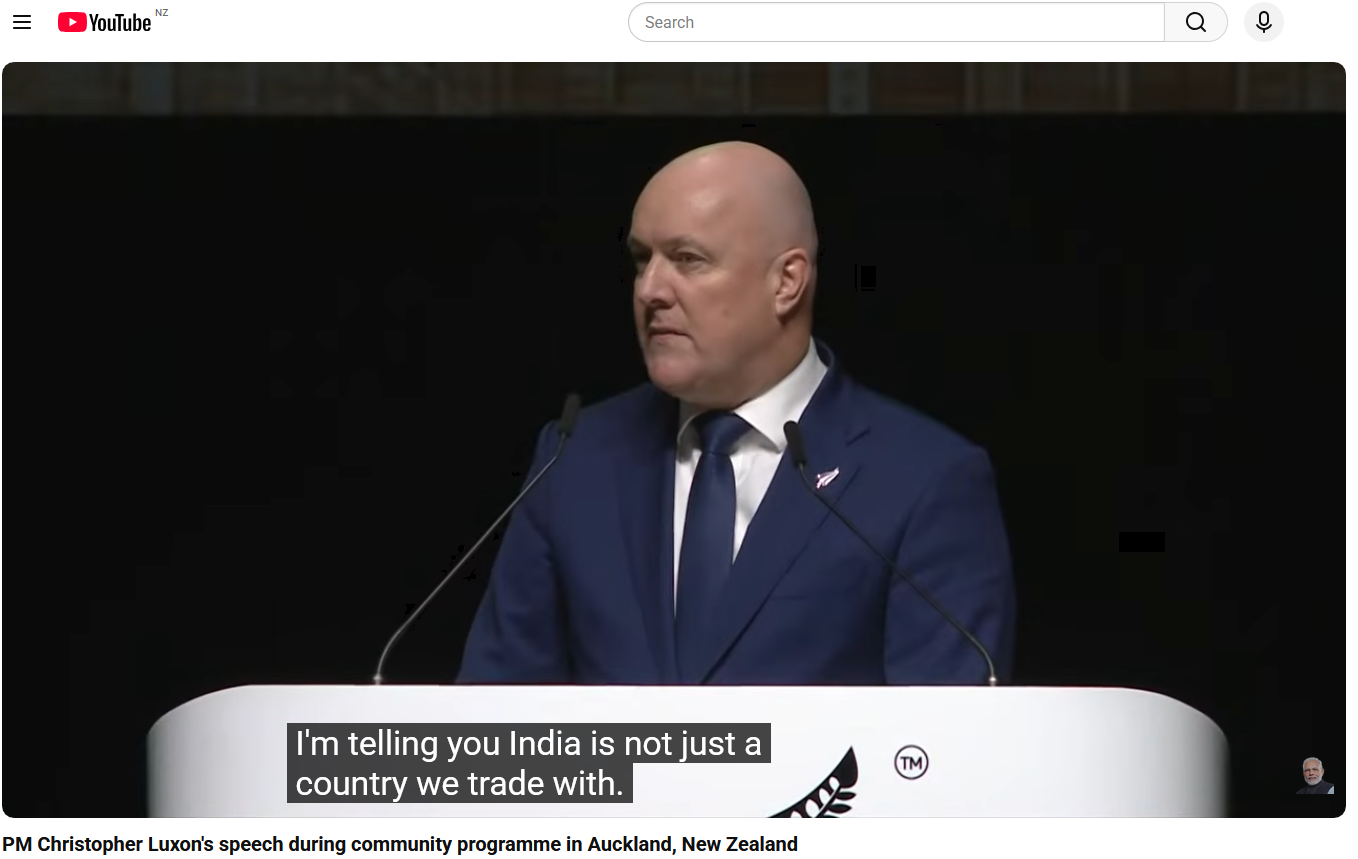
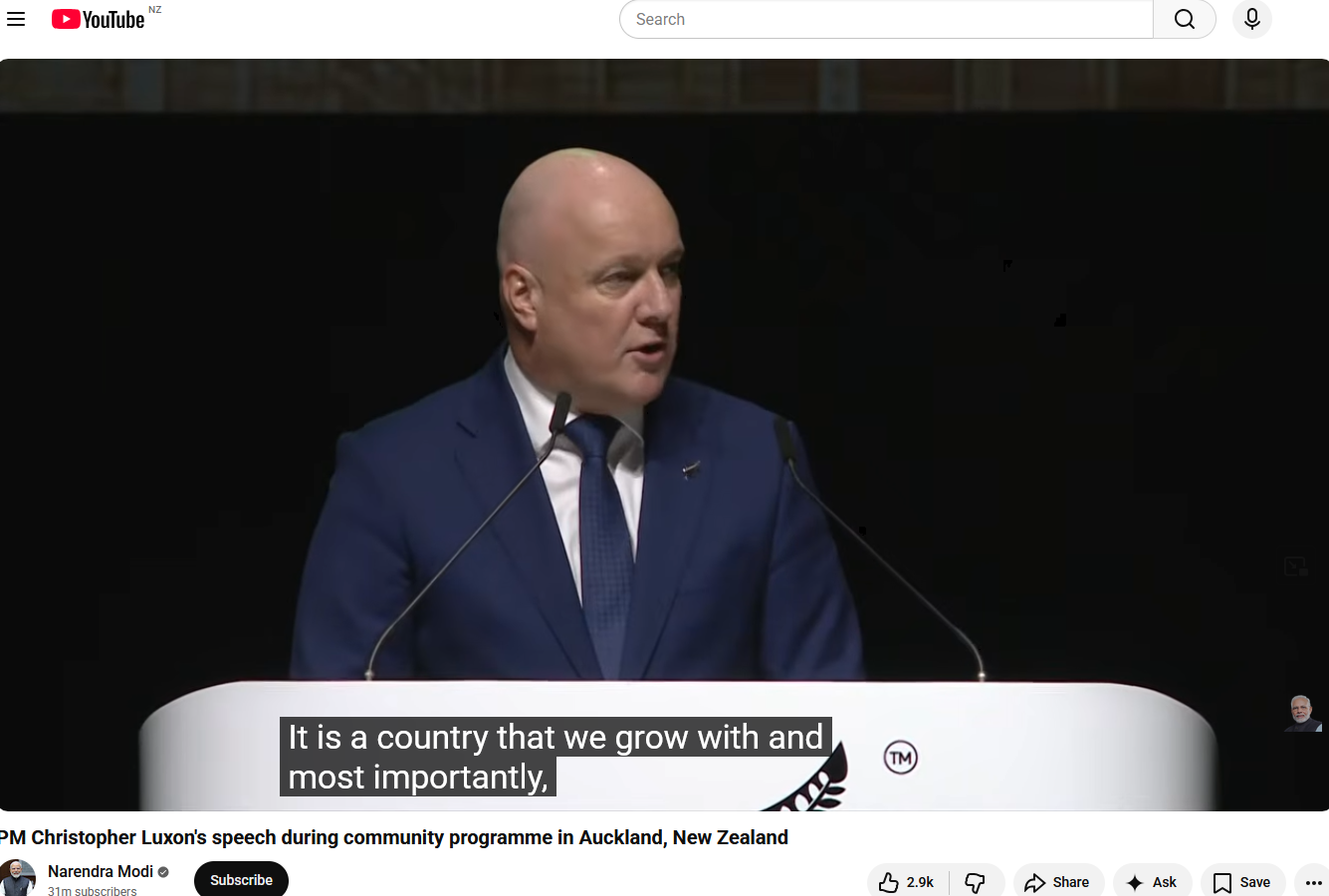
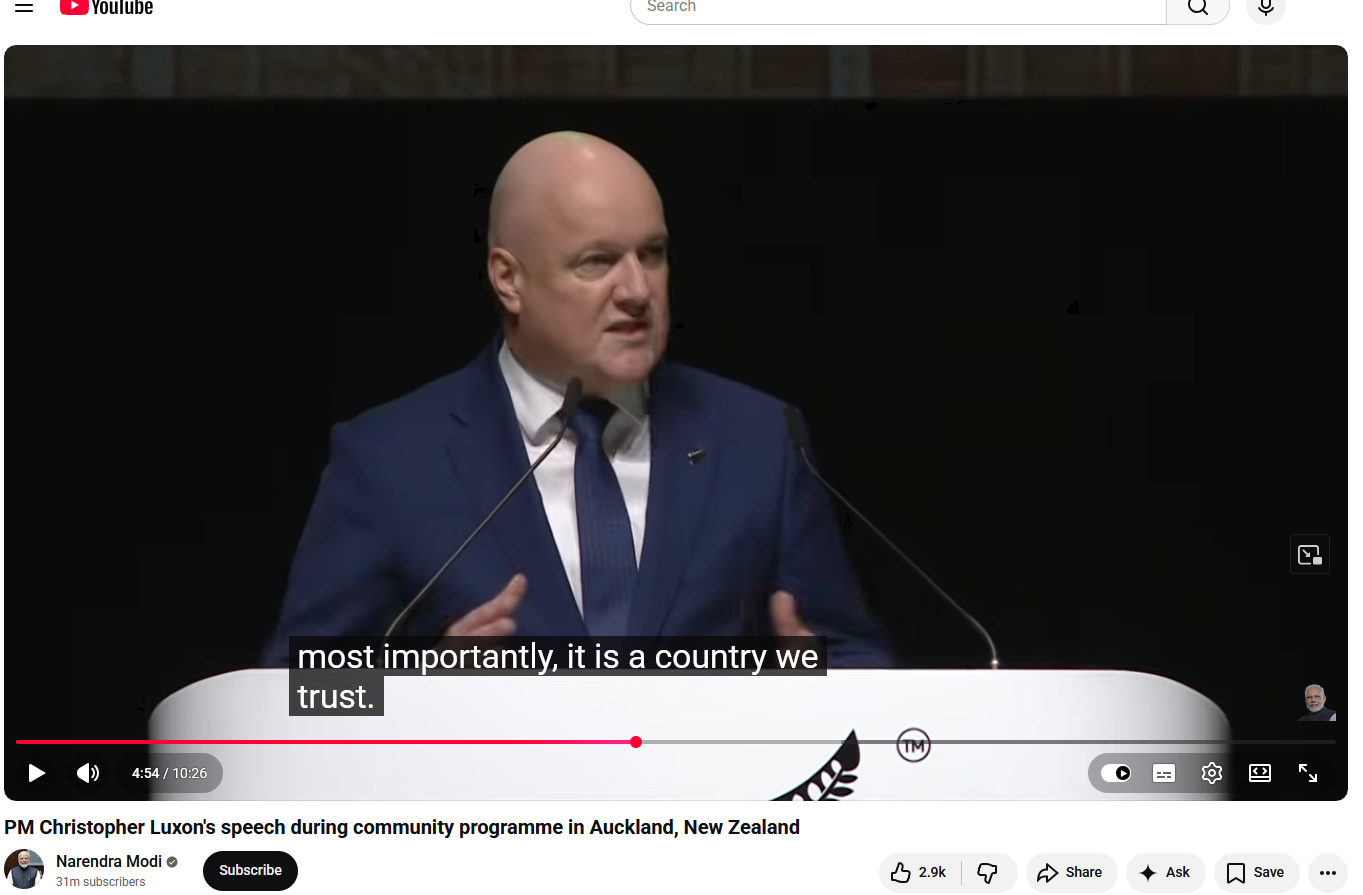
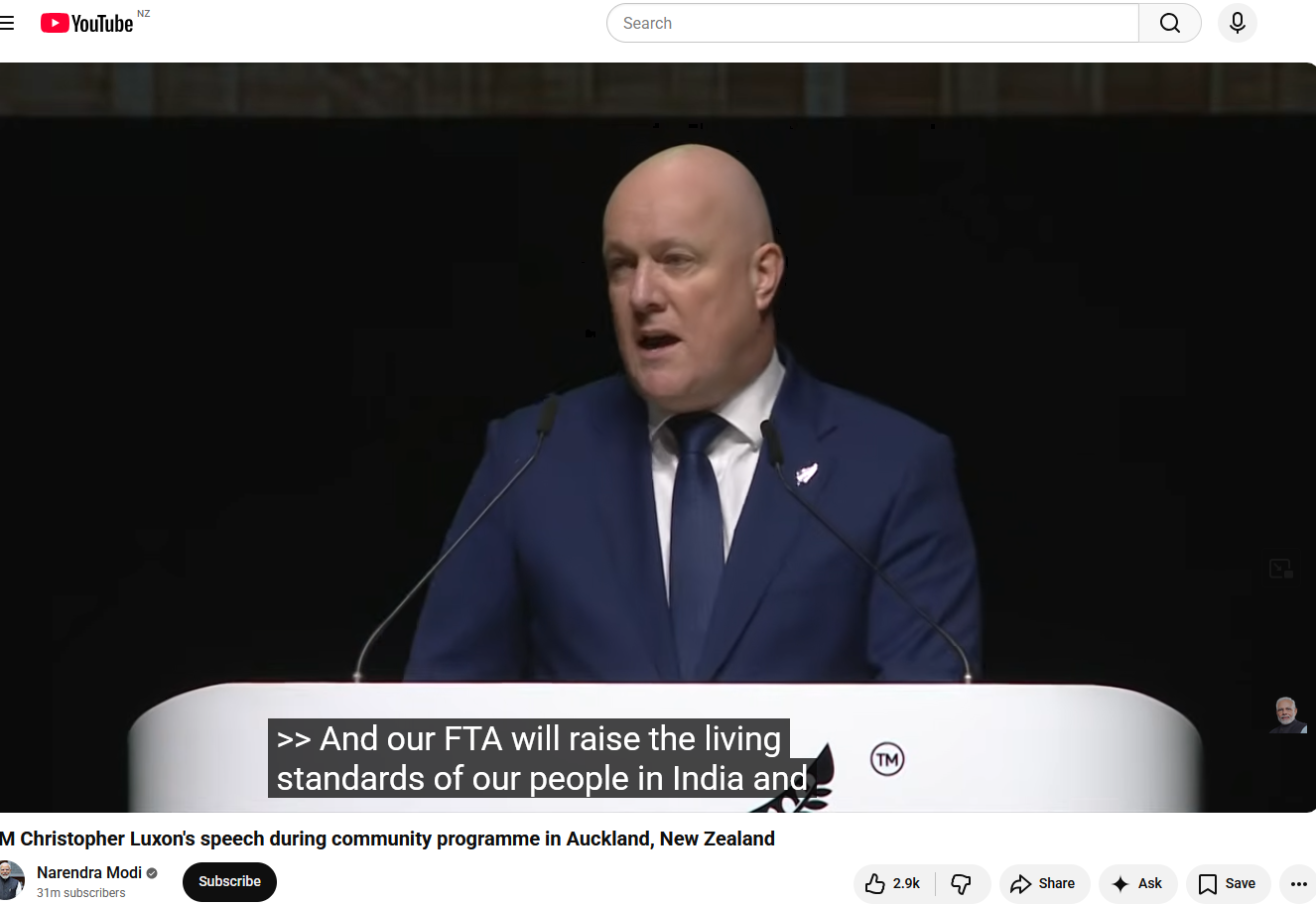
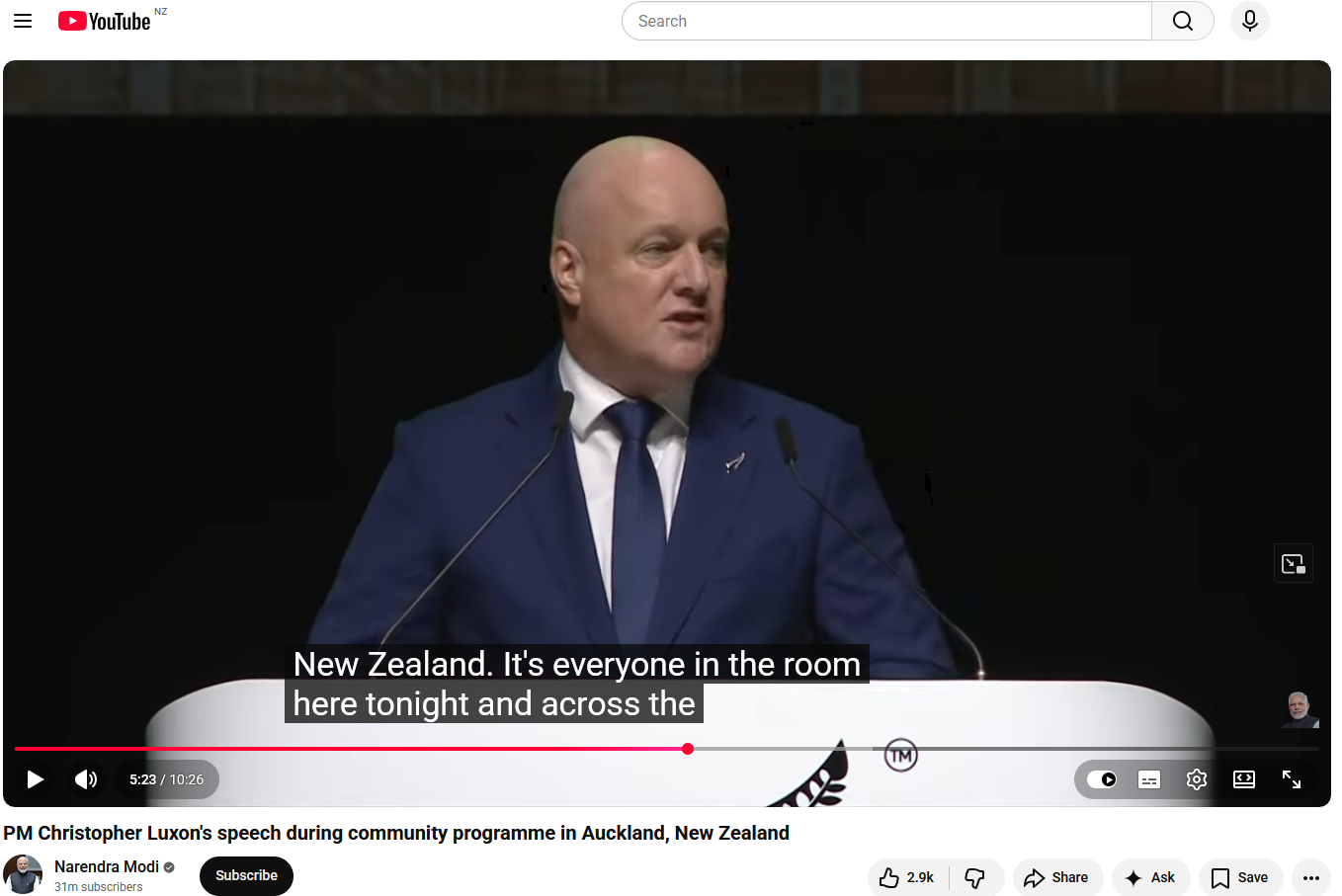
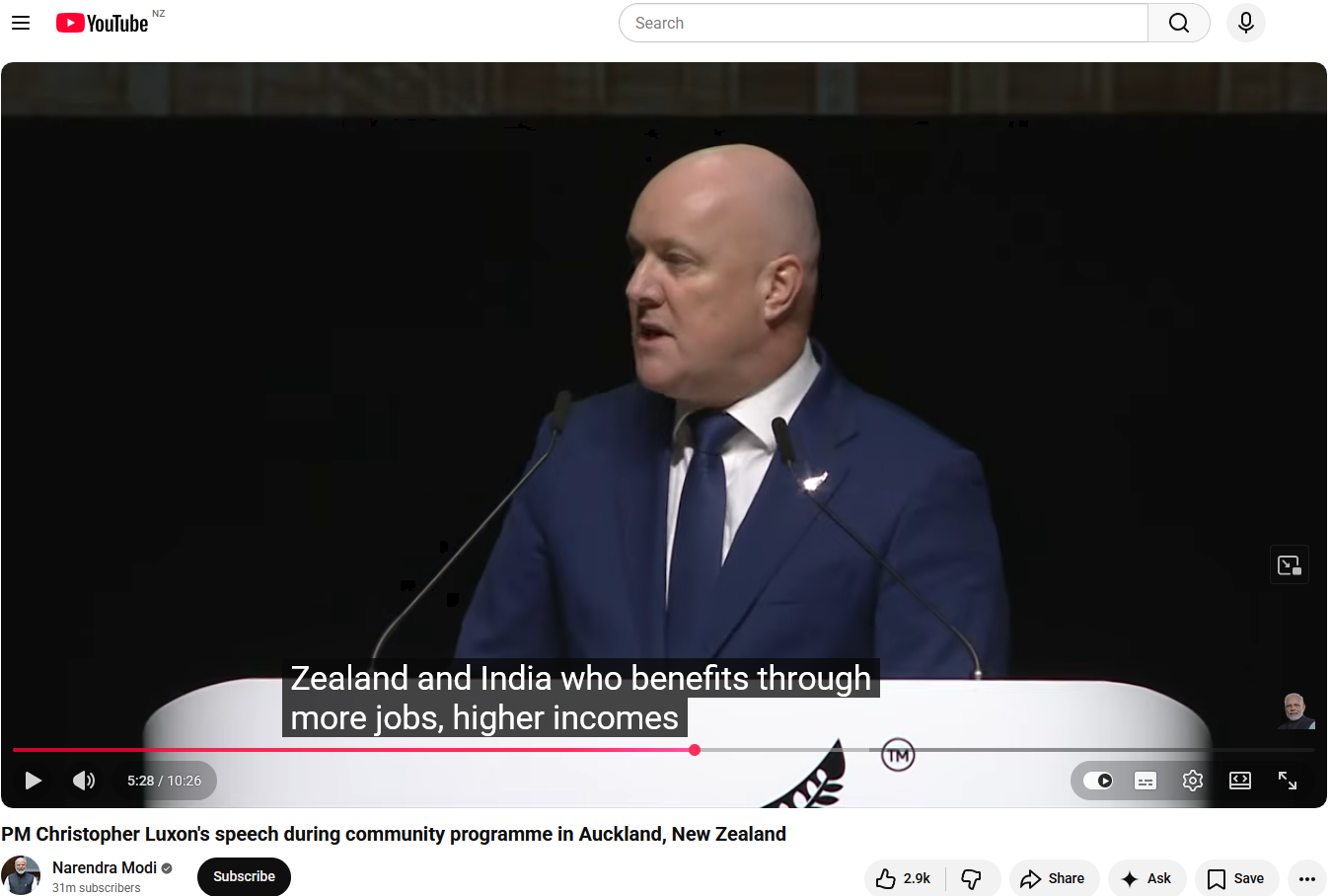
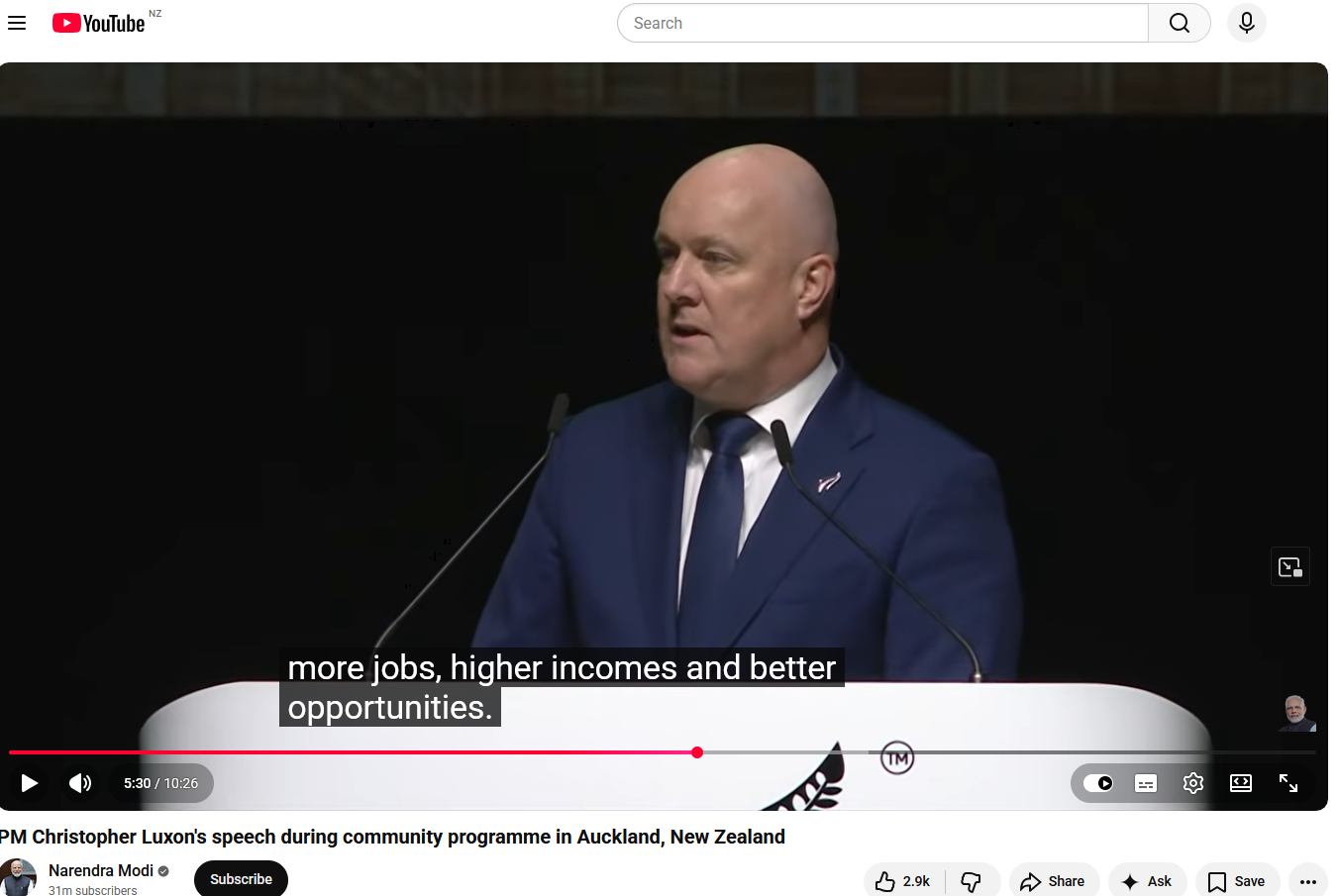
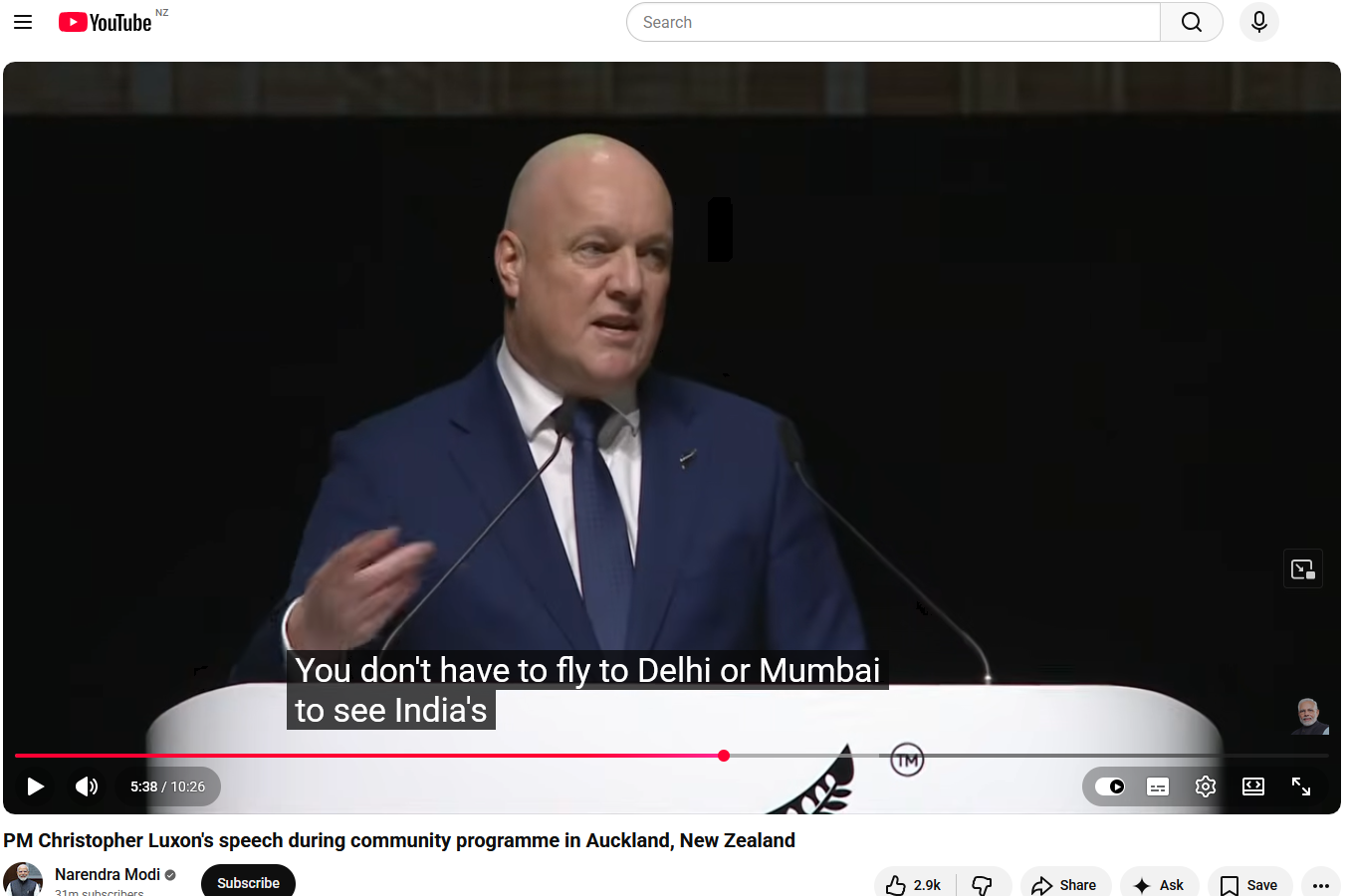
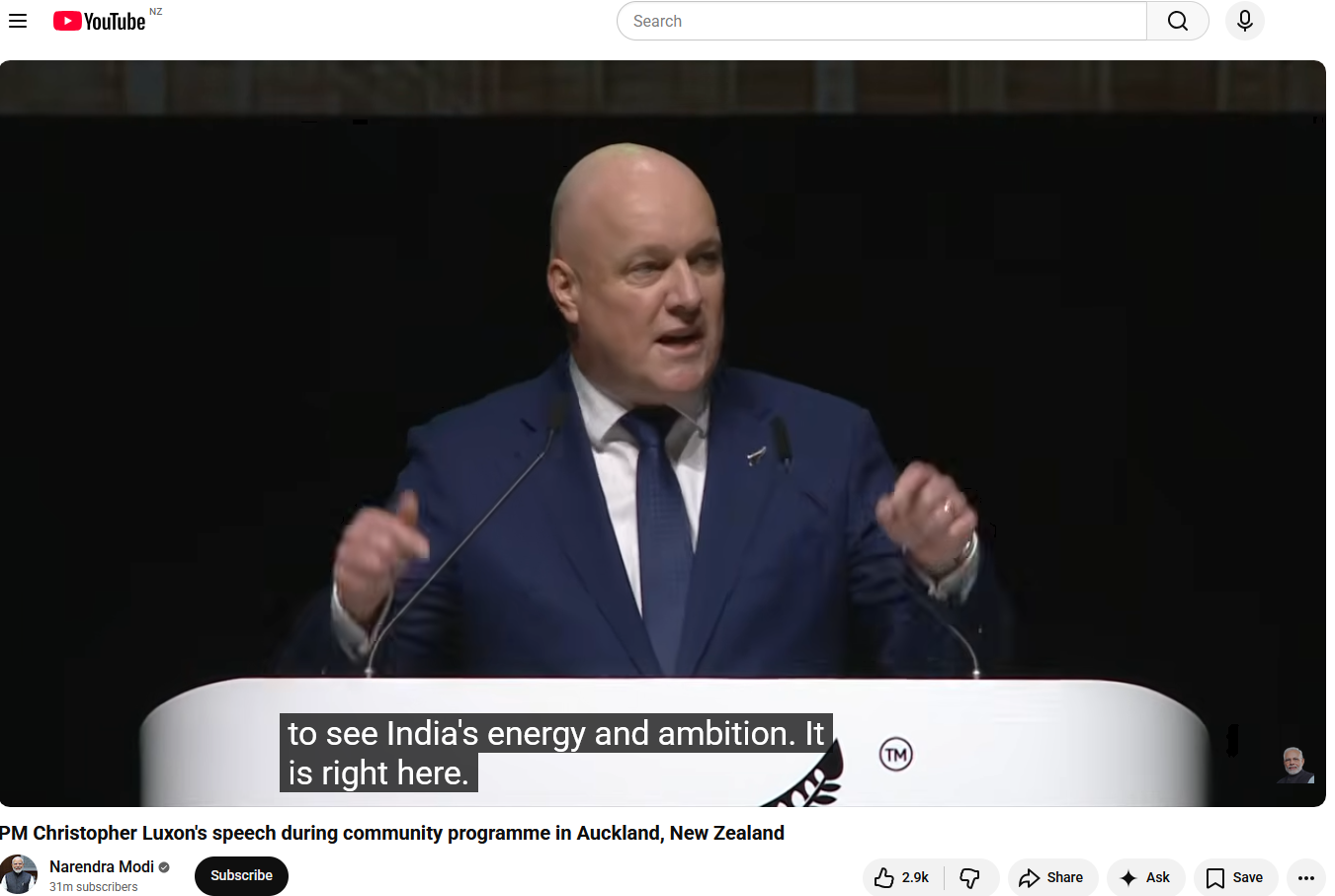
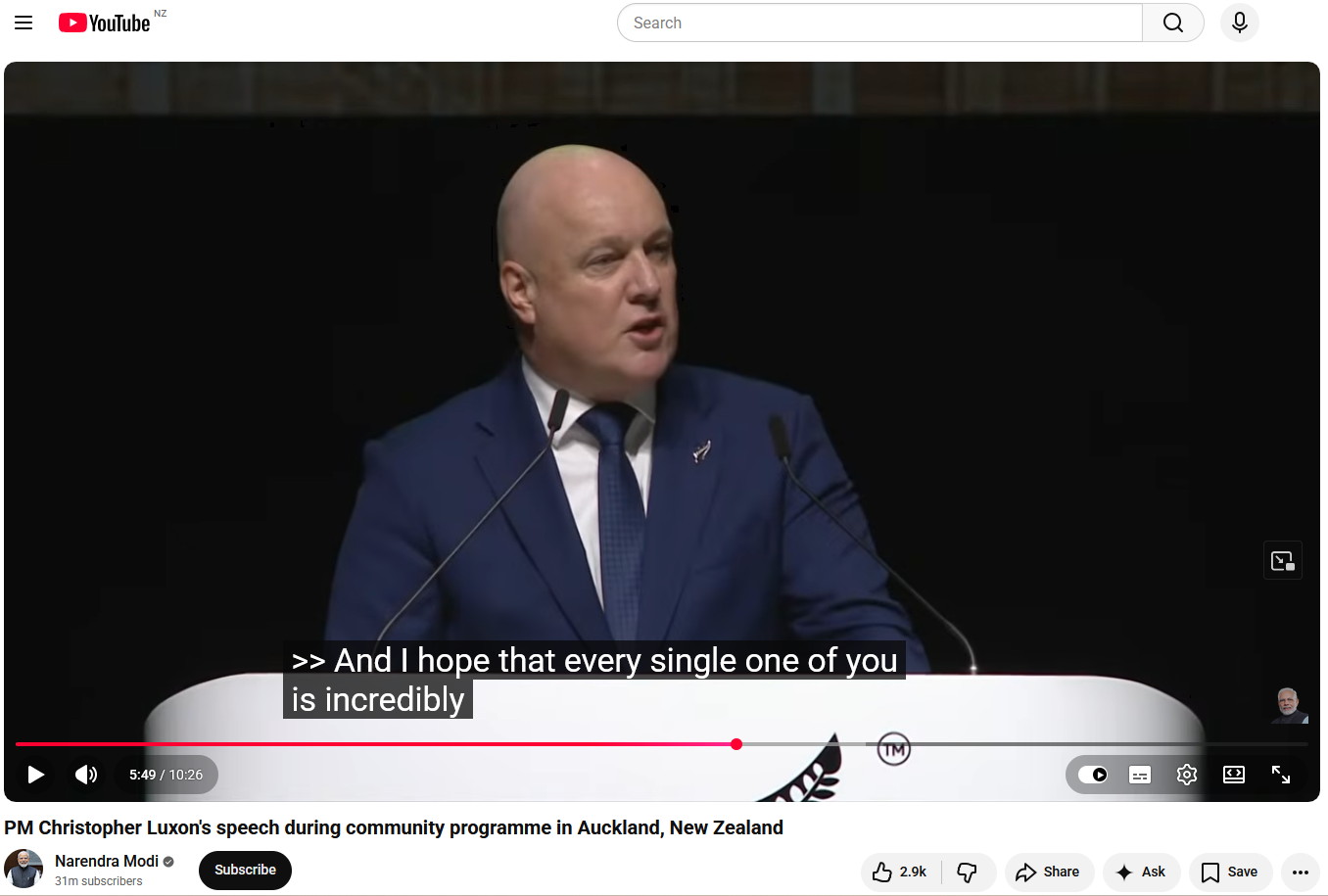
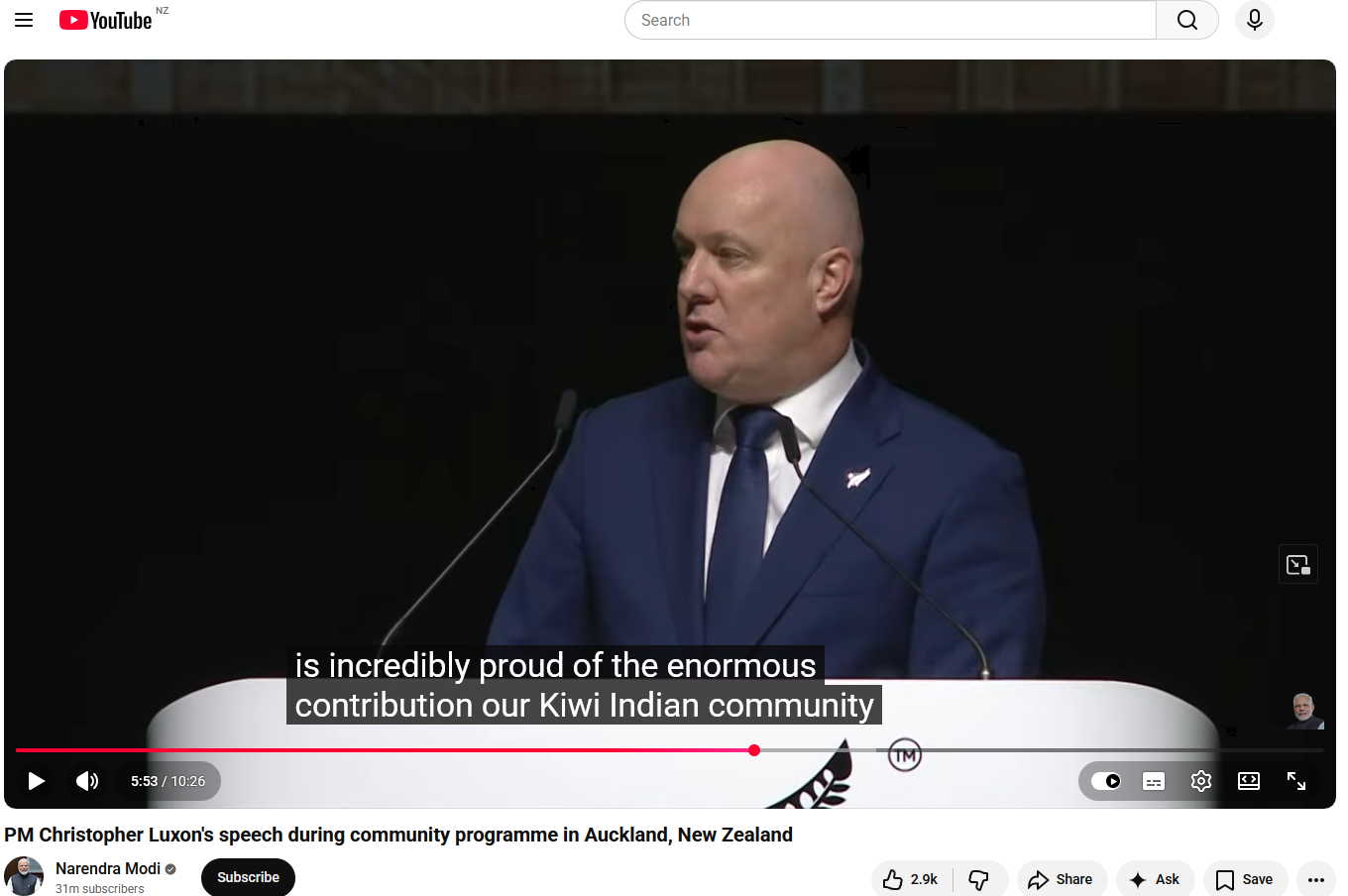
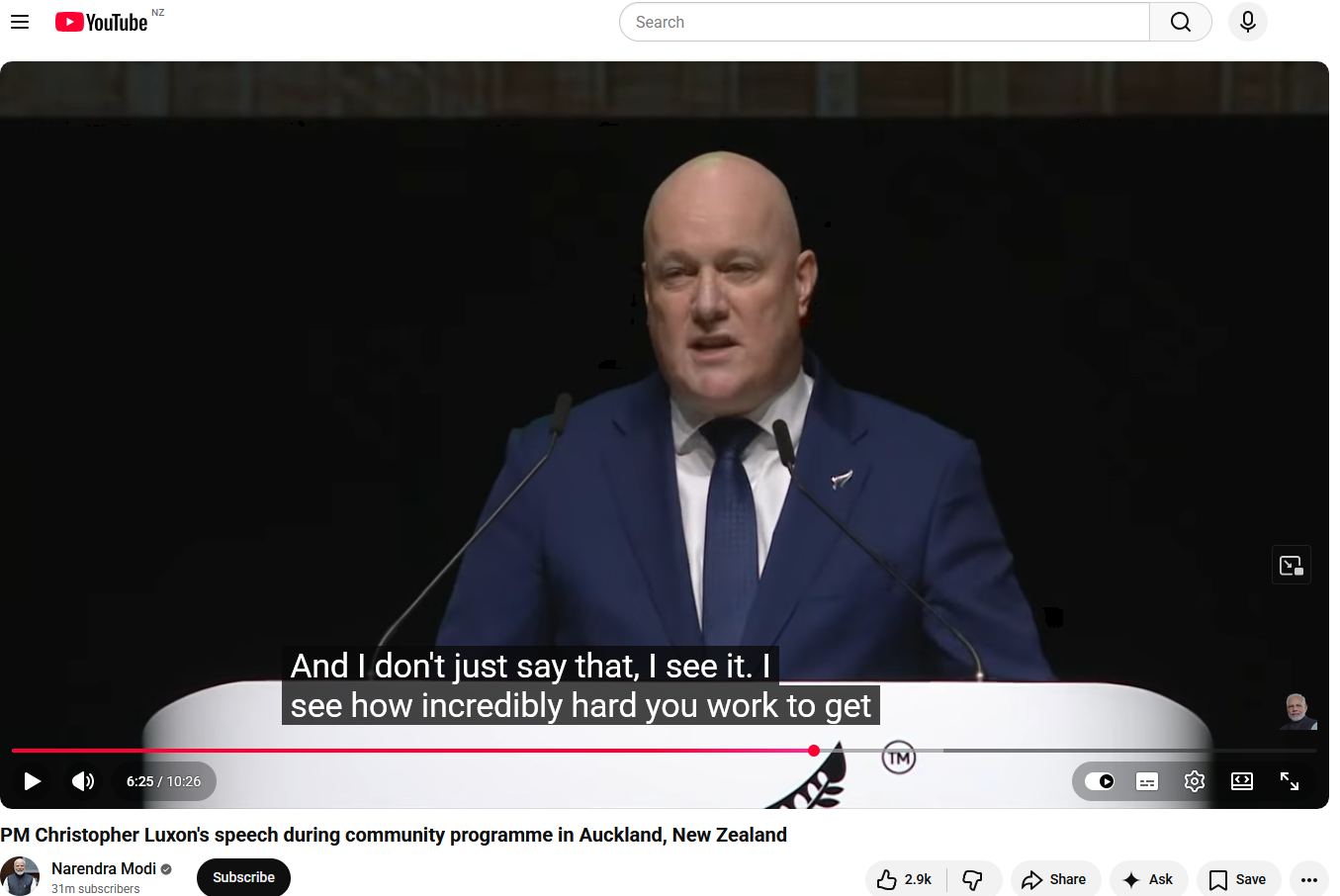
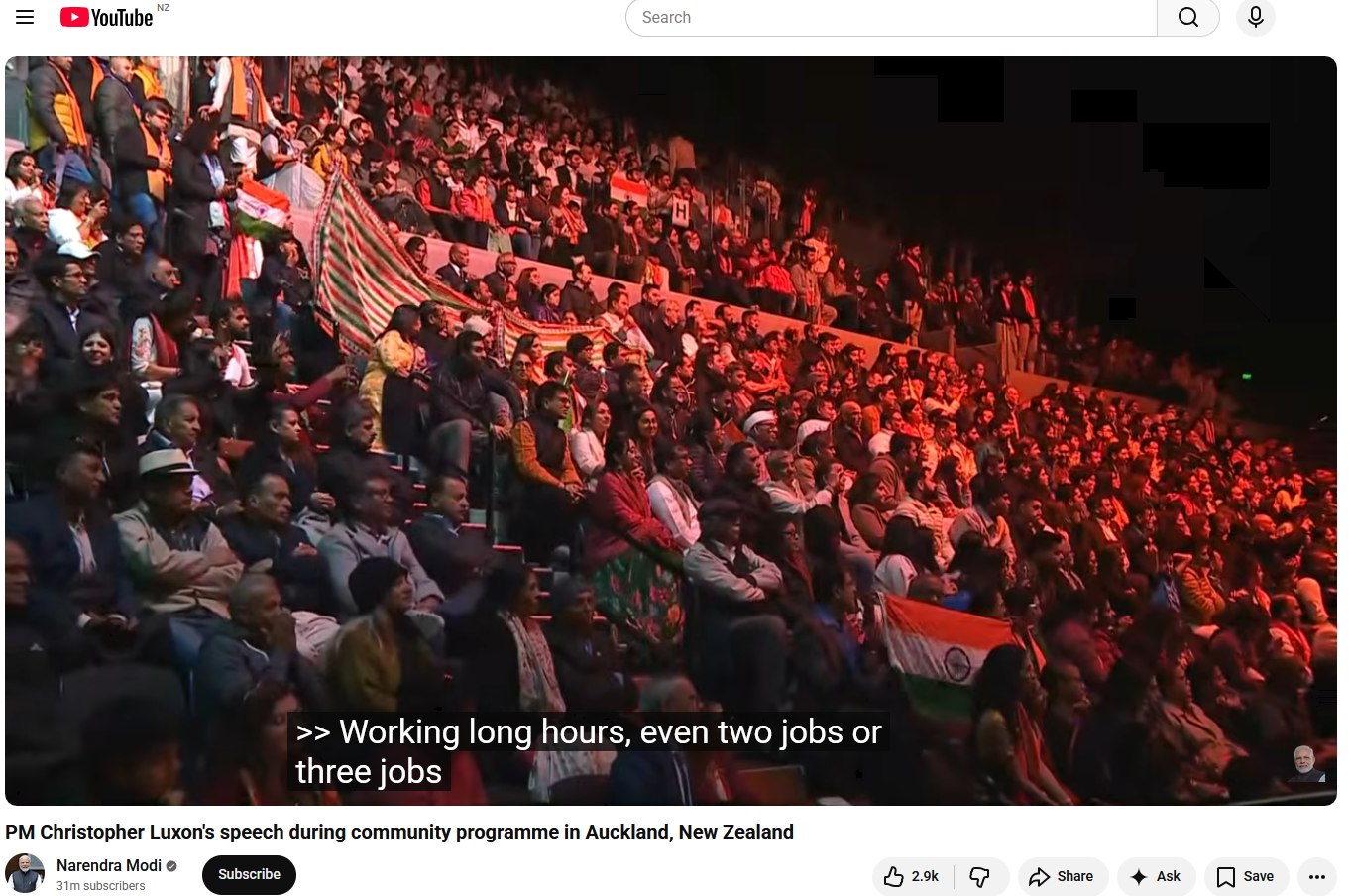
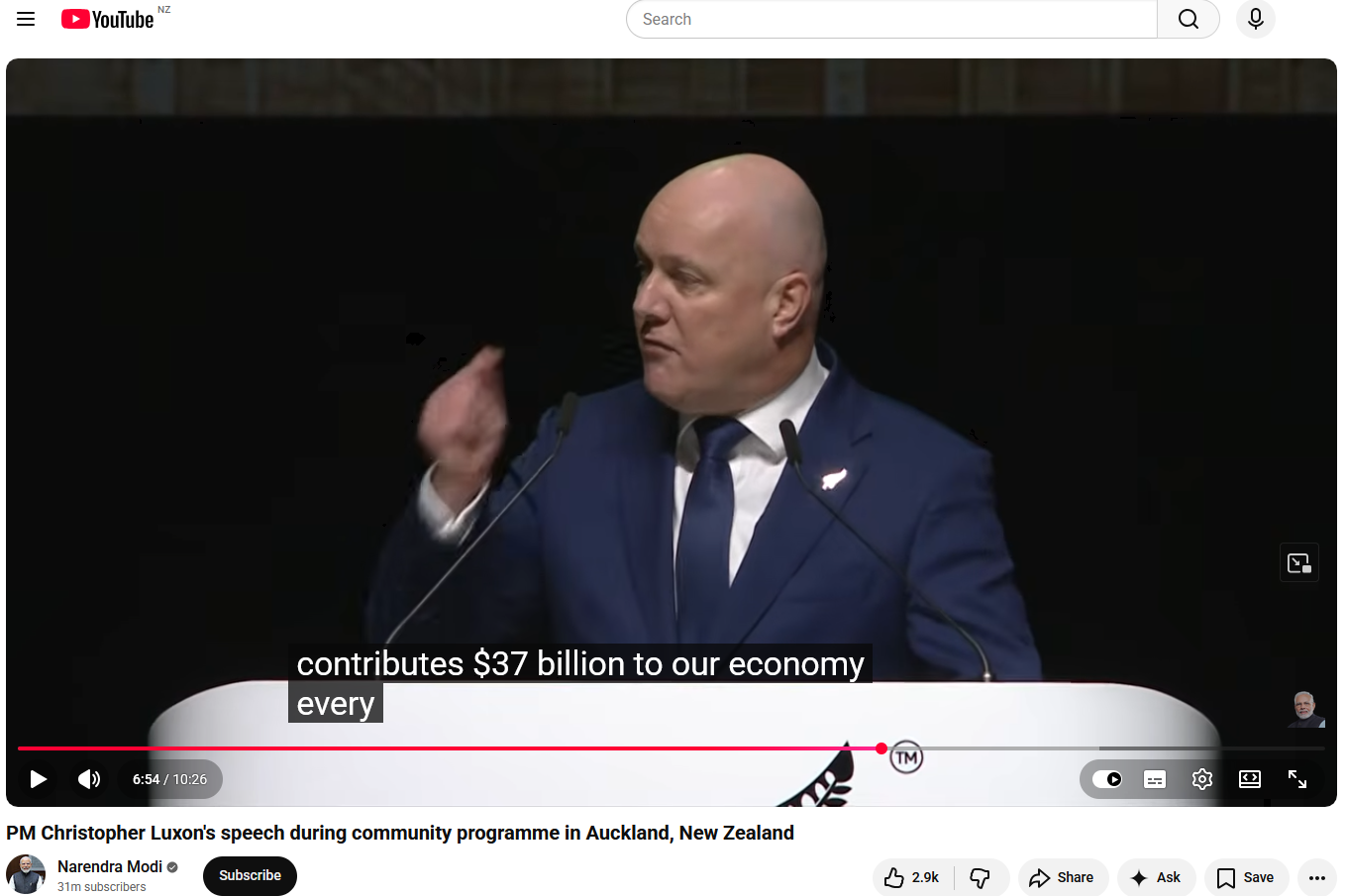
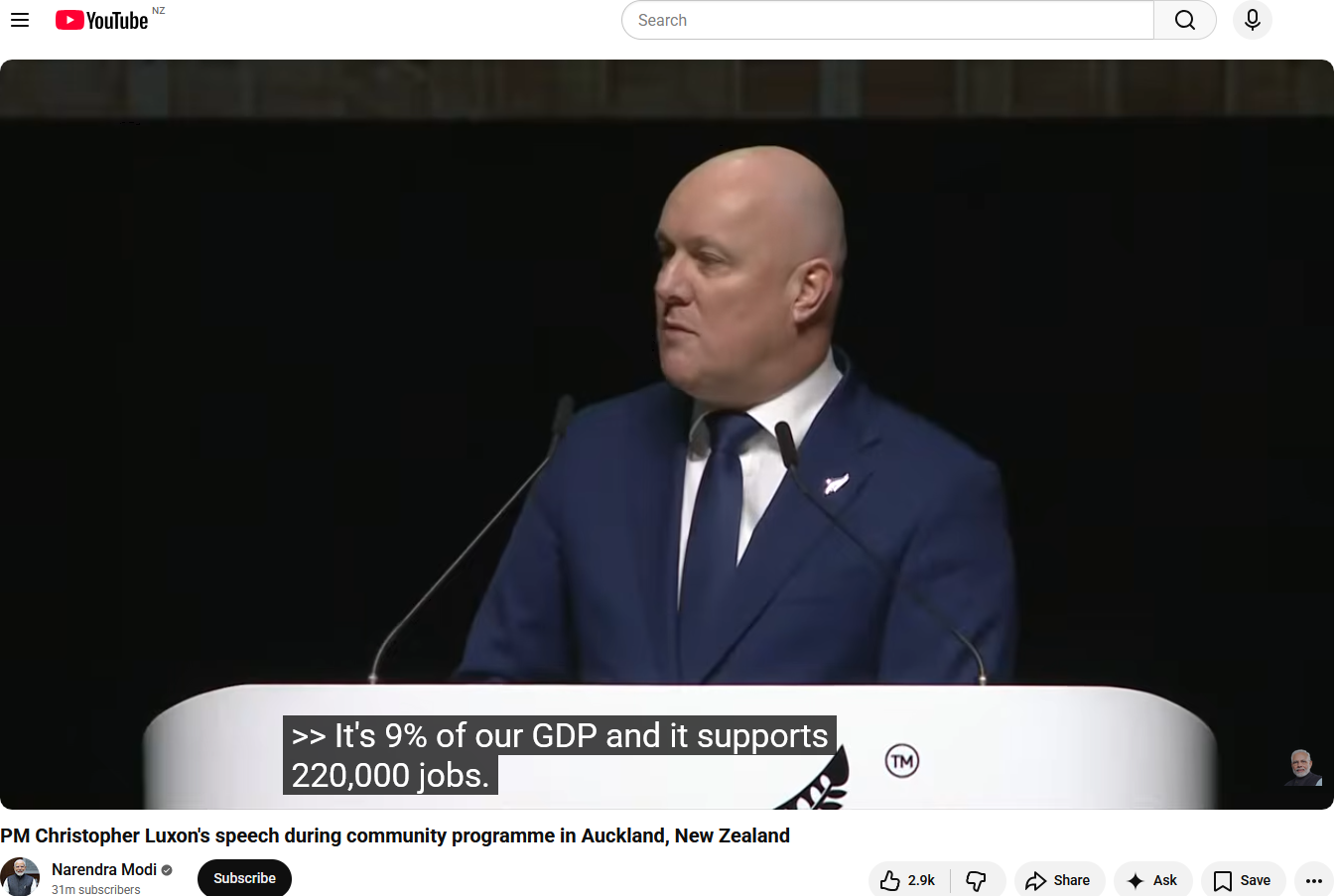
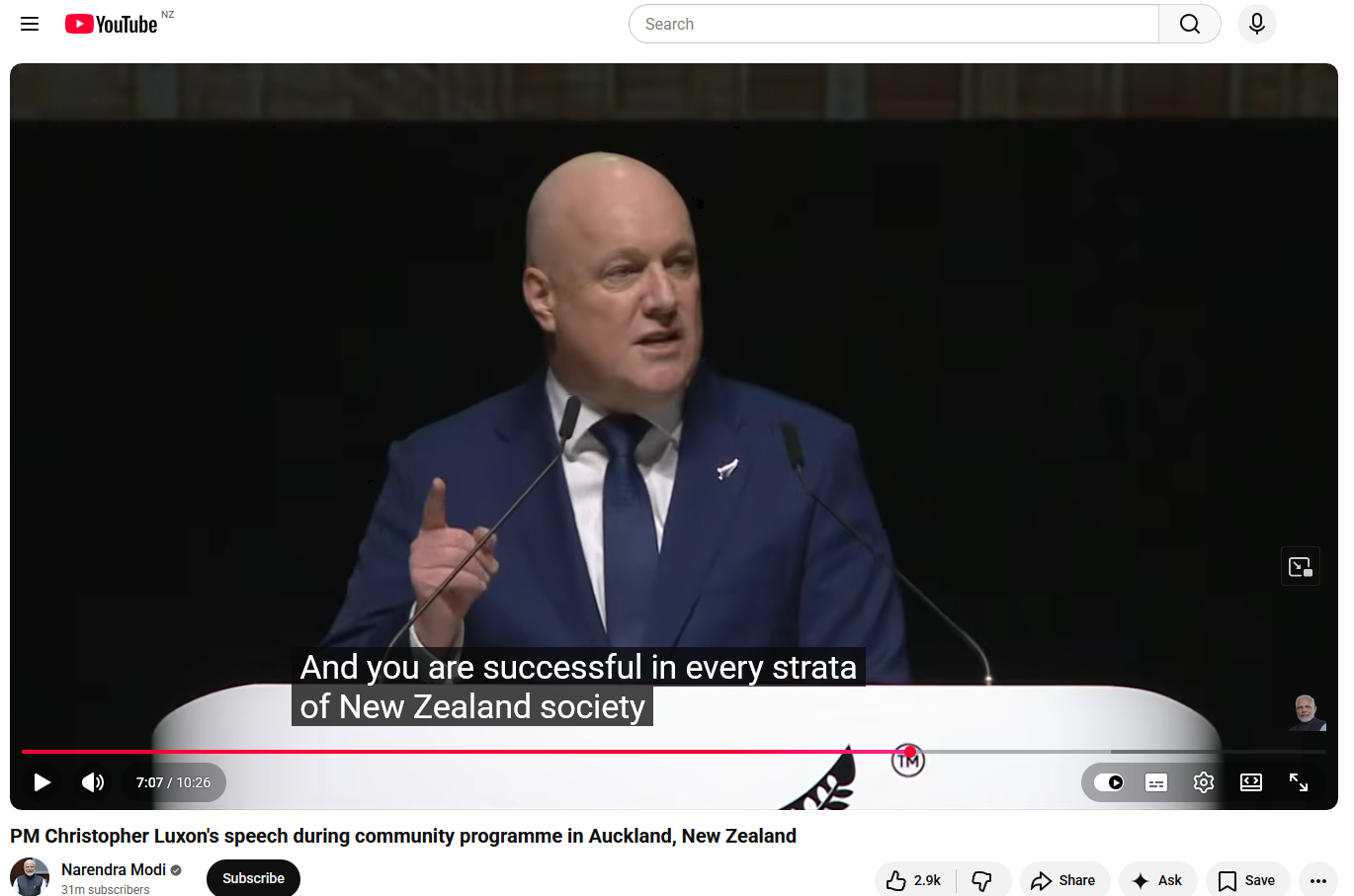
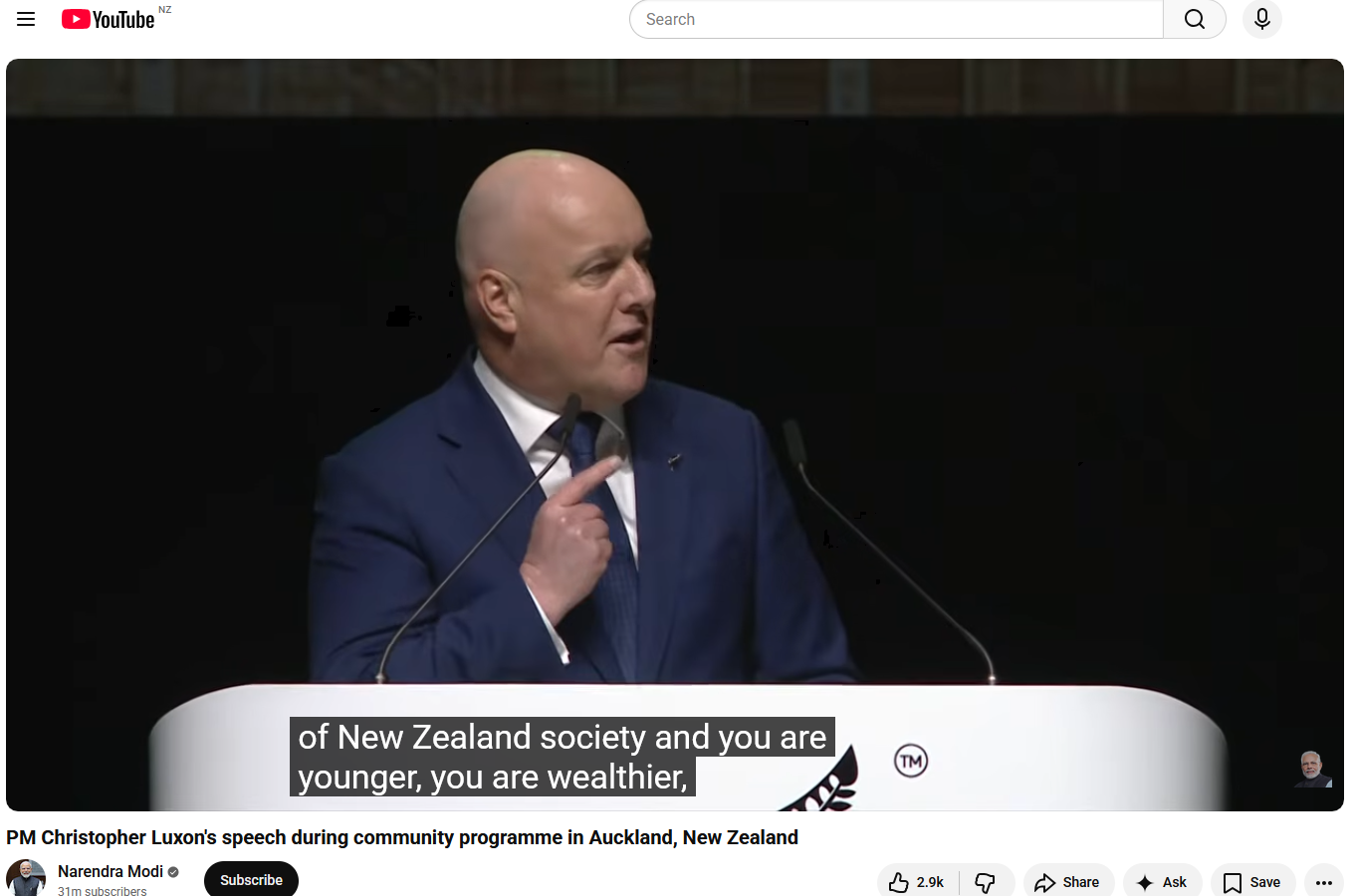
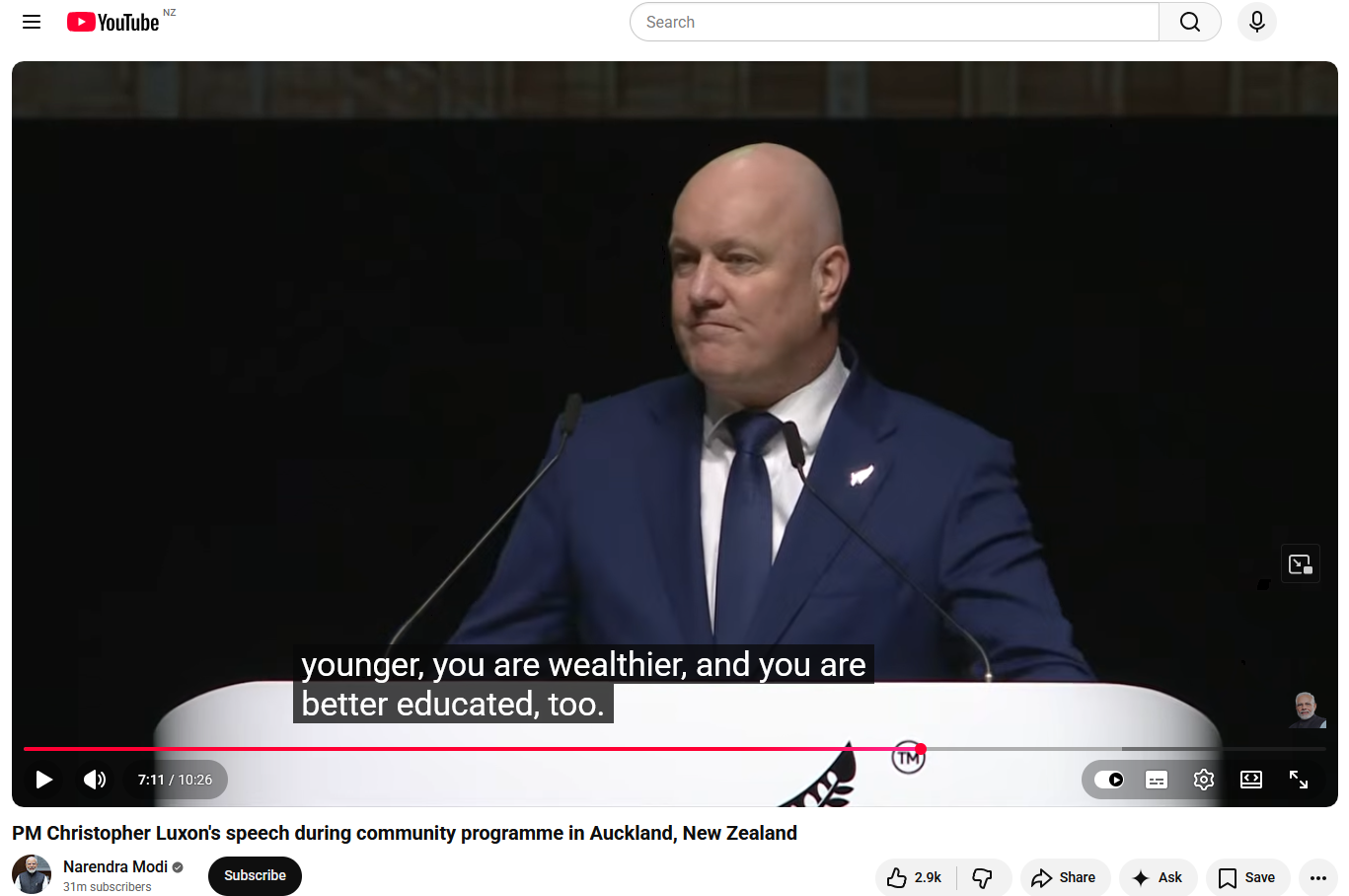
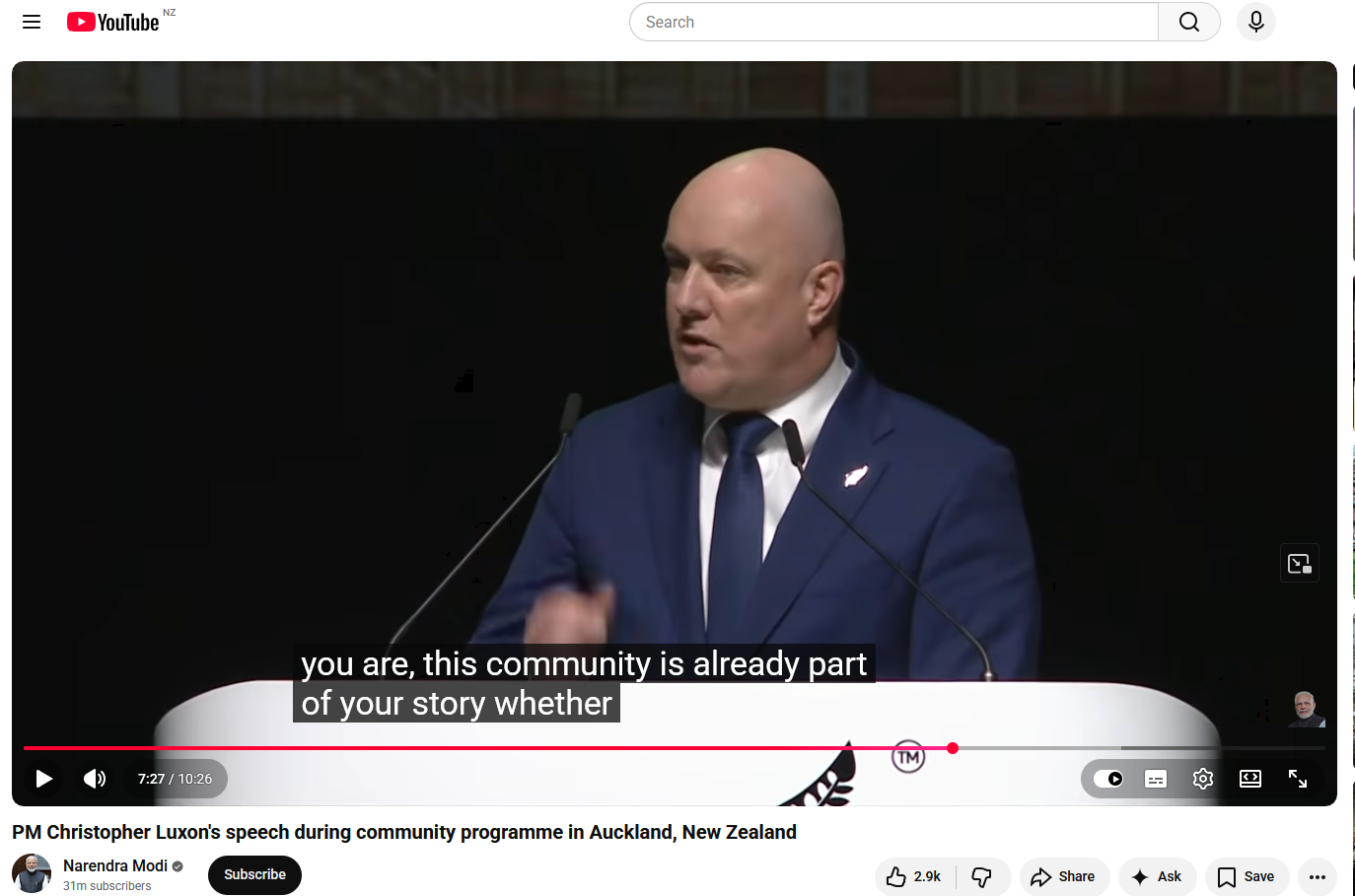
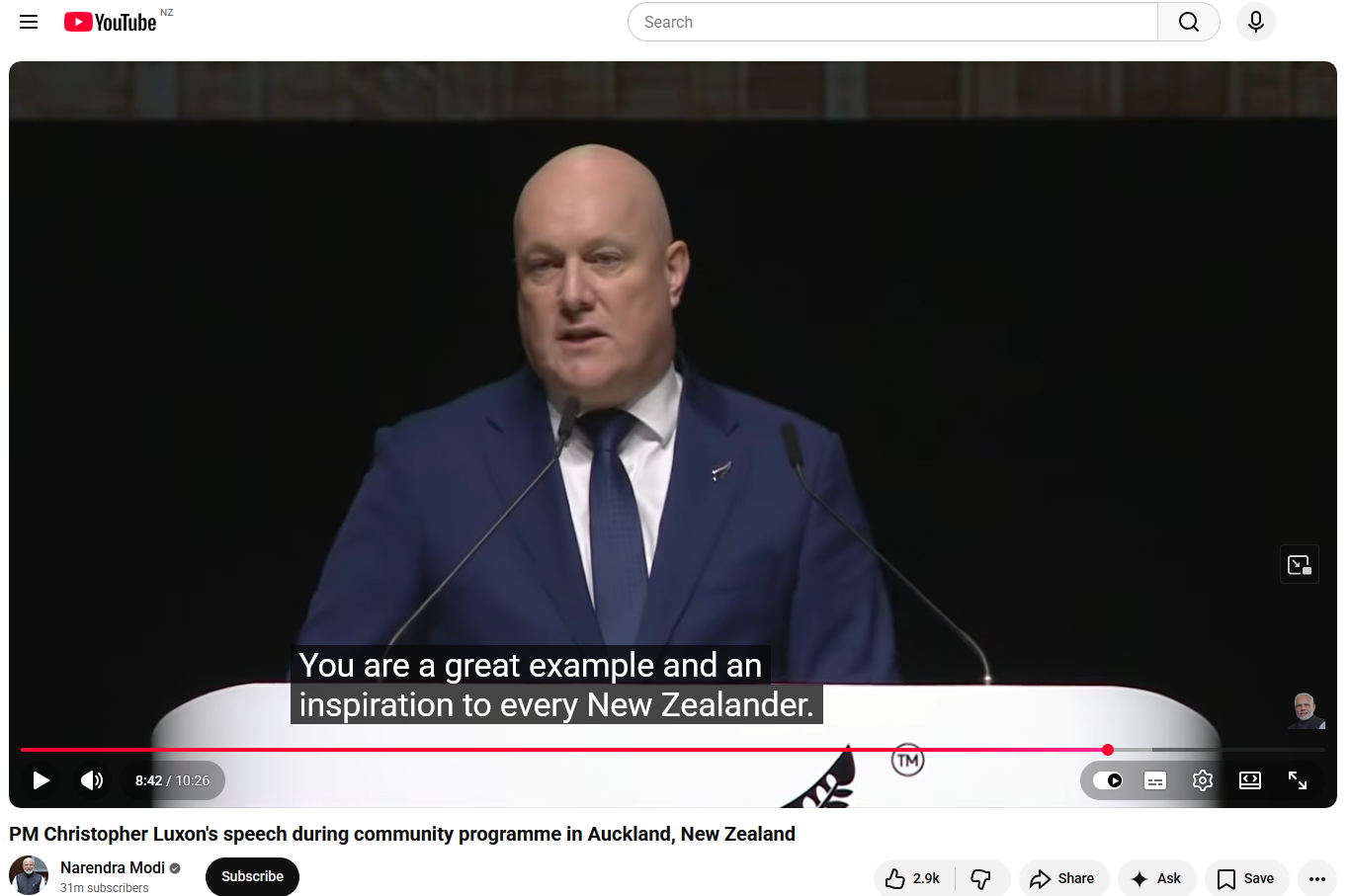
A report about the economic contributions by Indians to the New Zealand economy was released by the Waitakere Indian Association just before Narendra Modi visited Aotearoa. It was partially funded by the High Commission of India and Ministry for Ethnic Communities. Those are the numbers Luxon quotes.
That is how the community is primarily located within the schema of New Zealand. As migrants that contribute billions of dollars, as high energy, hard working, law abiding inhabitants etc etc.
And it is not just Luxon at this event but also ex PM Helen Clark just last week who was worried about the effect Winston Peters' racist remarks towards Green MP Lawrence Xu-Nan might have on our trade relationship with China.
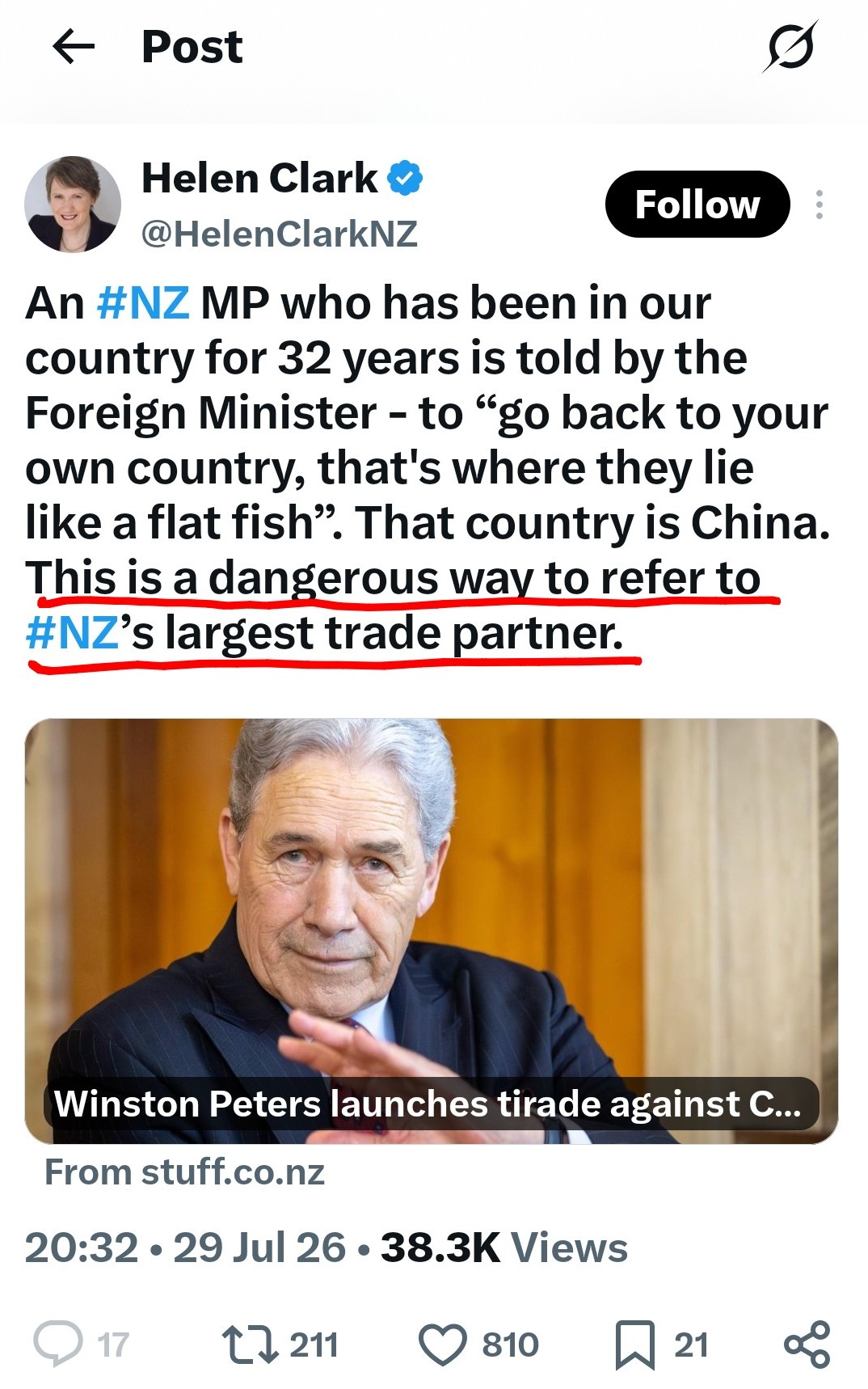
So whatever hue, this is the exact positioning these politicians want the Indian (and other migrants of colour) want to place in. Because pitting the idea of success against tangata whenua minimises and reduces their valid demands for changing racist, inequitable systems and infrastructures to an issue about the inability for hard work and keeping your head down. Protests, hikois and kapa haka in Parliament are seen as disruptive rather than resistance and a struggle for justice. They are termed as disobeying law and order that the model minority Indians apparently don't do. Maori, as we know, are over-represented as beneficiaries but the systemic barriers and ongoing effects of colonisation are dismissed and replaced with the label of lazy dole bludgers as opposed to the "wealthier, better educated" Indians Luxon spoke about.
While such myths are whole heartedly embraced by the Indians, they still fail to protect them from anti-Indian racism. Just like talking up Asian-Americans as a success story failed to protect them during the six days of rioting in L.A. Because these myths-of being high contributors to the economy, of being hard working and all that create a fake image of maintream/Pakeha-Indian solidarity that does not exist. So while Brian Tamaki (and Winston Peters) are derided for their racist remarks, they do not face any consequences. Just a few days of extra media attention.
Of course it is critical to point out that the same Indians who think they are white-adjacent and better than Maori (or tagata Moana) are not able to make the connection between Luxon praising them to the high-skies and refusing to sack Winston Peters. Then they wonder where the anti-Indian racism comes from as if it is an isolated phenomenon.
The only way to prevent anti-Indian racism is to reject the model minority myth, question the politicians who keep pushing it and stand in solidarity with Maori as settler-colonisers ourselves on this stolen land.
The Movement Beyond the Leak: Why Shanmugam Anitha's Dream Still Defines the Fight Against NEET
The Movement Beyond the Leak: Why Shanmugam Anitha's Dream Still Defines the Fight Against NEET.
By Alan John Koshy
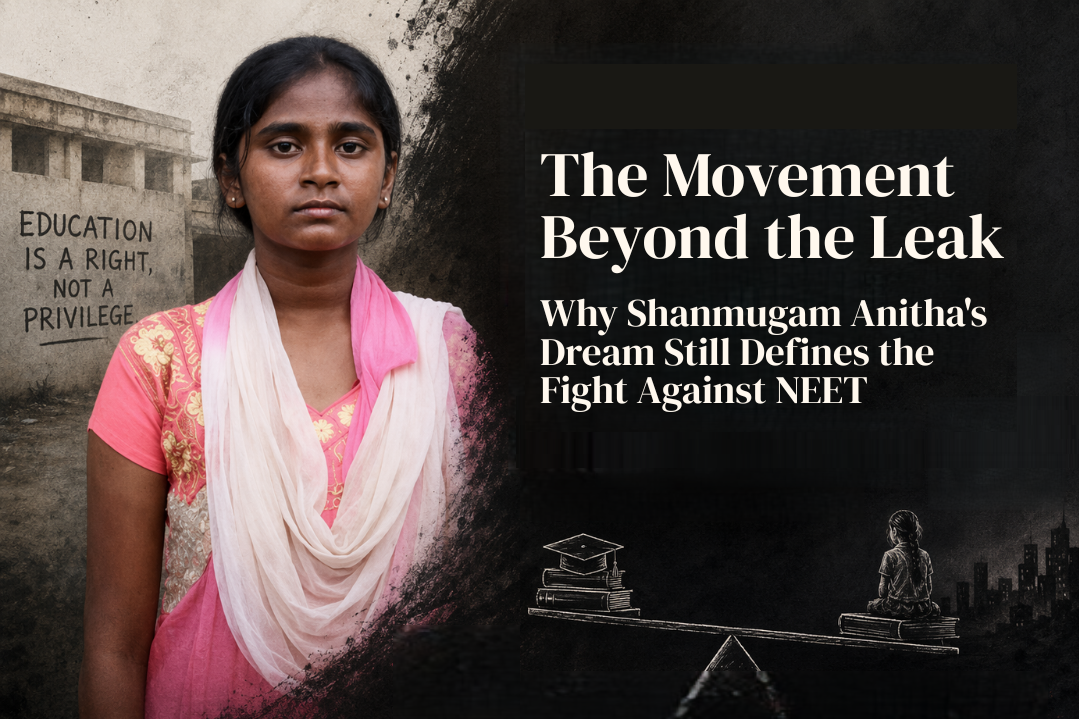
The recent protests that swept through Delhi, where thousands gathered and were met with brutal police crackdowns, may appear to the casual observer as an outburst towards the NEET paper leak scandals.
While the immediate demands for the resignation of the Education Minister Dharmendra Pradhan and compensation for affected families are critical, to limit this movement to a single examination irregularity is to ignore its much deeper and more painful origins.
The very spine of this movement was first shaped nearly a decade ago by the 17-year-old daughter of a daily wage labourer in Tamil Nadu whose dream of becoming a doctor was thwarted by the very existence of NEET.
A Child Who Deserved Better
Shanmugham Anitha was a 17-year-old girl from Kulumur village in Ariyalur district, a pocket of rural Tamil Nadu renowned for being the state’s cement hub. Her father worked as a daily wage labourer. Her mother had passed away when she was young, leaving Anitha and her four elder brothers to be raised by her grandmother in a home that did not even have a toilet.
She studied in a Tamil-medium government school, where she rose to become the only student in her entire district to score 100% in both Physics and Mathematics in her 12th standard examinations. Out of 1200 marks, she scored 1176. By any honest measure, Anitha was exceptional.
She wanted to become a doctor. Her own mother had died without timely medical help, and Anitha was determined that no one in her village would suffer the same fate.
But Anitha understood something that the architects of NEET refused to acknowledge. She knew that poor rural students could not afford the expensive coaching required to crack an exam that demanded 180 questions be answered in just 180 minutes. She strongly believed that if admissions were based on 12th standard marks alone, rural students like her would finally have a fair shot.
With this conviction, she approached the Supreme Court with a petition against NEET. She watched as Central Board of Secondary Education (CBSE) students, represented by senior advocate Nalini Chidambaram, argued that admissions should be made only on the basis of NEET. The Court agreed.
After the verdict, Nalini Chidambaram, who is married to former Union Minister P. Chidambaram, offered a chilling observation: "Any further appeal against NEET can only be done to God." That was a clear message to every rural, Dalit, OBC and Adivasi student in the country: Your fight is over, the doors are closed.
Nine days after the verdict, Anitha waited for a moment of solitude when her father and grandmother were out of the house. In that moment, she went to the innermost room of their small cement home that had held all her dreams and ended her young life.
The system had told her, in the clearest possible terms, that her 1176 marks meant nothing. That her brilliance in Physics and Mathematics was irrelevant. That her dream of serving her community was not valid unless she could afford coaching that her father's daily wages could never cover. She had been squeezed between the cracks of a broken system.
A Systematic Squeeze: The Data Behind the Exclusion
The Justice A.K. Rajan Committee was constituted by the Tamil Nadu government to quantify what Anitha's tragedy represented: the institutional exclusion of the poor and rural.
Justice Rajan, a retired Madras High Court judge who was born in a rural village himself, had once been forced to give up his dreams of becoming an engineer because of a change in exam rules in the 1970s. Perhaps that is why he understood, in a way that others could not, how a single examination could destroy a lifetime of aspiration.
The report, backed by over 85,000 public submissions, presents a damning case against NEET. Rural Tamil Nadu students, who once constituted a majority in medical admissions at 61.5% pre-NEET, saw their share drop to 49.9% post-NEET. The committee found that the exam has effectively wiped Tamil-medium students off the map. They went from representing up to 20% of admissions to a mere 1.6-3.2%. First-generation graduates, those with no doctor in the family, plummeted from nearly a quarter of admissions to just 14.5%.
Justice Rajan himself did not mince his words when he said: "NEET drives away the poor; only the rich and the affluent garner most seats". Anitha understood this before any committee was formed.
A System Working Exactly as Intended
NEET is administered in roughly 550 cities and towns across India, yet only a handful of these locations have the kind of coaching ecosystems that have become virtually mandatory for success. For students outside these areas, the exam is effectively inaccessible. This is not a Tamil Nadu problem. It is a national crisis.
With 63% of India’s population residing in rural areas and reliant on government healthcare, the country's medical model depends on doctors willing to serve villages. Fewer rural students becoming doctors means fewer doctors likely to serve rural areas. A public health crisis beckons.
These latest protests echo a decade-old struggle, much like the Rohith Vemula movement, that questions the structural barriers embedded within India's education system.
The JEE (Joint Entrance Examination) for IITs follows the same pattern as NEET. The same forces of expensive coaching, syllabus misalignment with state boards, and an examination format that rewards specialised training have gradually squeezed out rural, local language-medium, and first-generation students.
Once inside, students from marginalised communities face a hostile environment of caste-based discrimination, social isolation, and faculty indifference. Between 2018 and 2023, more than half of all dropouts from these institutions were from SC, ST, and OBC backgrounds.
A Roadmap for Justice
The A.K. Rajan Committee recommended the total elimination of NEET in Tamil Nadu and a return to admissions based on normalised high school scores, alongside a framework for "Adversity Scores" to ensure social justice.
These recommendations acknowledged that a child from a home without a toilet faces different challenges than a child whose parents can afford to send them to a top coaching institute.
Yet despite the Tamil Nadu Assembly passing a bill to this effect twice, the President of India has withheld assent, driven by the Union Government's advice.
The refusal to address the systemic discrimination against state board students is the logical conclusion of a system that views equity as a threat to centralised power.
The Deeper Truth
Babasaheb's vision for a truly equitable India states that a society which does not educate its poor cannot call itself progressive.
Until we dismantle an education model that treats coaching as a prerequisite and rural dreams as expendable, the injustice will continue to manifest.
Anitha's dream did not die with her. It lives on in every rural student who refuses to give up. It lives on in every protester who took to the streets. And it lives on in our collective determination to build a system that never again tells a child they are worthless because of the circumstances they are born into.
The Aotearoa Alliance of Progressive Indians stands in solidarity with students fighting for equitable access to education and reaffirms its commitment to social justice in all its forms.
How National and Labour Mainstreamed Hindutva in Aotearoa
We are grateful to Professor Mohan Dutta for letting us publish from his original post on his culture-centred blog.
Jai Shree Ram in Auckland: Two mainstream NZ parties, the Kia Ora Modi Event and Mainstreamed Hindutva
Mohan J. Dutta
On a winter evening in Auckland this week, under a palm tree on a street outside the arena where the Prime Minister of India was being celebrated, a group of men raised a saffron flag bearing the bow and arrow of Ram and the words Jai Shree Ram. They chanted as they waved it, one of them wearing the Indian tricolour like a shawl, and by morning the photograph had travelled proudly through the digital veins of the diaspora. It deserves a longer look than it got, because if a liberal democracy wants a single test for the arrival of Hindutva in its public square, that slogan is the test.
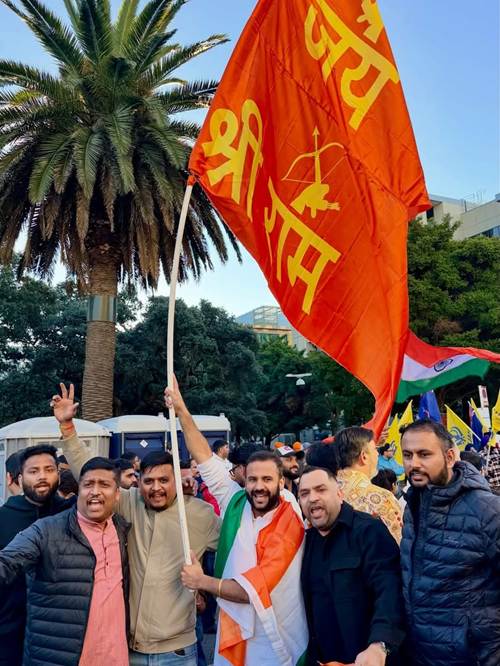 Demonstrators outside the Kia Ora Modi event, Auckland, July 2026, with a saffron Jai Shree Ram flag.
Jai Shree Ram was once a greeting exchanged between pilgrims, and it has been remade into a war cry: the chant that rolled through the streets of Leicester in 2022 as communal violence flared half a world from the quarrels that ignited it, the chant that travels with mobs linked to the RSS and the VHP when they descend on mosques and minority neighbourhoods in India, a devotion hollowed out and refilled with menace. When the slogan flies over an Auckland street it does not fly alone; it arrives in the company of markers the world has learned to recognise, politicians at Hindutva events, saffron scarves on parliamentary shoulders, the image of Bharat Mata borne aloft, and the Kia Ora Modi event gathered a remarkable number of them into a single evening.
The production
Look at the welcome poster the Hindu Council of New Zealand, one of the nodal organisations of Hindutva, sent into the world: a wharenui in one corner, the silver fern, the Southern Alps, the two flags braided together, and over it all the face of Narendra Modi rising like a sun. This is the movement's signature move, the iconography of the host country draped across the iconography of the project, the local greeting stretched over the same travelling production that filled a Houston stadium in 2019 under the name Howdy, Modi.
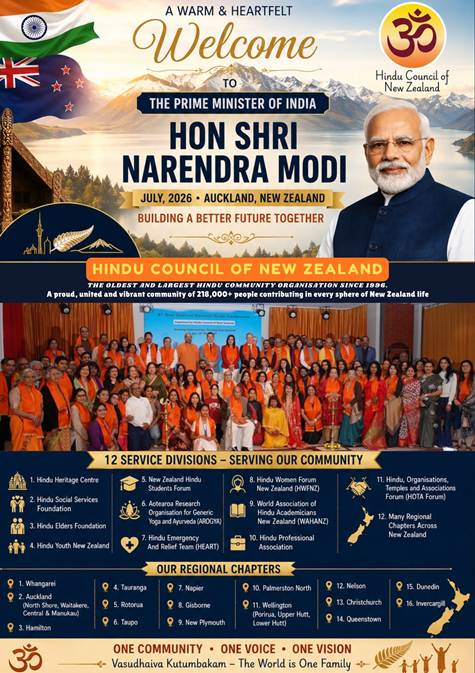 Hindu Council of New Zealand welcome poster for the July 2026 visit.
If the poster supplies the imagery, the Council's Facebook post supplies the theology, extending a sacred Poornakumbh Swaagatam to the Prime Minister of Bharat and hymning the timeless bonds of dharma joining Bharat and Aotearoa, so that a state visit becomes a homecoming of civilisations, a trade mission becomes dharma, and the vocabulary of the Hindutva movement settles in plain sight on a New Zealand feed, tagged to the High Commission and the Consulate.
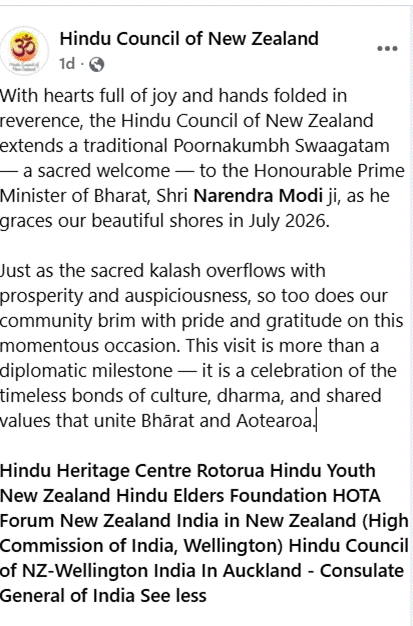 Hindu Council of New Zealand Facebook post framing the visit through Bharat and dharma.
When the Council's president boasted that every volunteer at the event was a woman, he reached for the regime's own phrase, Naari Shakti, woman power, the slogan of a government that garlands womanhood in the abstract while women human rights defenders grow old in its jails, a vocabulary that needed no translation on its journey south.
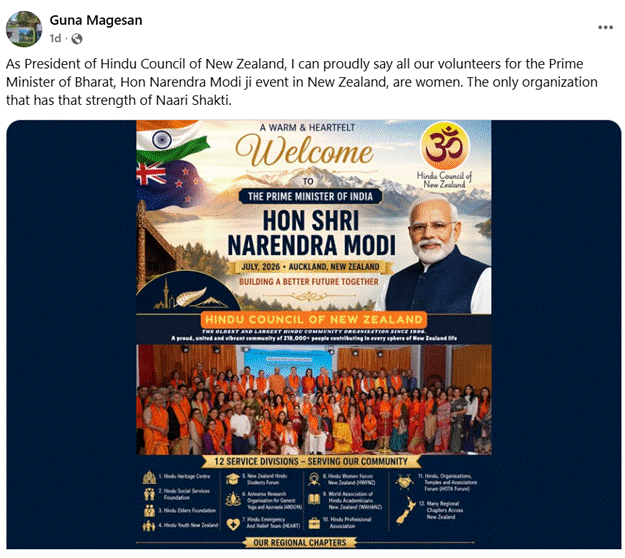 Post by the Hindu Council of New Zealand president on the event's volunteers as Naari Shakti.
The politicians
Into this production walked the political leadership of New Zealand. Prime Minister Christopher Luxon stood on the Spark Arena stage beside Modi, two men waving into a blaze of phone lights, and posted the footage himself, National MPs arrayed behind him. Every second of it will now be clipped, subtitled and pushed through the Hindutva ecosystem as recruitment material, burnishing the image the movement has spent two decades manufacturing: Modi as vishwaguru, teacher of the world, the singular leader on whose shoulders authoritarian populism always rests.
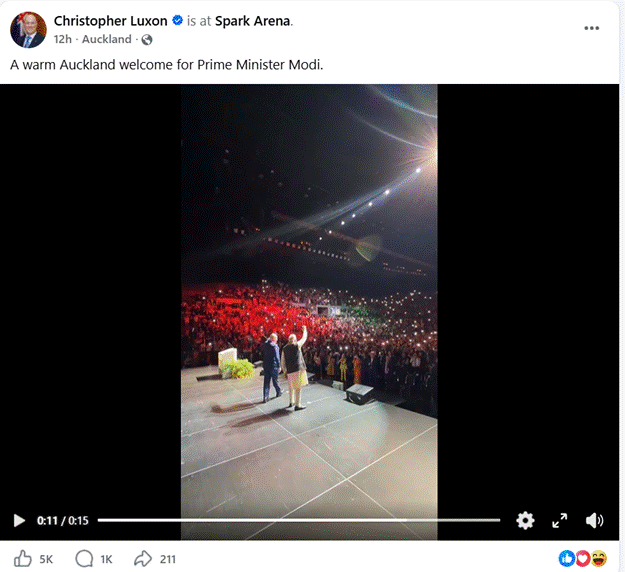 Prime Minister Christopher Luxon's post from the Spark Arena stage.
This is the same country whose own Security Intelligence Service, in the years after the Christchurch terror attack taught it what Islamophobic extremism can do, identified Hindutva as a form of extremism in the Aotearoa context, and it now has a Prime Minister who says he is not worried about Hindutva in New Zealand even as he parades into a Hindutva rally and wakes the next morning on the front pages of the Hindutva-linked media in India.
Labour offered no counterweight: Jenny Salesa filmed the twelve thousand inside the arena and pronounced the vibe amazing, while Chris Hipkins went to meet Modi with Vanushi Walters, who wrote warmly of the growing partnership between our two democracies. The warmth was bipartisan and so was the silence.
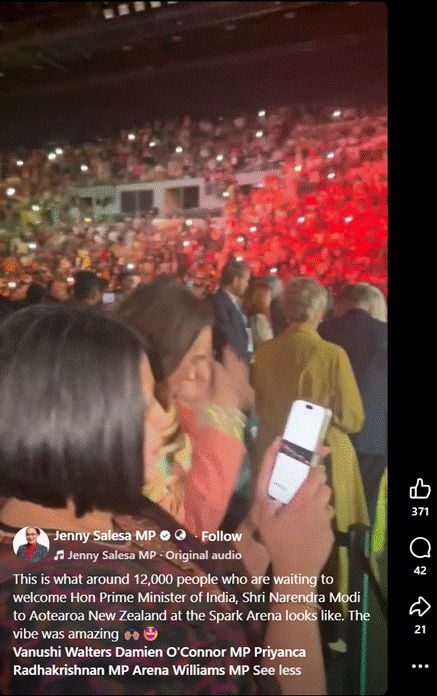 Labour MP Jenny Salesa's post from inside Spark Arena.
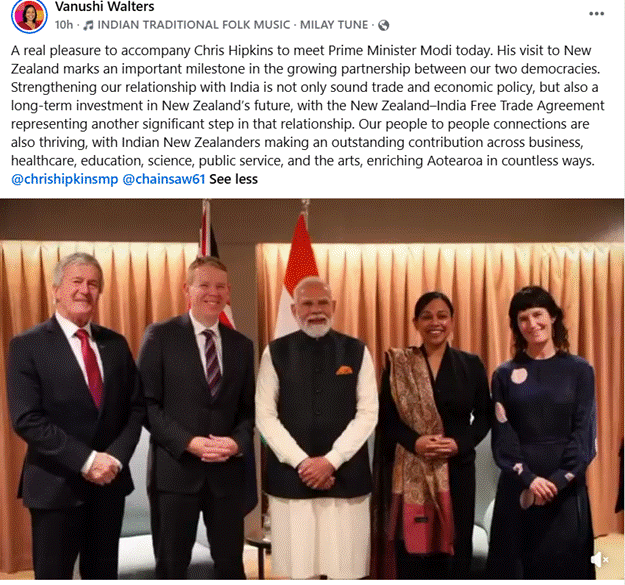 Labour MP Vanushi Walters' post on meeting Modi with Labour leader Chris Hipkins.
The most telling image from Auckland, though, is the one that was never taken, because Modi does not hold press conferences: across more than a decade in office he has not taken unscripted questions from his own country's journalists, years in which the Varieties of Democracy Institute downgraded the world's largest democracy to an electoral autocracy, its newsrooms raided, its scholars jailed, its universities hollowed out. Of the two democracies toasted at Spark Arena, only one still answers to its people, and neither of New Zealand's major parties found a word to say about it.
The cost
None of this is new to these islands. Narendra Modi first came to New Zealand in 2001, as a functionary of the Bharatiya Janata Party and a senior member of the RSS, before his years as Chief Minister of Gujarat, and the mainstream arrival of Hindutva here has been building ever since, in full view of a documentary base assembled with patience and at personal cost: the white papers published by the Center for Culture-Centered Approach to Research and Evaluation, the encyclopedia entries recording the movement's presence in Aotearoa, the organising of activists such as Sapna Samant and Oscar Romero, the sustained work of the Aotearoa Alliance of Progressive Indians, and five years of excellent reporting that traced the evidence and the linkages. The scenes captured in these photographs unfolded with that record open on the table, which makes them a choice rather than an oversight, and the bill for the choice will be presented twice.
It will be presented first in New Zealand, where the arrival of one majoritarian fury summons another: Hindutva hands Destiny Church and Brian Tamaki the enemy their Christian nationalism requires, and receives from them the enemy it requires in return, while Muslims, Sikhs, Dalits, tangata whenua and queer communities are caught in the space between them.
The thousands who streamed into Spark Arena came, most of them, for reasons as old as migration itself: to hear the songs of home in a southern winter, to see the leader of the country they left honoured by the country they chose, to stand for one evening inside a crowd that pronounced their names correctly. There is nothing to apologise for in that longing. But it is precisely this longing that the production harvests: the warmer the welcome and the fuller the arena, the louder the declaration to those trained to hear it.
And it will be presented in India, where every arena filled in a western democracy returns as proof that the world has blessed the project, that the raids and the jailings carry no cost abroad. The applause in Auckland does not stay in Auckland.
A saffron flag with a war cry flew over an Auckland street this week, and the political leadership of this country stood inside the arena it pointed toward. New Zealand should say plainly what it saw.
Why the India-NZ Free Trade Agreement. Anti-farmer, anti-worker, anti-indigenous
Free Trade Agreements (FTAs) are often celebrated as the route to economic growth, with the promise of increased market access, foreign investment and international partnerships. But the benefits are not always shared equally. Negotiating FTAs with wealthier economies of the Global North pose challenges for countries in the Global South as the two sides often operate on an uneven playing field. Developed countries usually have highly mechanised agriculture, advanced technology and more financial support for producers. Developing countries like India are still heavily dependent on smallholder farmers and labour-intensive agriculture. India’s own experience with previous FTAs has reinforced these concerns. For example, the India-ASEAN Free Trade Agreement has been linked to increased imports of goods like tea, coffee, fisheries and plantation crops, which has put pressure on domestic producers (Ratna & Kallummal, 2013). The Times of India (2025) reported that India has a merchandise trade deficit with five out of seven countries and blocks it signed FTAs with. On the backdrop of this, the India–New Zealand Free Trade Agreement has raised debates on whether trade liberalisation can go hand-in-hand with protecting millions of Indian farmers dependent on agriculture for their livelihood.
The All India Kisan Sabha (AIKS), one of the country’s largest mass organisations of agricultural workers and peasants with millions of members has strongly opposed the agreement, viewing it as an example of an unequal trade structure that could worsen existing vulnerabilities in Indian agriculture (All India Kisan Sabha, 2026). The AIKS described the India-New Zealand FTA as an ‘onslaught on Indian agriculture’ and the organisation demands the Indian government to scrap the FTA. AIKS says Indian farmers already struggling with the burden of rising operational costs, climate uncertainty, indebtedness and weak price realisation and are thus very vulnerable to import competition. Specifically, the organisation cautions that increased market access for highly efficient agricultural exporters such as New Zealand could exert pressure on domestic producers, particularly in sensitive sectors like dairy where millions of rural households depend on small-scale production for their livelihoods (All India Kisan Sabha, 2026). AIKS highlights a provision in FTA that India agreeing to remove import tariff on high value dairy products like bulk infant formula ‘could hugely benefit New Zealand based dairy big business and harm the class interests of Indian dairy farmers’.
Similar apprehensions are being voiced by apple growers in the Himalayan regions of Himachal Pradesh and Jammu & Kashmir where horticulture is the backbone of rural livelihoods. Farmers in these regions are worried about the reduction of import duties for New Zealand apples under the FTA leading to cheaper imports flooding the Indian market during peak marketing seasons when domestic apples are stored and sold (The Economic Times, 2025), according to recent reports. Growers argue that even small import quotas can affect market prices and reduce returns for local produce, especially when considering India’s lower productivity and higher production risks compared to New Zealand (The Indian Express, 2026). The FTA will negatively impact 150000 families associated with apple farming in Himachal Pradesh. Leaders and farmer associations in Himachal Pradesh have also demanded stronger safeguards, such as higher import duties and seasonal restrictions, warning that unchecked imports could destabilise the hill economy and discourage long-term investment in orchards (Economic Times, 2026).
Various New Zealand unions have expressed two main concerns about the Free Trade Agreement. One being that the high number of work visas granted makes migrant labour vulnerable to exploitation. Especially since they are unlikely to know their rights and be dependent on their employer for their visas.
The second concern was that this migrant labour from India was being imported at the cost of developing a local work force.
These unions also stated that none of them had been consulted during negotiations. Sandra Gray, president of the New Zealand Council of Trade Unions articulated that there was real worry that New Zealand would be buying goods manufactured under exploitative conditions in India.
Finally te Tiriti, the Treaty of Waitangi, is not referenced in the FTA.
Maori were not included in any negotiations.
And, we argue that even though the FTA mentions UNDRIP (United Nations Declaration on the Rights of Indigenous Peoples) and that the cultural and traditional knowledge of the people of both countries, the Indian clause of considering all Indians as 'indigenous' is deeply flawed. Indigeneity as applied in India to all people erases the various tribes who inhabited the land first. This paper explains it better.
https://www.iwgia.org/images/publications/IA_3-08_India.pdf
This language actually excludes the various tribes while pushing the idea that an upper caste Hindu, is indigenous. It is a way to colonise, appropriate and steal indigenous resources, lands and knowledge.
It is also a way to propagate concepts such as yoga and Ayurveda being indigenous when they are Brahminical in origin. AYUSH (Ayurveda, Yoga, Unani, Siddhi and Homeopathy) is a visa category in the FTA and the Hindu fascist ecosystem has already started talking about how they can work with Maori as indigenous peoples. It is a sham. Because Adivasi in India are socially excluded and erased.
Therefore, through its exclusionary language, the FTA is anti-indigenous to the first peoples of India and tangata whenua in Aotearoa.
Ultimately the India-NZ Frree Trade Agreement does not centre either the Indian or New Zealand public, Indian farmers and workers or New Zealand labour.
References:
- · All India Kisan Sabha. (2026). Scrap India–New Zealand FTA: AIKS statement. https://bilaterals.org/scrap-india-new-zealand-fta-an
- · The Economic Times . (2026, April 29). India–New Zealand FTA raises alarm among apple growers, Congress flags concern over threat to hill economy. Economic Times Government. https://government.economictimes.indiatimes.com/news/economy/india-new-zealand-fta-raises-alarm-among-apple-growers-congress-flags-concern-over-threat-to-hill-economy/130607279
- · Ratna, R. S., & Kallummal, M. (2013). ASEAN–India Free Trade Agreement and its impact on India: A case study of fisheries and selected agricultural products. Foreign Trade Review, 48(4), 481–497. https://doi.org/10.1177/0015732513504713
- · The Economic Times (2025). India’s FTA gap: New Delhi has trade deficit with 5 partners; ASEAN deal under review. The Economic Times.
- · https://timesofindia.indiatimes.com/business/india-business/indias-fta-gap-new-delhi-has-trade-deficit-with-5-partners-asean-deal-under-review/articleshow/122501066.cms
- · Siraj, H., & Khurana, K. (2026, May 5).
- · From apples to Mānuka honey: How the India–New Zealand FTA impacts agricultural trade.
- · The Wire. https://thewire.in/trade/from-apples-to-manuka-honey-how-the-india-new-zealand-fta-impacts-agricultural-trade
- https://www.rnz.co.nz/news/politics/593548/unions-warn-india-nz-fta-could-lead-to-migrant-exploitation
Brian versus The People Of Colour he wants to purge.
We started out to write a statement about Destiny Church leader Brian Tamaki’s hate speech video from 17 June 2026 in which he called for certain communities of colour and for Hindus, Muslims and Christians to be ‘purged’ from Aotearoa New Zealand, and calling for mosques to be burnt but considering the reactions from assorted community organisations, politicians and media the issue requires a brief analysis. That takes time.
First though we strongly condemn Brian Tamaki’s racist, hateful words. While it is true that Narendra Modi’s government has not only oppressed but been extremely violent against Indian Muslims, Christians, various minorities and indigenous communities, it is indeed ironic that Brian Tamaki weaponises that oppression to carry on his violent rhetoric against various communities of colour and non-Christian faiths in Aotearoa. Because Brian is just like Narendra! Deliberately inciting animosity and bloodshed for his own agenda knowing fully well that the threshold for any law to apply is high. Or non-existent.
Brian also knows there no political desire for any discourse on hate speech towards tauiwi of colour and different faiths. It is a difficult space to navigate that requires patience and critical thinking, that we must all accept, is beyond the current lot in Parliament. Only very few of them have the ability to develop a comprehensive approach and of course many of them use violent words against the people of Aotearoa themselves.
That is why Christopher Luxon’s callous response, that he was not interested in anything that Brian Tamaki says. That is also why Chris Hipkins agrees. Although he said Brian Tamaki was a thug he still did not want to counter him. Not a word even from his number 13 list candidate Rakesh Naidoo, a supposed sterling police officer and hero in the inter-faith world. Wannabe members of Parliament, candidates, can speak up especially in their area of expertise and especially at number 13 but Naidoo has been silent. He could have persuaded Hipkins that Labour must assuage our communities yet there is an empty void.
Neither Luxon nor Hipkins have understood that hate speech leads to disastrous actions. What lead to the murder of 51 Muslims in Christchurch on 15 March 2019? Did that happen in a vacuum? So what could possibly happen when a known rabble rouser calls for mosques and temples to be burnt? We have witnessed in India the consequences of Narendra Modi’s language so much so that Islamophobia is embedded in everyday life, casually, at micro-level with aggression against Muslims normalised.
Therefore, it was critical for both Luxon and Hipkins to respond to Brian Tamaki, not brush it off. That is what good leaders do.
As we said before, the current lot in Parliament lacks critical thinking and the ability to talk to our communities. Except as voters and economic contributors.
Finally, we discuss the response from our communities.
There was much outrage, rightly so.
But as we have always said, momentary affront goes nowhere.
One person loudly called for people to lay 105 complaints as if that going to deter Brian Tamaki from his racist, anti-rainbow, anti-non-Christian kōrero in the future.
Then there were our community ‘leaders’. Repeating themselves like a broken record.
Faith organisations called for government action and a whole bunch of them wrote a childish letter to members of Parliament threatening they will only tick party vote in the upcoming election because of their lack of action against Brian Tamaki. Strange bedfellows, two of the signatories the Federation of Islamic Associations of NZ and the Hindu Council of NZ. As if a Hindutva organisation that actively advocates for mosques to be burnt and bulldozed in India, that pushes Indian Bengali Muslims across the border into Bangladesh, an organisation whose mothership RSS mobilised mobs to demolish Babri Masjid in Ayodhya on 6 December 1992 is best friends the conservative Muslims of FIANZ.
Is that how it works? Common ‘enemy’ Brian Tamaki gives them cognitive dissonance that they together write a laughable letter saying they shall not participate in a democratic process while seeking solutions within a democratic setup!
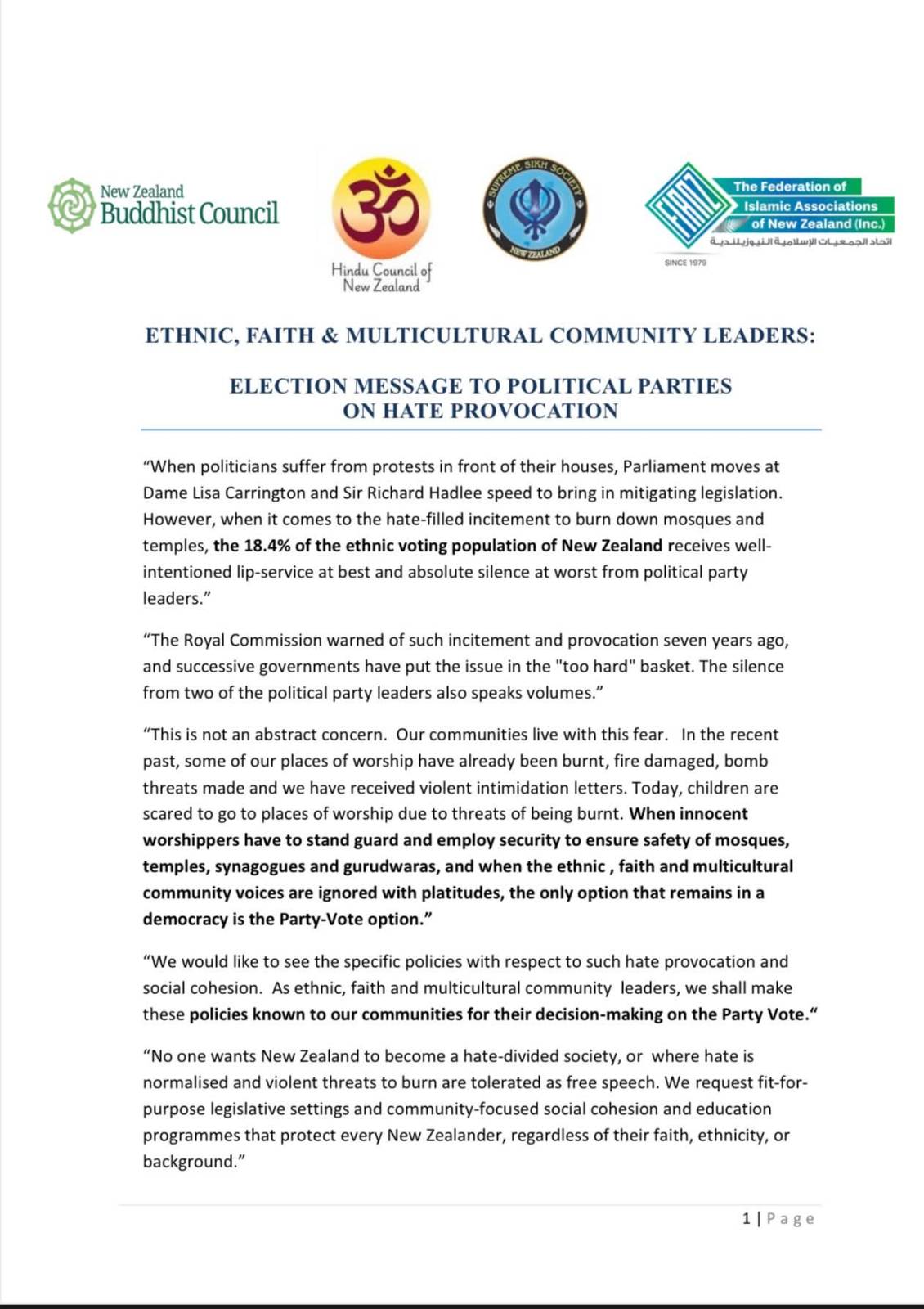
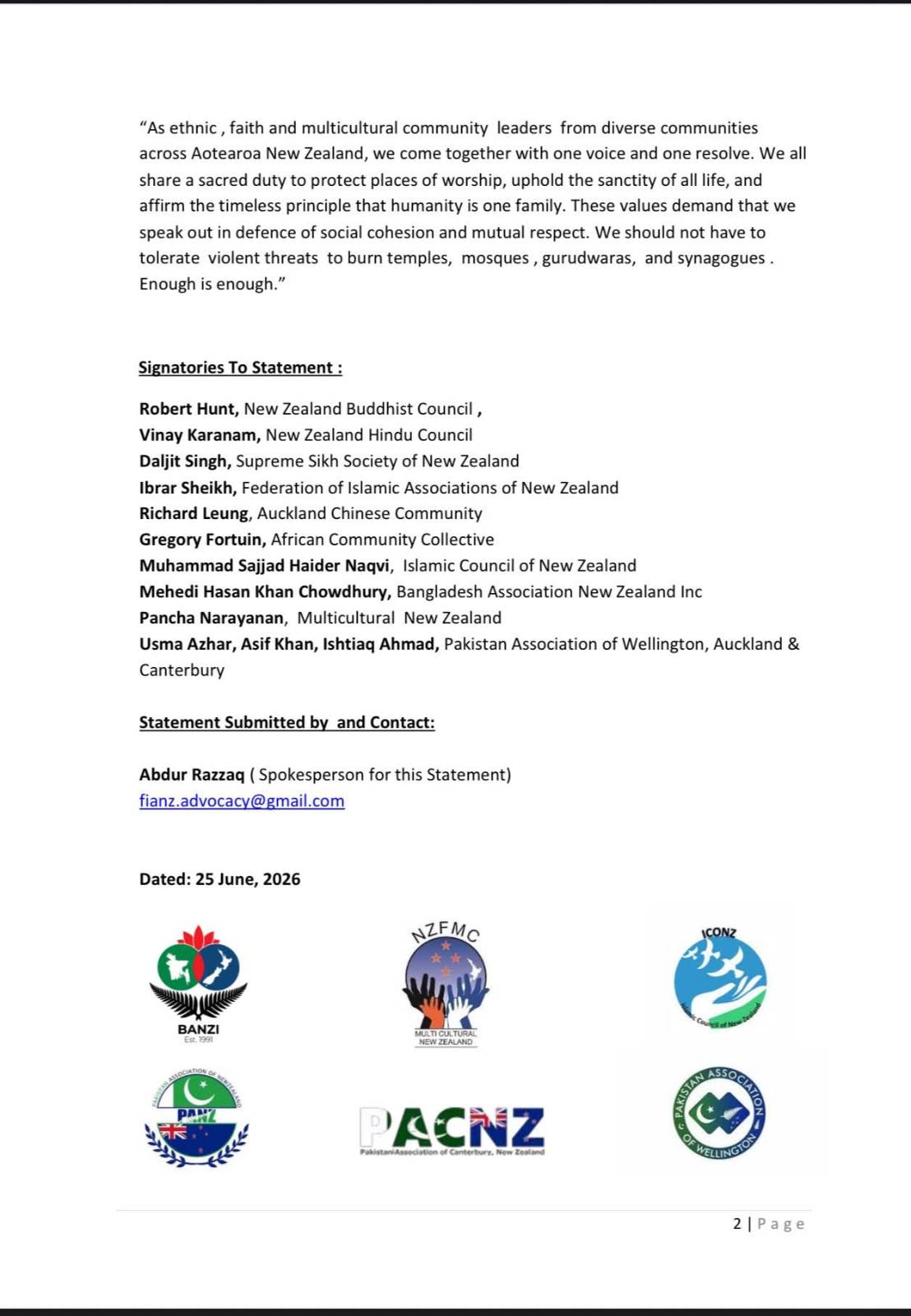
How do we resolve this then?
Again, we have said this previously.
The solution is through sustained grassroots work where we build trusting relationships in intercultural spaces (as opposed to multicultural spaces), where we bypass staid, conservative, fearful community and religious ‘leaders’ and nuance-less politicians to have difficult conversations about co-existence and social cohesion (for want of better terms). No place for Zionists, Hindu fascists or other conservative religious types.
This includes us as tauiwi bringing in tangata whenua and working within the framework of the Treaty of Waitangi. No performative nonsense.
Then there is the progressive left of Aotearoa. We all know that when the progressives do not act, when they do not show allyship and stand alongside minority communities, the extreme right-wing enters that space.
The solution is in collective solidarity. For all of us to stand together for our workers, for our trans people, for our poor, the marginalised.
Of what purpose interfaith or religious spaces when they will not support the ‘other’ while expecting government to safeguard them?
After all, how does one stop a person like Brian Tamaki when current laws do not cover his hate speech? Not from reactive outrage or asking for 105 complaints to be made
People power is how one pushes politicians to make change. That means making them see people not as mere voters but active participants in our democracy. And for us, the communities to discard those conservatives while including the margins of the margins as we move towards harmony.
They Don't See What We See. A new but old lesson in listening.
Ever since we spoke about Rakesh Naidoo and his Hindutva politics after the Labour list was dropped on 5th June 2026, there has been a deluge of ‘sceptical’ queries seeking ‘evidence’ of that politics and offering justifications as to why Rakesh would interact with fascist Hindu organisations wearing his police uniform.
It has been interesting but not surprising to see liberals and ‘inclusive’ types doubt a collective of Indians with varied lived experience of Hindutva in India and Aotearoa, working at grassroots level, developing safe and trusting relationships with our people (and other vulnerable South Asians), meticulously documenting and archiving this fascism on this whenua.
Those who forget the simple acts of listening and showing solidarity.
Because why would anyone call out a high-ranking police officer guaranteed to become an MP for his Hindutva politics just as a joke?
The issue here is that it is not Indians or other South Asians who doubted us but the non-Indians and non-South Asians. Yeah, because they know ‘non-Hindutva’ Indians and South Asians who have worked with Rakesh Naidoo who do not think he is a Hindu fascist. So why have these ‘non-Hindutva’ Indians and South Asians not publicly supported Rakesh? Surely there is no risk for their whanau back home in championing a high-ranking police officer/politician here is there? Not like those vulnerable Indian minorities particularly Muslims whose families have been threatened and intimidated and therefore who cannot raise concerns about Rakesh publicly. So let us see these ‘non-Hindutva’ Indians who deny Rakesh Naidoo’s Hindutva politics.
The issue also is when liberal and ‘inclusive’ types forget about the silenced marginalised and then turn around to reprimand them if they dare to raise their head one way or another. Show us the evidence, never mind your lived experience.
We stand by what we say and here is a 101 breakdown why Rakesh Naidoo attending Hindutva events in his police uniform under the guise of his ‘job’ is a dangerous problem.
1-Let us assume Rakesh attended Hindutva events over multiple years without knowing their fascist roots. Innocent Rakesh. Imagine a police officer in charge of ethnic communities not knowing what global intelligence agencies have been sharing with each other for decades. Especially since VHP, RSS, Bajrang Dal and other Hindutva orgs from India have been off and on various terror watch lists for decades. Imagine not reading up on the histories and politics of the ethnic and faith communities you interact with. What does that say about doing a job properly?
2-Now let us assume that Rakesh knew all along about the violent Hindutva organisations whose events he attended in police uniform. And he also encouraged other police to do so. How horrifying. A police officer deliberately going into extremist spaces and behaving like it is all ka pai. Then talking about how said, on-terrorist-watchlists organisations can collaborate with the police. Why would he do that? To normalise their terror and Islamophobia? To legitimise the fascism? To blunt any potential criticism from vulnerable communities? To covertly intimidate Indian Muslims and other minorities? Because nothing says cahoots than a high-ranking police officer in uniform hobnobbing with Islamophobic Hindus.
3-But then the argument presented is, what else can Rakesh do if not go into Hindu extremist spaces because there are no other ‘Hindu spaces’. Therefore, he does not have a choice but be there. An NZ Police superintendent for ethnic communities who is so weak he cannot call out violent fundamentalist Hindu organisations but happily goes into their spaces because there is no alternative! Like, Rakesh could not initiate a secular South Asian collective space because he does not have the power to do so? What does that say about doing a job properly?
Our vulnerable Indian minorities, especially our Muslims, have already experienced men in uniform collaborate with the RSS, VHP, Bajrang Dal and their affiliates in India to bulldoze, lynch, push across the border and kill people so how would they respond to an Indian origin police officer in these spaces in Aotearoa? Be traumatised, triggered, fearful, anxious. Feel unsafe. Unable to speak because they cannot trust the police.
Now let us dwell on feelings. When we say we are afraid and angry and anxious, you ask us for evidence. These emotions do not implicate Rakesh. They are just emotions. Gut instinct, discomfort, inherently recognising hegemonic power play because we have seen this before…all meaningless for the liberals and ‘inclusive’ types. Does not translate into the tangible and acceptable. Like, sorry Rakesh in Hindu Council photos is not proof of his fascist ideology. He is just doing his job. It is a photo-op.
(Remember how the wider Muslim community kept warning about an impending harmful event but not one listened because their observations and inferences were not ‘evidence’?)
Hindutva is not black and white like white supremacy. The saffron scarves, the flags, the slogans, the forehead marking, Hindi imposition, forced vegetarianism…all come after the ideology is well established and embedded socially and in the power structures.
To understand how Hindutva functions one must know the methodologies and manifestations.
Hindutva operates at multiple levels. While there is a ‘high command’ (RSS), it is also decentralised, mobilising at grassroots level through cultural work, entering social spaces and climbing up into power structures. Hindutva strategically adapts to audiences, giving them what they want while integrating ethno-nationalism in everything. A ‘double-sidedness’. Projecting ‘a "respectable religious conservatism" to middle-class and international audiences, while concurrently promoting aggressive Hindu majoritarianism at the local level.’ (Chapter 5 in The New Experts Populist Elites and Technocratic Promises in Modi's India by Anuradha Sajjanwar.)
It is what Australian academic Felix Pal calls it ‘organisational diffusion’. Which works in three ways:
1-Creating large number of proxy organisations to ‘simultaneously appeal to multiple audiences; saying all things, at all times, to all people; greatly expanding their constituencies and resource bases into otherwise mutually exclusive audiences’.
2-Controlling reputation through ‘a switchboard mechanism, the production of diffuse interorganizational networks allows for the episodic obfuscation and revelation of interorganizational ties, enabling far-right actors to strategically distance themselves from violence and illicit activities in their networks, while also taking collective responsibility for legitimizing activities like charity or service provision.’
3-Leadership accommodation in which allows for diffusion of leadership positions.
It is within this structure that Rakesh Naidoo can operate with impunity. If you cannot discern and pick at this diffusion then you will never know. And you can recognise that diffusion only if you are immersed in it or study it deeply.
Which our liberal interrogators and their ‘non-Hindutva’ friends have not. Hence, they cannot see Rakesh’s deceptive politics or that there is a power imbalance due to which our vulnerable Indians/South Asians cannot speak up. Hence, for them, our anxieties as invalid.
We stand by what we say about Rakesh Naidoo being a Hindutva operator.
The kōrero in the South Asian community now is that if we have a Labour government then Rakesh will either be a Minister of Police or Minister for Ethnic Communities. Letting the Hindu establishment flourish and silencing our Muslims even more. There is real discomfort and nowhere to go. Labour cannot be trusted.

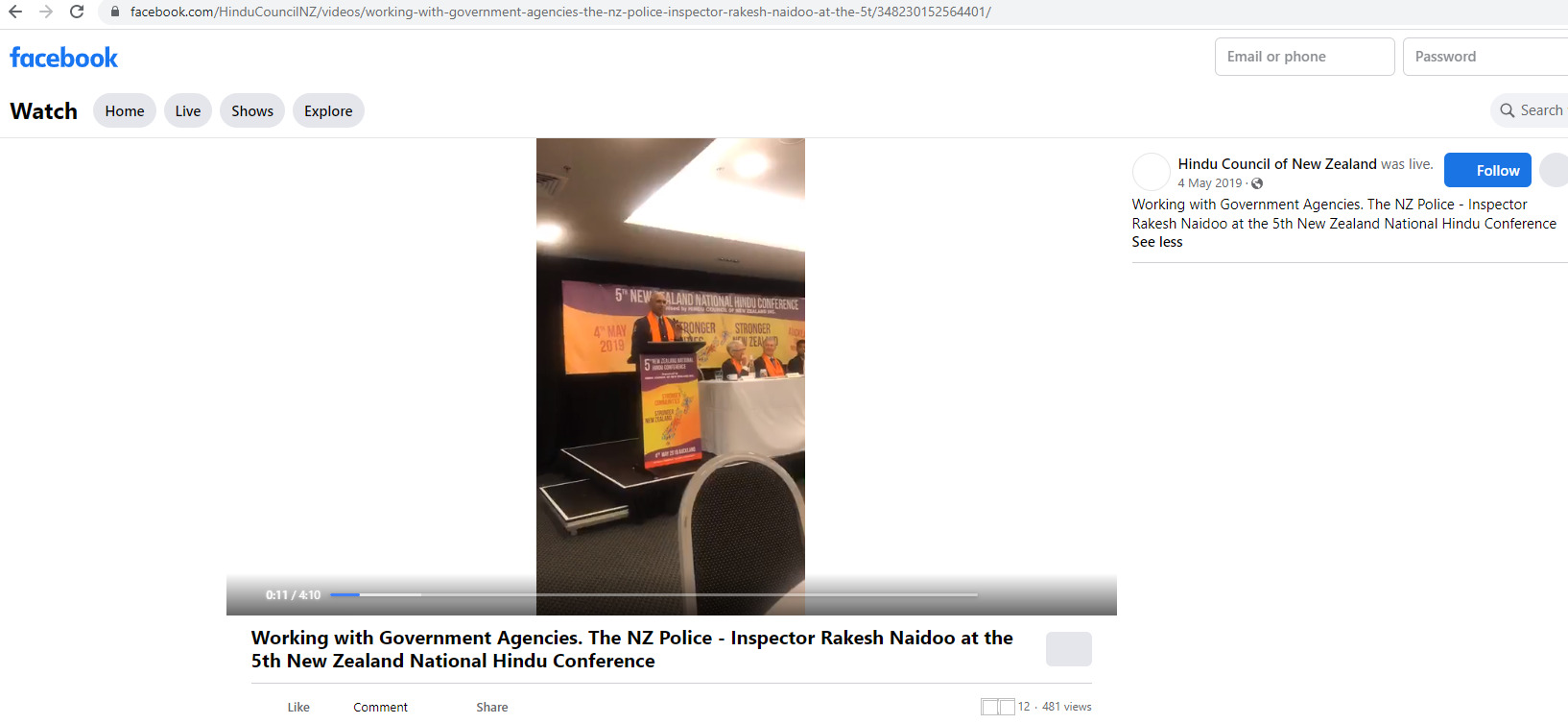
Rakesh Naidoo at the 2nd NZ Hindu Elders Conference in Wellington, October 2024.
The Delusions Of Labour Regarding Rakesh Naidoo
Last night we posted this on some of our socials: