Denying Bail To Umar And Sharjeel. A Travesty.
This was meant to be a short statement to unequivocally condemn the recent ruling from the Supreme Court of India denying bail to Umar Khalid and Sharjeel Imam after five years in prison without charge and no timeline set for a trial.
But it has turned into a blog post.
Because the formation of Aotearoa Alliance Of Progressive Indians was a response to the activism and leadership of Umar Khalid and many other members of a people’s resistance movement against Hindu fascism.
Because we must remember and never forget what happened, name those who sacrificed, those who stand tall, those who fought for justice, for the soul of India.
A progressive, prosperous, inclusive, peace-generating India benefits not just the subcontinent but South Asia and the world.

UMAR KHALID
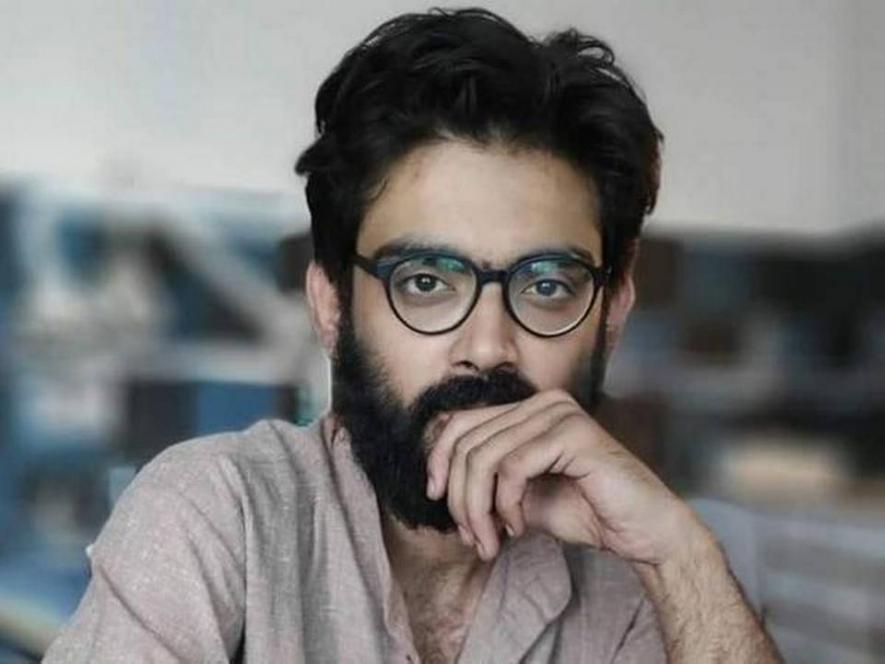 SHARJEEL IMAM
Umar was first arrested in 2016 on sedition charges for shouting ‘anti-national’ slogans at a student rally organised on the third anniversary to protest the hanging of Afzal Guru at Jawaharlal Nehru University (JNU). Three students-Kanhaiya Kumar, Umar Khalid and Anirban Bhattacharya, were alleged to have shouted anti-India slogans (disproved later) and were labelled the ‘tukde-tukde gang’, those seeking to break up India, by right-wing media. A label is now used freely then to stop any critique on democracy, government, politics, ideology…by anybody.
This post is not about Afzal Guru but you can read who he was and what he was alleged to have done in this article by Arundhati Roy instead. The hanging of Afzal Guru is a stain on India's democracy.
Or you can read her book Hanging of Afzal Guru: And the Strange Case of the Attack on the Indian Parliament
Looking back now though, both, Afzal’s story, the unknown bombers, the allegations of anti-India sloganeering, the slander of tukde-tukde gang, mocking intellectual discussions were all a precursor of the misinformation and mass hysteria Hindutva would generate over a sustained period until such time people are numbly obeisant. A prototype for the intentioned Hindu fascist dystopian India. A trial, if you will.
In August 2018, two Hindus, Naveen Dalal and Darwesh Shahpur, attempted to assassinate Umar for being an ‘anti-national’. They were arrested and immediately granted bail.
Umar by then was a PhD student at JNU with ongoing involvement in student unions and resistance movements. Always on the radar of the government of India and media.
ProtestingThe Citizenship Amendment Act (CAA).
Narendra Modi’s government introduced the Citizenship Amendment Bill in 2016 offering Indian citizenship to ‘illegal migrants’ who were religious minorities (Hindu, Sikh, Buddhist, Jain, Parsi and Christian) from Afghanistan, Bangladesh and Pakistan. This Bill was passed by the Lok Sabha (lower house) in January 2019 but lapsed with the dissolution of the 16th Lok Sabha.
The bill was re-introduced as the Citizenship Amendment Act in December 2019 and was passed in Lok Sabha and Rajya Sabha (upper house) the same month. It led to widespread protests across India and in the diaspora.
This Act essentially makes way for Indian Muslims to be made stateless through various mechanisms as well as harming other minorities. (See image of CAA, NRC, NPR handout from AAPI below.)
They first started in the North-Eastern border state of Assam and spread to Jamia Milia Islamia University in Delhi. Hundreds of police forcibly entered the campus and beat the students hunting them from libraries and toilets.
https://en.wikipedia.org/wiki/2019_Jamia_Millia_Islamia_attack
This led to more student protests across universities in India even as police brutality continued.
https://cjp.org.in/anti-caa-protests-continue-regimes-excesses-exacerbate/
It was an important moment in India where a people were standing up against the suppression of political dissent, an important part of any democracy.
However, it was when local Muslim women came together for a sit-in protest at Delhi’s Shaheen Bagh against the Jamia attack that the world noticed. Shaheen Bagh stands out as the most critical protest against CAA. Indian women have always been at the forefront of the freedom struggle, organising and agitating. But Indians have forgotten the sacrifices made by their ancestors and Shaheen Bagh showed us that even in an independent India we must never take democracy for granted; that having an elected government is not a sign of freedom; that how we treat our minorities and marginalised is a true indicator of the state of a nation. Shaheen Bagh was an intergenerational, non-violent road barricade that grew spontaneously, attracting people from everywhere with crowds growing up to 150,00 in number on some days. Bilkis Dadi (Grandmother Bilkis), the then 82-year-old matriarch who was there daily from day 1 was listed in the Times 100 for 2020 and by the BBC in their 100 inspiring and influential women the same year. Bilkis Dadi turned up at the farmers’ protest in December 2020 but was removed by the police.
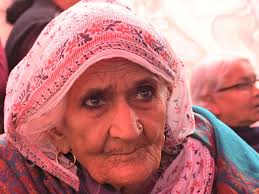
BILKIS DADI
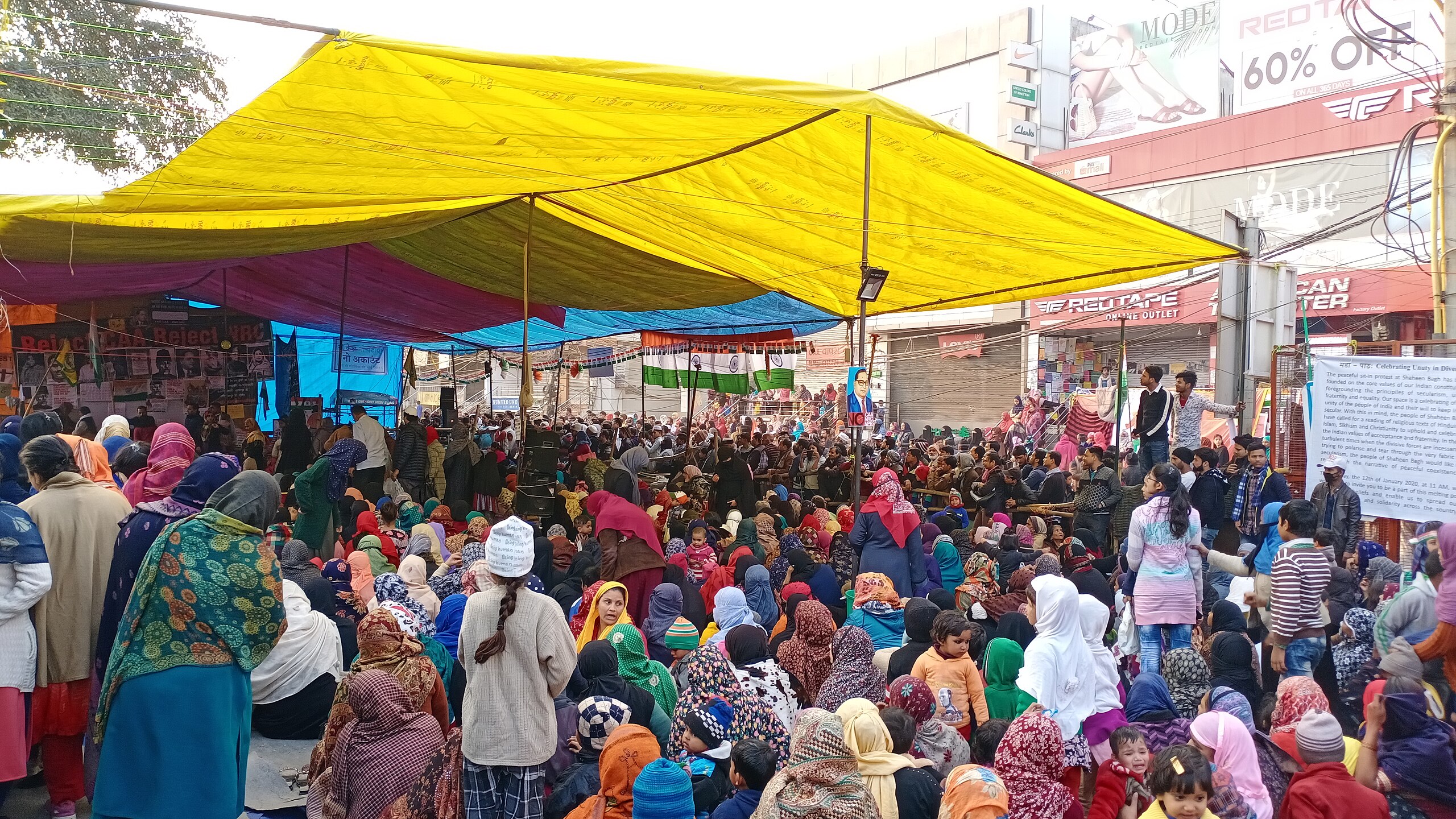

SHAHEEN BAGH ANTI-CAA SIT-IN PROTEST
The Shaheen Bagh protestors stayed put even through the riots in February 2020 despite multiple efforts to forcibly remove them by the government of India and its proxies. Until Covid-19 arrived in 2020.
Read Mapping Assertion and Belonging: Reflections on the Life of the Anti-CAA Movement in New Delhi, India to understand the significance of the Shaheen Bagh sit-in against CAA.
Delhi Riots February 2020.
On 23 February 2020, BJP ‘leader’ Kapil Mishra demanded the Delhi government forcibly remove a sit-in at Jaffrabad or he would take things in his hand. Violence erupted the same day in the North East Delhi where Shaheen Bagh is. Hindu mobs entered Muslim homes and establishments bearing saffron flags (Hindutva insignia), carrying weapons and shouting Jai Shri Ram (that David Seymour also chanted in January 2024 while attending a Hindu extremist event in Auckland). The violence continued over the next few days with destruction, gas bombing and setting fire to property. A mosque was vandalised. Delhi Police, controlled by the central government, was either hands-off or made weak attempts to control the violence. 53 people died, most of them Muslim. Meanwhile Narendra Modi hosted Donal Trump and tweeted once asking people to maintain peace.
Political prisoners.
By April 2020 the government of India started arresting Muslims charged with conspiring to or inciting the February riots under the Unlawful Activities (Prevention) Act (UAPA). A law from 1908 British era Raj that was formalised by the Indira Gandhi government in 1967 to prevent secessionist activities and subsequently tweaked over decades until it became the UAPA we know today. The current version allows the government of India to label individuals as terrorists.
As any such law anywhere, it is full of vague terminology and can be interpreted as convenient for the oppressors of the day.
- Gulfisha Fatima was the first person arrested under UAPA in April 2020.
- Then Safoora Zargar, who was 3 months pregnant at that time, in April 2020
- Meeran Haider and Shifa Ur-Rehman in April 2020.
- Sharjeel Imam in August 2020.
- Umar Khalid in September 2020.
Kapil Mishra freely continues to preach his Hindutva ideology as a BJP leader and is now a minister in the Delhi government.
Contemporary resistance movement in the Indian diaspora of Aotearoa.
On 15 December 2019 a group of Indians in Auckland organised a protest against CAA followed by a march from Jean Batten Place to Myers Park in January 2020.
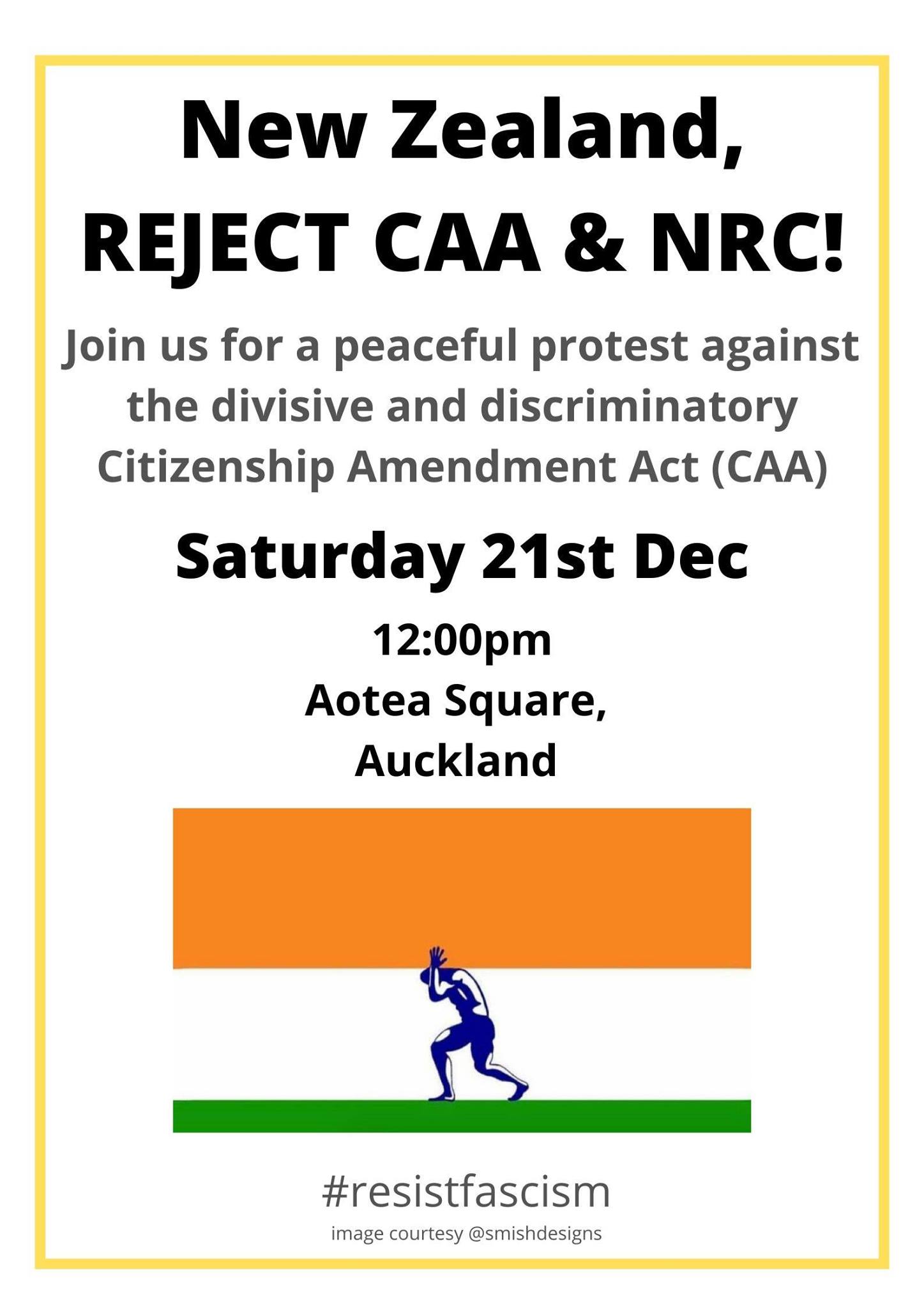
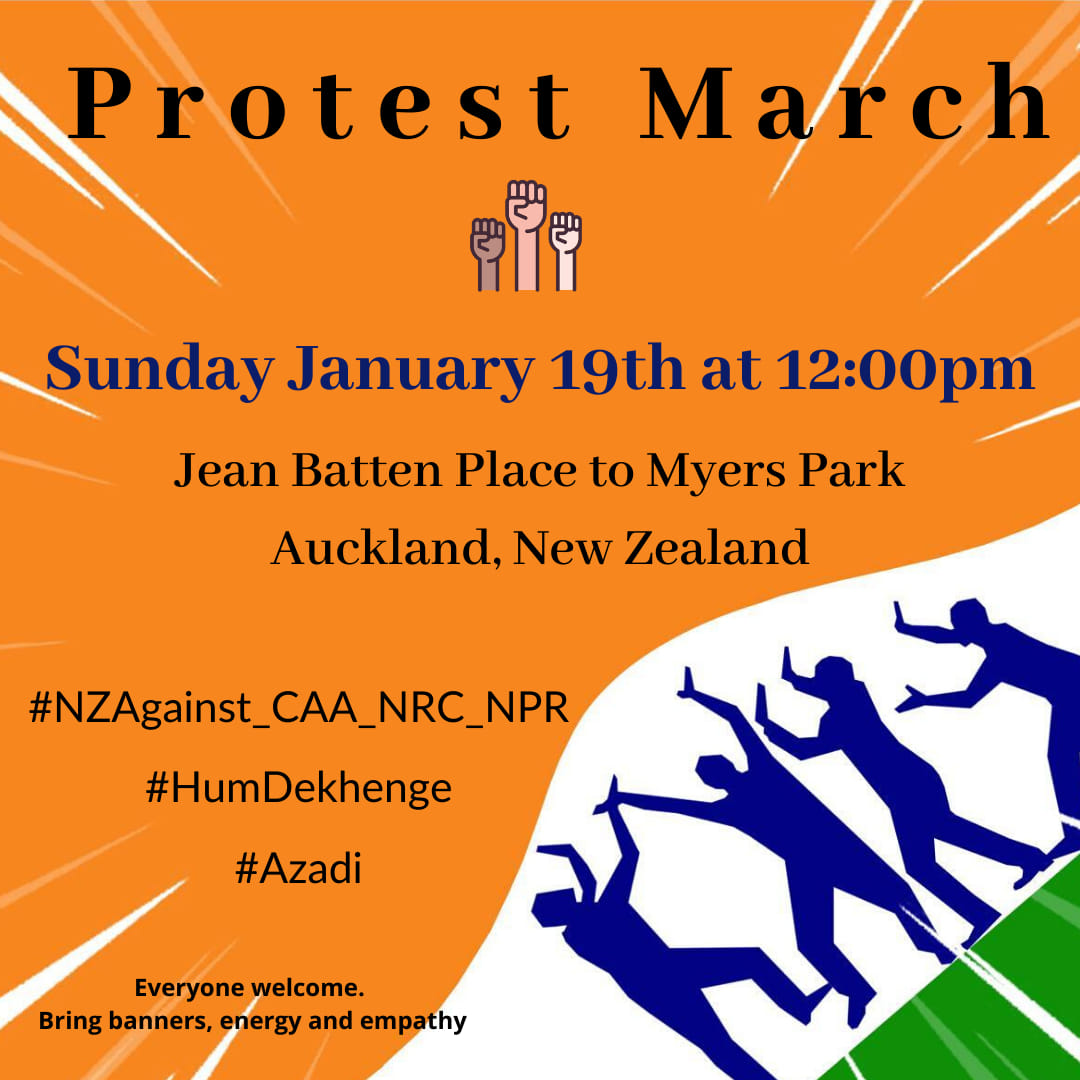
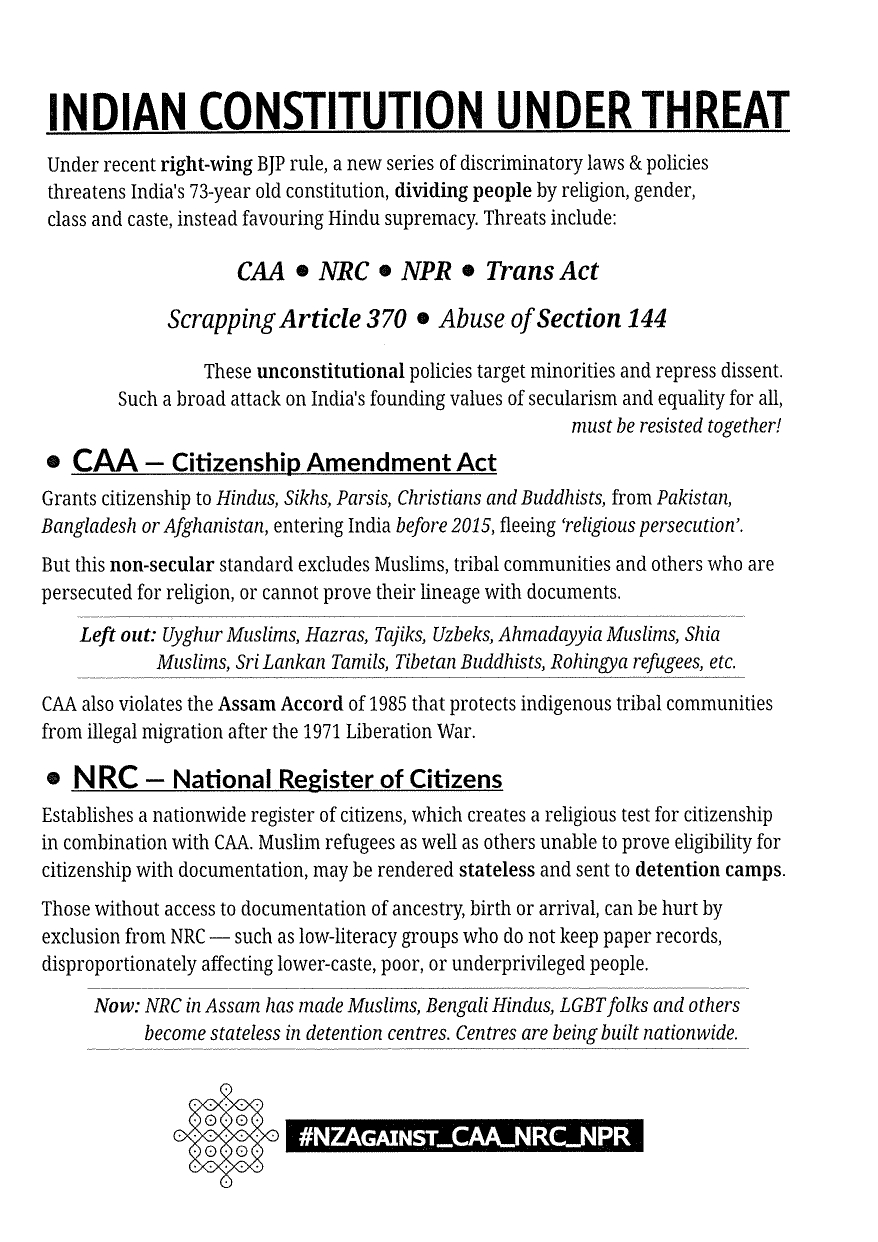
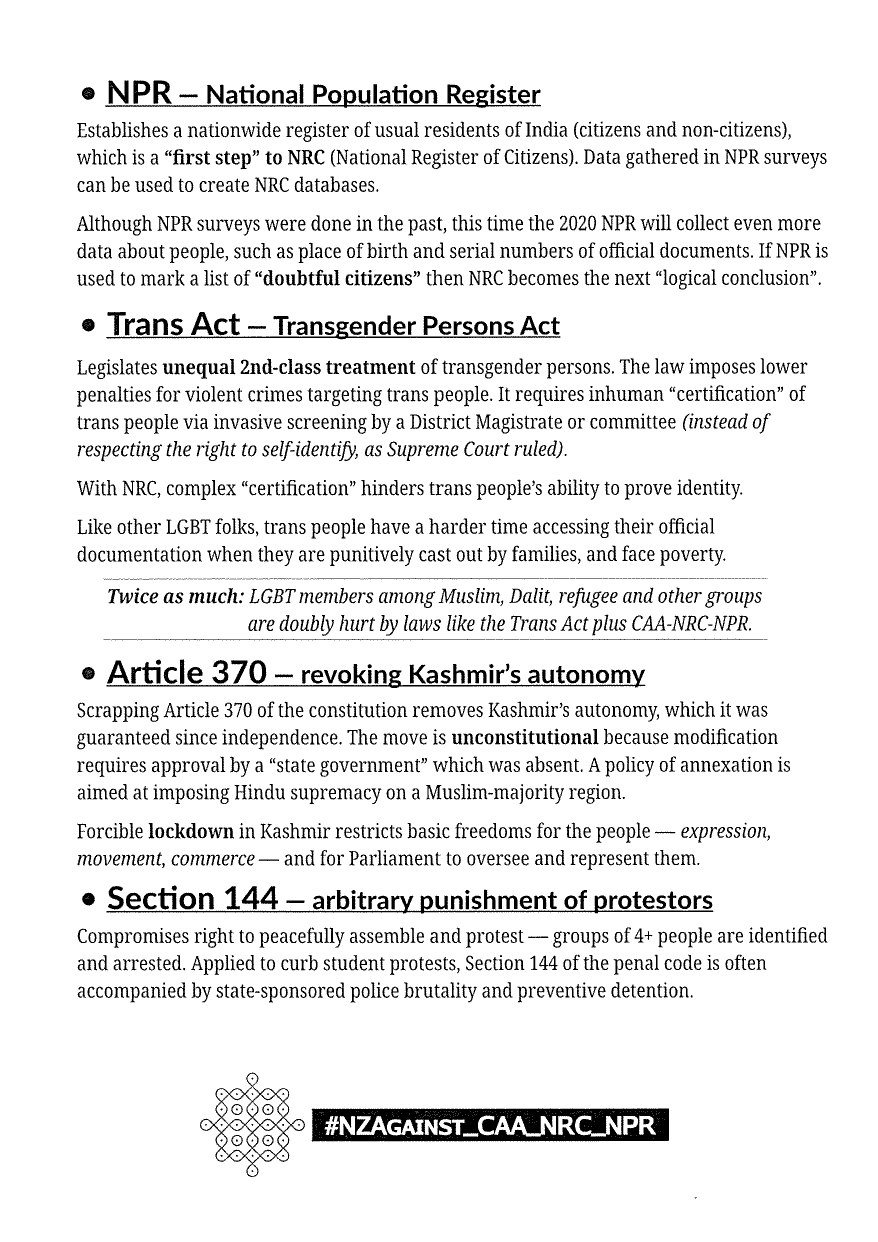
We came together again in February 2020 to highlight the riots in North East Delhi.
It is here we want to point out how long-standing Hindu patriarchs have shaped the Indian community here for the Pākeha gaze and how mainstream media in Aotearoa continues to disregard the vastness and depth of the Indian community, indulging in easy, superficial, transactional connections without reflecting on their ignorance.
And hence why resistance from our people here matters.
It was in February 2020 that Shane Jones said, to paraphrase, there were too many people from New Delhi who had immigrated to New Zealand and Indian students had ruined the country.
John Campbell interviewed Venkat Raman, editor of Indian Newslink in March 2020 about Shane Jones’s comments but not a word about the riots in Delhi and neither does the duplicitous Venkat mention CAA or the riots because Indian minorities do not matter to him unless they can be weaponised for his own benefit.
https://www.1news.co.nz/2020/03/11/shane-jones-doubles-down-on-indian-students-comment
The anti-CAA protests in India started a movement across the Indian diaspora through which we all connected with each other.
Umar and Sharjeel’s continued incarceration and refusing them bail harms all Indians. It is an indictment of the Indian judiciary, their supplication to Hindu fascists.
This decision:
(a) Not only sends a signal to Indian minorities, especially Muslims, that there is no place for them in the Hindu fascist imagining of India. That they must never stake a claim, seek ownership of or participate in progressing the nation. That they must always ‘obey’ the government.
(b) But it has wider implications for ALL Indians who question the government, who demand their democratic rights and resist oppression.
A nation that was slowly usurped by the British since they established the East Indian Company in 1600 and left it divided by drawing a random line on a map, is not only being further divided while also dismantling democratic institutions and practices. Where an opiated Hindu upper caste and socio-economic class, conservative or liberal, turns a blind eye to injustices, while weaponizing representation and anti-racism in the diaspora, or is fearful of repercussions, it normalises subjugations. One day it will be their turn.
In the words of the immortal Rahat Indori sahab (sir)
‘लगेगी आग तो आएंगे घर कई जद में, यहां पे सिर्फ हमारा मकान थोड़ी है' Many houses will burn when there is a fire, not just mine alone.
He also wrote:
|
हमारे मुंह से जो निकले वही सदाक़त है
जो आज साहिब-ए-मसनंद है , कल नही होगे किरायेदार है ज़ाती मकान थोड़े है.. सभी का खून है शामिल यहा की मिट्टी मे किसी के बाप का हिन्दुस्तान थोड़ी है..
|
My mouth speaks the truth It is not your tongue in my mouth Those who sit on the throne today will not be there tomorrow They are mere tenants, not owners Everyone’s blood is in this country’s soil
Hindustan/India does not belong to any one person.
|
We conclude with a few words from Aamir Aziz's poem सब याद रखा जाएगा We will remember everything.
|
तुम जेल में डालो, हम दीवार फांद लिखेंगे तुम FIR लिखो, हम तैयार लिखेंगे तुम हमें कत्ल कर दो, हम बनके भूत लिखेंगे, तुम्हारी कत्ल के सारे सबूत लिखेंगे तुम अदालतों से बैठकर चुटकुले लिखो हम सड़कों, दीवारों पर इंसाफ लिखेंगे बहरे भी सुन लें, इतनी जोर से बोलेंगे अंधे भी पढ़ लें, इतना साफ लिखेंगे तुम काला कमल लिखो हम लाल गुलाब लिखेंगे तुम जमीं पर जुल्म लिख दो आसमां पर इंकलाब लिखा जाएगा सब याद रखा जाएगा सब कुछ याद रखा जाएगा |
Put us in prison, we will jump over the walls and still write Lodge a police complaint against us we will write we are ready to face you Murder us we will write as ghosts. Providing evidence about all those you killed While you write jokes in court and we will paint justice on the streets and walls We will shout so loud the deaf can hear us, we will write so clear the blind can read us You write black lotus we write red rose You may oppress us on this earth but we will write revolution in the sky We will remember everything We will remember every single thing |
The Dangers Of Superficiality And Extraction (or Academics That Parachute).
This post is a response to an academic paper Inter-ethnic Racisms in Aotearoa:A Study of South Asian Communities in New Zealand by Cayathri Divakalala and Rachel Simon-Kumar that was sent to us.
(Click on the link above in bright pink to read the paper and our detailed comments.)
Aotearoa Alliance of Progressive Indians (AAPI) has been resisting discrimination in the Indian diaspora of Aotearoa for more than five years now. We are a loose, informal collective of diverse people with Indian whakapapa who resist Hindutva, the Hindu fascist ideology and its multiple avatars, in different ways. Our kaupapapa also includes documenting the discrimination, Hindu fascist methodologies, the people and their organisations. We call out government/political inertia and endeavour to educate mainstream society. Our activists cut across class, caste, religion, region, language and gender.
That is why an academic research paper analysing discriminations in South Asian communities is of interest to us and we shared it with our activists for feedback. Does this paper reflect the issues in our communities? Are there any solutions?
The verdict was unanimous. This is a shoddy piece of academic research. We had to respond. Because we know this paper will be sent to various ministries, government agencies and councils who, being the Pākeha organisations they are, will take it seriously, without thinking hence further harming our communities. After all this research was funded by MBIE, the ministry of business, innovation and enterprise.
Before we start we want the readers to know that a core AAPI principle is to ensure that our marginalised people who must be able to express their concerns while staying safe. Hence our posts are often under the broad APPI name as this one is.
We will enumerate the issues rather than elaborate because we are not academics and we do not have the capacity to counter-argue. However, we urge the readers to click on the link above to see the pdf file with comments from our activists some of whom have clearly lost patience by the end of it.
The paper talks about South Asian communities but fails to correctly define the region, then focuses only on the diaspora of the subcontinent before inserting an Afghan just for the purpose of manipulating the quantitative data. The authors conflate South Asia and the subcontinent constantly. The sample size is also too small and does not give us a breakdown of the whakapapa of the participants.
- We know through our various protests and activist mahi that neither Rachel Simon-Kumar nor Cayathri Divakalala have ever shown any interest in what discrimination is at the grassroots level. No relationship building, no developing trust, no humility or listening to the people. Cayathri has researched South Asian queer communities through Adhikaar Aotearoa that she co-founded but the Adhikar Report from 2022 does not define South Asia or talk about the intersection of Hindutva, caste, class, language, region or religion. You can be queer, casteist and exclusionary. Like Indian Origin Pride which is made up of upper caste Hindus that have never put their bodies on the line for rainbow struggles, never shown solidarity with any queer resistance and yet benefit from legislations like marriage equality in Aotearoa.
- Both authors are dangerously ignorant about ‘Khalistan’. We put this in quote marks because they needed to go back to the 1970s and early 1980s Punjab, know about Operation Bluestar, know about the assassination of Indira Gandhi, the subsequent Sikh pogrom and the recent farmers protests in India resisting the Modi government’s farm acts before making a statement like: “The recent resurgence of the Khalistani separatist movement within parts of the Sikh diaspora has exacerbated tensions with Hindu communities.” These words are incredibly harmful. First, there is no resurgence of the Khalistani separatist movement. This was a bogeyman created by Hindutva adherents to attack protesting farmers and label them terrorists. Second, the tension was created by Hindu extremists to generate fear. Do not brush the ‘Hindu community’ as a monolith.
Our advice to the authors-educate yourself on Indian history and contemporary socio-political issues. Simply attending Indian community protests in support of the farmers here in Aotearoa would have enlightened you. Your illiteracy is irresponsible and perpetuates violence against the Sikh community.
- Let’s talk about Hindutva. This deserves a book-about how privileged academics talk about ‘inter-ethnic racisms’ without naming the poison! These authors fail to define Hindutva and how it manifests even as they quote Sneha Singh talking about Hindutva’s chameleon-like abilities to transform. The Rashtriya Swayamsevak Sangh (RSS), the mothership of Hindutva, celebrates a century of existence this year 2025! And we have an Indian academic, Rachel Simon-Kumar, researching ethnic communities stay mum. Is she afraid or does not care because it apparently does not affect her? Or, is it that delving into Hindutva will affect her funding opportunities and access to the 'community leaders' with whom she works? Real community work is about naming those that harm people. Not beat around the bush. No kudos in that. It is a sign of weakness. And ego. The Pākeha at whom this research is aimed will not ask about it. They never do. That is why we have taxpayer funded vegetarian only public Diwali events under the name of multiculturalism. Rachel does disservice to our people with her deliberate omission about Hindutva. But if you talk about the racism in the community the community will ask about Hindutva.
Our suggestion to the authors-name Hindutva. One cannot do research on racism/discrimination/tensions within subcontinental communities without talking about Hindutva. What it is, the people who propagate this in Aotearoa, their organisations and the multiple avatars. Hindutva is a global threat. It works with white supremacy and Zionism. Hindutva actively harms our minority communities and even those Hindus who stand up against it. Hindutva erases pluralism. Therefore, it is ironic the authors use buzz words like diversity, inclusion, social cohesion etc while participating in the erasure themselves.
- Then we come to caste. Any Indian and/or subcontinental academic who works in this area will know to begin by talking about their location in the caste hierarchy and their position on it. We wish to emphasise here that even non-Hindu Indians practice caste discrimination and anyone saying they don’t know their caste are very privileged. Anyone who says they do not need to reveal their position are using their privilege to extract from the caste oppressed. (That these authors use the term ‘low caste’ rather than caste oppressed is evidence enough of their lack of engagement and knowledge, rather their caste privilege.) We ask, what is the authors’ location and positionality? Otherwise, this mahi is a mere superficial exercise to gain currency around activist work and grassroots resistance grounded in the oppressed communities. It is obvious the authors have not done any work on caste. Or BR Ambedkar would be central to this paper. It is Brahmanical/upper caste behaviour where one takes for granted their privilege such that they parachute into a community and take away what they think is enough to use for themselves.
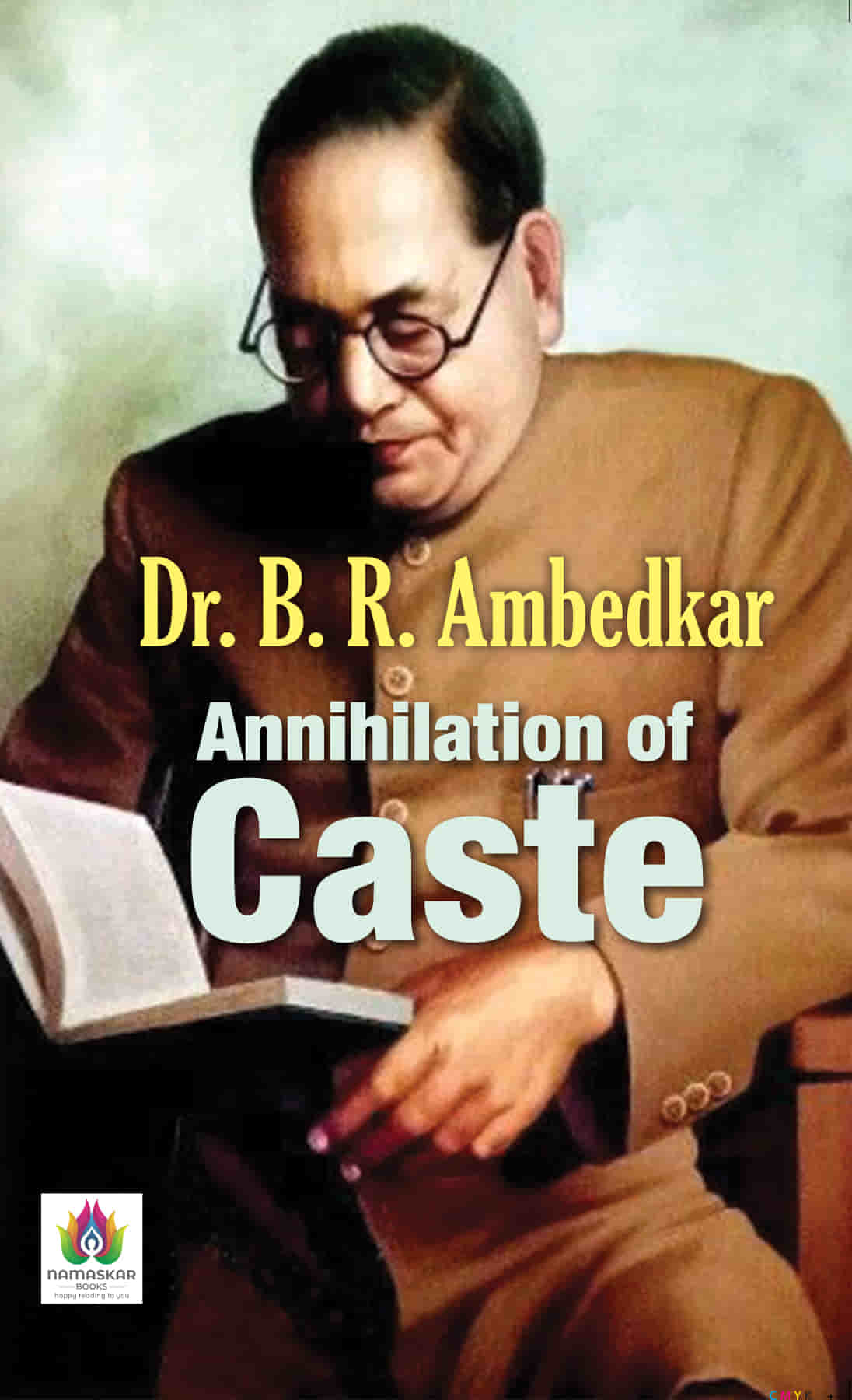
Our recommendations to the authors: Learn from Māori and Pasifika academics. Embed yourself in the community, check your class, caste and other privileges, de-centre yourself, be humble, build trusting relationships, listen to the minorities and marginalised, ensure their safety first only then endeavour to write. We suggest looking up American sociologist Gail Omvedt although you should already know her work since you are writing about caste and racisms. Be like Gail.
Finally, while we agree that there must be more Tiriti education and connections with tangata whenua to create belonging and potentially reduce racisms, just saying that is not a solution per se. The solution is to find ways to do that, which you failed to ask your respondents. How do we develop community led solidarities with each other and to resist colonial forces?
We are shocked that this research paper, that we would potentially mark as a D, was even published. That the advisor esteemed professor emeritus Sekhar Bandyopadhaya approved it. That Jennifer Janif perhaps lacks critical insight, and the third advisor is a government person stooge (so their opinion does not matter).
We are however not shocked that mischief monger patriarch Venkatraman published it on his platform Indian Newslink or that the authors, all the while talking about intra-ethnic racisms, were agreeable for one of our senior most racists to appropriate it. That entails another post though. Coming soon.
Recommended readings for those interested:
1. Annihilation of Caste by BR Ambedkar
2. https://tif.ssrc.org/2022/10/19/hindutva-appropriations-of-indigeneity/
3. https://www.nationthailand.com/blogs/more/commentary/40031317
4. Girmitiyas by Brij V Lal
5-The novel Train To Pakistan by Khushwant Singh
HINDU EXTREMISM BY FAUX FEMINISM. AN EXERCISE IN STEALTH AND CULTURAL COLONISATION.
The High Commission of India is hosting the first Hindu women conference today, 20 September 2025.
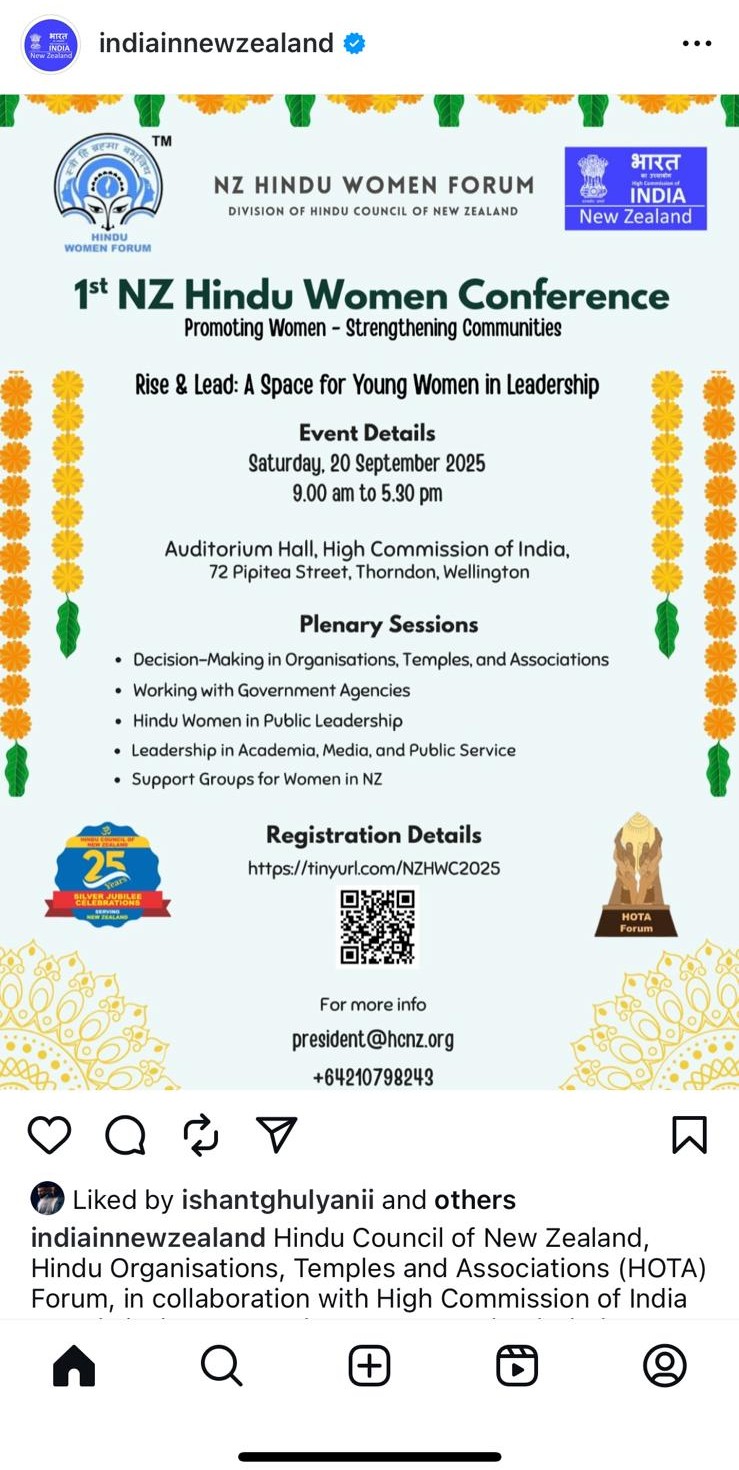
This should worry all. Not just Indians in Aotearoa but everyone. While it might appear to be a benign multicultural event aimed to uplift and empower Indian women in Aotearoa, i.e. women of colour, the image clearly informs us that is a gathering of upper caste Hindu women within the umbrella of the Hindu Council of New Zealand and HOTA, Hindu Organisations, Temples and Associations. We have written extensively about the Hindu Council and that it is the Vishwa Hindu Parishad, deemed a Hindu terrorist group https://fatfplatform.org/assets/India-shields-Hindutva-terror-groups.pdf
HOTA is just another extension of the same. https://hotaforumnz.org/ We recommend the reader gets familiar with the symbols and language of Hindu extremists. They all exist in Aotearoa.
The feminist aspirations of this Hindu Women Conference then are just a carrot to dangle in front of the horse of multiculturalism, the Pākeha liberals use to showcase Aotearoa as an inclusive country.
We want to remind all Indian women here, and those that do not know the feminist history of India, Brahmin women can get a formal education today because of Savitribai Phule, a Dalit woman, a caste-oppressed woman who started the first girl’s school in India.
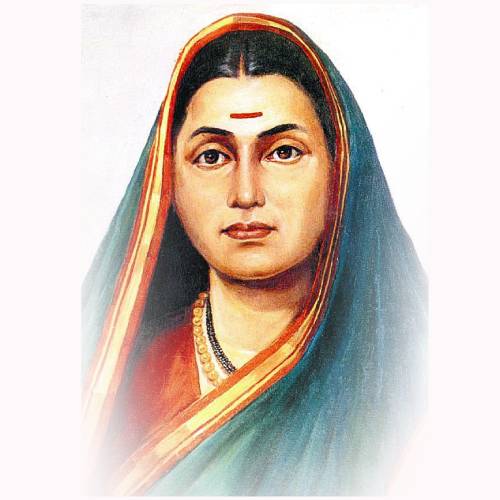 Image from Savitribai Phule Shikshan Mandal
So, for upper caste Hindu women to talk about leadership within the framework of Hindutva is not feminism. It is about their role in perpetuating the patriarchy and maintain their own hierarchy.
These women want to talk about decision making in temples but have likely forgotten that when the Supreme Court of India permitted menstruating women in the Sabarimala Temple, it was the same conservative groups that protested and rioted. https://www.weforum.org/stories/2019/01/an-indian-temple-s-ban-on-women-of-menstruating-age-is-finally-breached/
A shame the High Commission of India has forgotten its role as a diplomatic mission and as support for ALL Indians. Instead hosting Hindu extremists and their terrorist organisations at the cost of making our minorities here feel unsafe.
There is another reason though. Having such an event in camera perhaps, allows the organisers to control the narrative.
Upper caste Hindu women are always taught to fear Muslim men. This conference is made for that. And one cannot talk about such issues if the attendees are not the already converted. Or politicians who think they are attending a multicultural-women-of-colour event.
We state here that all women are unsafe from Hindutva men, the Hindu trads https://www.bbc.com/news/av/stories-61610891 with their inherent violence and misogyny. In person and online.
Recently one of our activists Dr. Sapna Samant had Indian male trolls attack her for commenting on a story about the upcoming Auckland Diwali event.
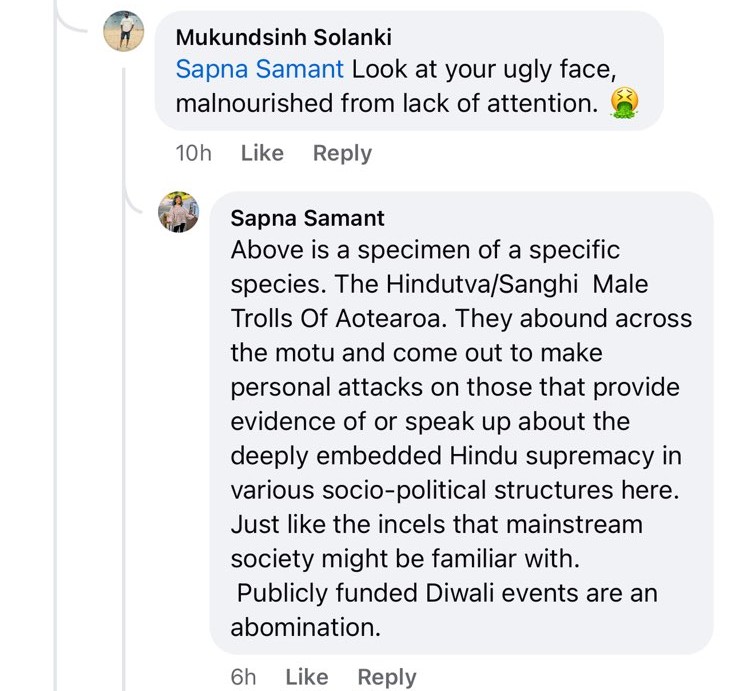
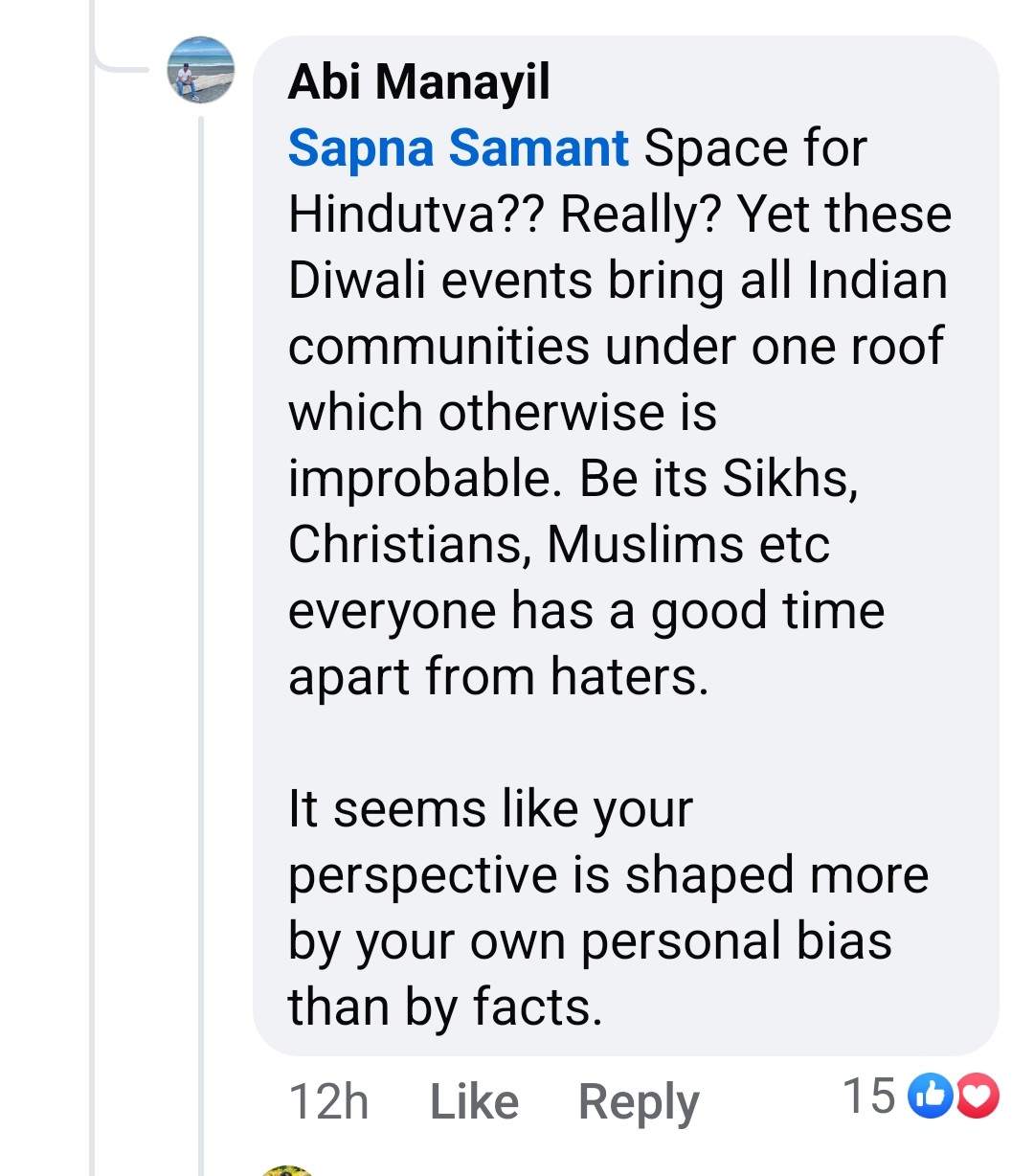
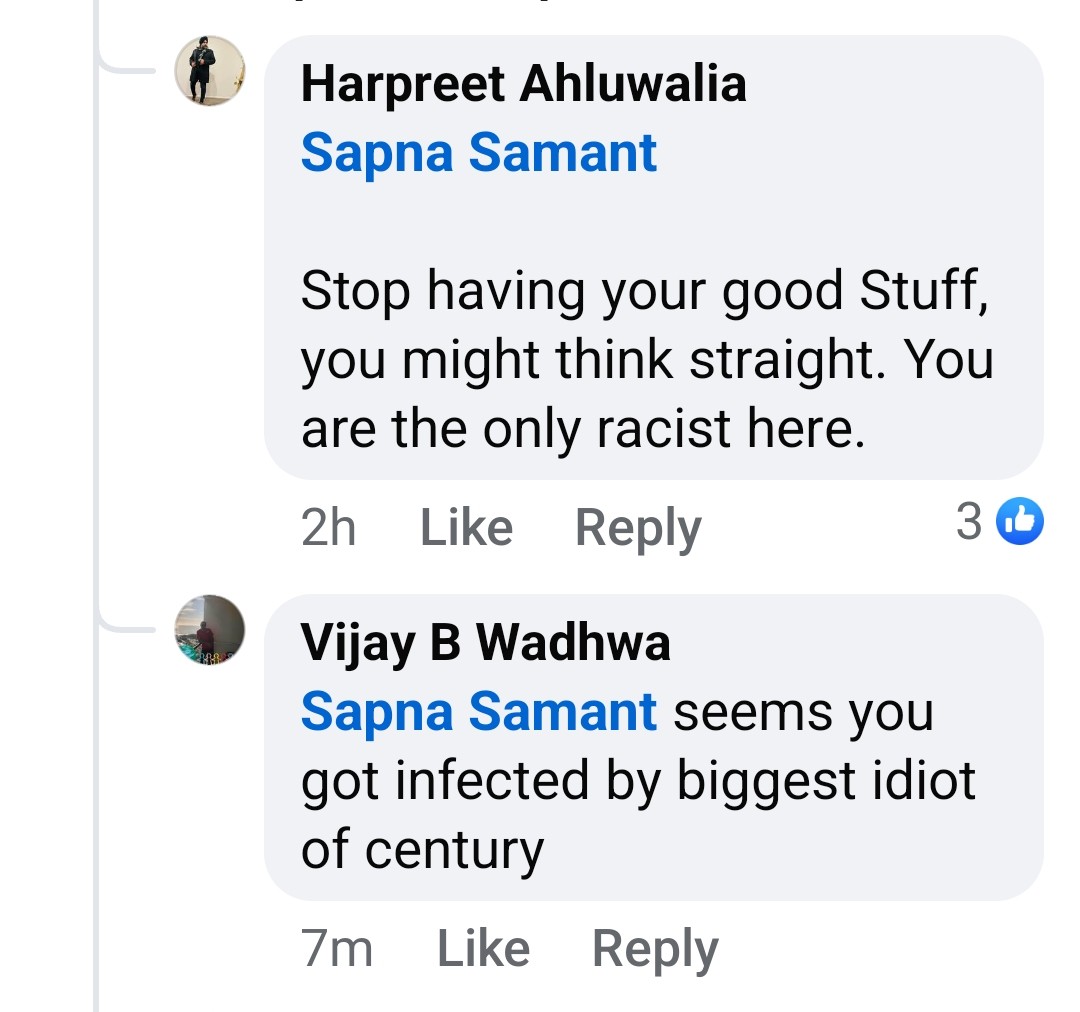
We write this first, but it is likely the mainstream will hear of this from RNZ’s IndoNZ journalists where it is framed as a multicultural event with all traces of Hindutva removed. And legitmised by a politician or two.
We also post here a link to Professor Mohan Dutta’s white paper Cultural Hindutva and Islamophobia that we suggest the readers visit/revisit to know and understand how Hindutva works to be culturally acceptable in Aotearoa.
In Solidarity With Migrant Nurses.
Aotearoa Alliance Of Progressive Indians strongly condemns Te Whatu Ora Health NZ, Waikato and Palmerston North Hospitals’ communique, demanding that migrant nurses use only English at all times in the hospital.
This directive imposing English is a continuation of the ongoing systemic and individual racism that exists in the colonial institutions of Aotearoa New Zealand.
Prior to the 2023 general elections, the National party leader Christopher Luxon promised New Zealanders ‘ National will deliver more nurses and Midwives’ to address severe shortage ‘contributing to ballooning waitlists, delays accessing treatment or maternity care, and overcrowded emergency departments.’
Instead this government has consciously and deliberately reduced funding in the health sector in the name of austerity. Targeting migrant nurses and health care workers is part of the strategy to ultimately hold them responsible for Te Whatu Ora Health NZ’s alleged ‘budget blowout’.
A week ago, various media outlets reported how Te Whatu Ora Health NZ blamed a forecast of $ 1.7 bn deficit on over recruiting of nursing staff. Te Whatu Ora’s Commissioner Professor Lester Levy told RNZ Morning Report on October 8th 2024 that ‘ Te Whatu Ora was employing 3000 more nurses than it had budgeted for’ and ‘that was part of the financial problem’. He attributed the number of nurses on ‘fruitful international recruitment and a previous lack of internal oversight’.
NZ Herald reported on October 8th 2024 of a briefing from Te Whatu Ora Chief Executive Margie Apa to Health Minister Dr Shane Reti on June 7th which warned 'substantial increases in nurses employed by Health New Zealand' in 2023/24 financial year meant ‘little to no growth is affordable for 2024/25 and in some areas reductions will be needed’. RNZ reported Margie Apa saying low staff turnover as one reason for over-expenditure.
It seems the reproaching these fruitfully recruited international nurses who will not leave their job is an easier way to distract from an incompetent government, minister of health, commissioner and chief executive.
The health staff at Thames hospital and Waikato hospital conducted protests in July and August 2024 respectively due to concerns of dire shortage of nurses and other frontline health workers. However instead of listening to their fears about unsafe staffing the leadership of Te Whatu Ora prefers to vilify migrant nurses for its financial woes.
The nefarious attempts to divide a work force based on identity and language is a classic colonial tactic of ‘divide and rule’ imperialism. By creating an ‘us and them’ among nurses Te Whatu Ora Health NZ wants to break the morale and unity of nurses.
Instead of these diversion tactics, the coalition government should fulfill the pre-election promise of more staff, better safety and not-so-crowded emergency rooms by increasing funding to our health sector not bleeding it.
AAPI stands in complete solidarity with the nursing workforce and urges Te Whatu Ora Health NZ to give an unconditional apology to our migrant nurses.
Fact checking Aotearoa Hindu fascist denials and obfuscations
Last week TVNZ did a piece on the general elections in India :
in which all that Mr Vinod Kumar of the Hindu Council of NZ and Murali Magesan of Hindu Youth said must be challenged.
One of our activists made a slide show looking at how Hindutva flourishes in Aotearoa that we disseminated across our social media platforms including Instagram.

We ask Murali why he even entertains the idea that academics would engage with Hindu fascists when they have not only jailed academics in India but openly threaten and undermine them across the world? Does he not know how Hindu fascists terrorised academics participating in the Dismantling Global Hindutva Conference in 2021? One tactic of Hindu fascists is to bully their opponents into submission. (We recommend reading the experience of Sapna Samant on our blog.) Has he never heard of GN Saibaba, a disabled academic who was recently released from prison where he was held for ten years for alleged links to the banned Communist Party of India (Maoist). GN Saibaba was acquitted by the Nagpur bench of the Mumbai High Court? Perhaps he knows the names Shoma Sen, Hany Babu, Anand Teltumbde, all academics who were arrested and held on fake charges with thirteen others in the Bhima Koregaon violence of 2018? Perhaps Murali should do some reading although it might be a bit too much to expect that. After all Bhima Koregaon was where the Dalits defeated the Peshwa's army, the Brahmins, the oppressors, in 1818. So telling a Pakeha journalist with faux innocence that them Hindus invite academics to talk to them, trying to show how he (and Hindu Youth) are inclusive would not even win a Razzie.
Then we have Vinod Kumar who openly acknowledges the presence of the Hindu Swayamsevak Sangh in Aotearoa New Zealand(HSSNZ). We reiterate here that HSSNZ is the diaspora avatar of the Rashtriya Swayamsevak Sangh (RSS), the mothership of Hindutva. HSSNZ has 7 'chapters' across the country indoctrinating young minds with Islamophobia and a warped sense of 'Hindu' history in the name of culture.
But then Mr Kumar has the gall to deny Hindu fascist violence against Muslims and Christians in India.
Professor Mohan Dutta counters the falsehoods against Christians: here and Muslims: here
If you go the TVNZ Q and A segment at the top of this post you will see many Hindu fascists commenting with 'Hindu pride' blind and oblivious to how Hindu nationalism not only harms all Indians but the world. Hindus themselves, those know the pluralism but also deeply understand the need to dismantle caste and misogyny, are in danger from Hindutva.
Professor Dutta speaks about Hindu pride here
Democratic Elections Or Erasing Democracy?
The Indian general elections, to choose 543 members to the lower house (Lok Sabha) of the parliament are set to commence on April 19th 2024 and scheduled in seven phases until 1st June. It is the largest democratic exercise of world, with more than 970 million eligible voters. The 2019 Indian general elections witnessed a voter turnout of 67% from 912 million eligible voters, and a record in women’s participation with 67.18% (298 million). The Hindu nationalist Bharatiya Janata Party (BJP) of incumbent Prime Minister Narendra Modi, led coalition National Democratic Alliance (NDA) secured 45 percent of total votes, 353 parliament seats and a second term in government. Narendra Modi’s BJP emerged as the single largest part in parliament with 37.30 percent votes and 303 MPs. Under the neoliberal, ultra nationalist rule of BJP, India has slid backwards in all indices of democracy-from suppression of freedom and expression to unlawful imprisonment of dissenting activists, students, journalists and politicians.
Fast forward to 2024, the world’s largest democracy is set for another general elections, with Modi and his Hindu nationalist party aiming for an easy win for third term, and a more unified coalition of opposition parties (INDIA Alliance), in their do or die effort to stop BJP returning to power. All opinion polls published by corporate owned media houses of India are predicting BJP, a landslide victory. However, India, with its complex and diverse domestic politics, has a track record of post-election results that often contradict pre-poll surveys.
Everything is not in favor of Modi, and BJP as portrayed by the mainstream media for the following reasons.
- Anti-incumbency factor towards a government in power for the last ten years, who cannot tackle rising unemployment rates, and post covid cost of living. The BJP have already denied seats for 63 of its current MPs (21% of total MPs), to mitigate the anti-incumbency sentiments. The party have so far only published a list of 265 candidates, and number of current MPs going to lose their seats is likely to go further up.
- All sectors of society including workers, farmers, women, youth and small t medium businesses have suffered from the pro-corporate policies of this BJP government. The massive farmer protests, youth protests, controversial Agnipath scheme of temporary recruitment to armed forces, and protests by women wrestlers have caused serious damage to BJP’s ambition of a third term in government.
- The discriminatory citizenship law CAA, and pogrom of Indigenous Christians in the BJP ruled state of Manipur, have wreaked havoc in the consciousness minorities, and pro-democratic secular masses, who are expected to poll in large numbers against BJP.
- The NDA alliance led by BJP is cracked and weakened with multiple parties leaving the coalition due to the authoritarian approach of BJP leadership.
- Giving a huge set back to NDA, after the BJP broke the Shiv Sena, the second largest party in the coalition, into two factions in the state of Maharashtra in 2022 to subvert the democratic process and form its own majority state government there, the Uddhav Thakeray faction of the Shiv Sena joined the opposition Indian National Developmental Inclusive Alliance (INDA Alliance). This faction of the Shiv Sena will put up a tough fight in the state of Maharastra, where NDA won 41 parliament seats in 2019.
- Other minor parties like Shiromani Akali Dal (SAD), All India Dravida Munnetta Kazhagam (AIDMK), have also left the coalition.
- The most recent Electoral Bond scam have put BJP under pressure, that its main funding sources including controversial mining corporations, and big businesses who were on the radar of various investigation agencies, got clean chit after they donated BJP.
What potentially favours Modi?
- Domination in owned mainstream media, and social media spaces, helps the party to set nationalistic narratives and shape public opinion.
- Implementation of communal and divisive policies like CAA, abrogation of Article 370 of Indian constitution that ensured semi-autonomous status for the Muslim majority state of Jammu & Kashmir, and consecration of Ram temple on the site of Babri Masjid mosque demolition, have placed Modi as the undisputed Führer of Hindu nationalists.
- Another narrative of Modi is that India is set to become a global superpower under the leadership of Modi, also supported by both India and western capitalists whom Modi offers unchecked access of resources of India, by weakening environment and employment laws.
- Being a favorite of Western neoliberal governments, Modi and BJP gets enormous support from leaders like Anthony Albanese in 2023, praised ‘Modi is the Boss’ in front of a hyper nationalist Indian crowd in Sydney, and Joe Biden who hosted a white house state dinner for Modi.
- BJP, with its gigantic corporate funding, continues to have unimaginable upper hand in campaign trail by buying out any space available.
- High octane party machinery, cadre base of BJP, and its parent organization Rastriya Swayam Sevak Sangh (RSS), and foreign funding from Nonresident Indian (NRI) ultranationalists are add on.
- The machinery is expert at distracting through outrageous statements and constantly bringing up Pakistan as a threat.

However, during the last ten years BJP has successfully dismantled almost every independent democratic institution like universities, the Election Commission, Reserve Bank, Economic Planning Commission, courts of justice, and law enforcement bodies, to suit their totalitarian governance style. Opposition leaders, their public and personal life are constantly under surveillance of government agencies. Two sitting chief ministers were recently arrested while the homes many new candidates of the INDIA Alliance are raided by the Enforcement Directorate (ED) under the pretext of accepting bribes.
There is unrest in the northern region of Ladakh while China hovers on the border having entered the territory in 2020, bu the Modi government is more interested in usurping land from the indigenous Ladakhis in the name of 'development'.
The unbridled Islamophobia and oppression of other minorities continues.
It’s worth noting that the two members of Election commission of India (which has a total number of 3 members including the Chief Election commission) resigned days before official announcement of general elections.
In 2019 55% of total votes polled against BJP but were scattered among different opposition parties which secured BJP a massive win, in an electoral system of First-Past-Post voting.
The opposition is more united and the INDIA Alliance is a hope.
Now for the people of India to stop Modi winning another term.
Holi. An introspection.
Holi the festival of colours has come and gone. A festival that has broken the boundaries of religion, that everyone can enjoy.
But also, there are many with memories from India where the 'festivities' were forced on them. Hindus, Muslims, Christians and women.
We have seen many posts on various social media platforms where Muslims and women were surrounded by Hindu goons shouting Har Har Mahadev and Jai Shri Ram while pouring water and spraying colour on people. Is that the spirit of Holi? Does consent not matter? For a nation to be a true leader in every way we should be able to introspect about the meaning of our majority festivals and how they can be inclusive while also giving people a choice.
This is a lovely post from Hindus For Human Rights helping initiate the discussion around Holi.
Holi - Cultural Dynamics, Social Critiques and Syncretism
Meanwhile here is a Bhil Holi dance.
Our Note To PM Chris Luxon
We wrote to PM Chris Luxon about Mr David Seymour and Ms Melissa Lee attending the Ram Mandir event at Eden Park in Tamaki Makaurau Auckland.
Information about and objection to MPs endorsing Ram Mandir
Kia ora Mr Luxon
Attached is a media release from Aotearoa Alliance Of Progressive Indians, Hindus for Human Rights ANZ and The Humanism Project about the Ram Mandir celebrations in India (and Australia+New Zealand).
Please read to understand the background of this event.
We also wish to object to the presence of Mr David Seymour and Carlos Cheung MP from Mt Roskill at the celebrations on 21 January at Eden Park in Tamaki Makaurau Auckland. We also wish to object the endorsement by Ms Melissa Lee via video.
The Ram Mandir, as you will read from the media release, is the culmination of a traumatic event in the history of India and will continue to hurt a vast number of Indians especially Indian Muslims. This temple does not represent Indians.
Congratulating a fascist regime and parroting lines given by its representatives is indeed participating in the terror of Hindutva which is Hindu supremacy. We suggest you inform yourself about it. Perhaps talk to SIS about it.
Mr Seymour chanting Jai Shri Ram is akin to saying Heil Hitler, if you knew how incendiary this chant is in India and for Indians
We understand you wish to visit India and finalise a trade deal. While trade has benefitted humans for millenia, we wish to caution about how your deal might affect the minority communities in India.
We are happy to discuss Hindutva and/or trade with you. After all these issues are not just centred around business and economics but real humans.
Nga mihi nui.
Team AAPI

We have not yet received any reply apart from the standard response you get when you write to a member of Parliament or minister.
We know Mr Luxon was at Rātana today but and he might have missed the brouhaha. After all he was facing tough questions about te Tiriti referendum that ACT have proposed.
So we will wait and update if his office does get back to AAPI.
Meanwhile here is some more reading and watching.
https://thespinoff.co.nz/politics/24-01-2024/why-two-government-ministers-presence-at-a-hindu-nationalist-rally-is-causing-concern
https://mickhall.substack.com/p/seymours-use-of-chant-mainstreams
https://feijoa.substack.com/p/new-zealand-ministers-praise-modi
Hindus In New Zealand: The Intersection of Misogyny and Islamophobia in Online Spaces
Post from an AAPI activist.
Triggering content.
I am writing this blog feeling utterly disturbed, disappointed and unsafe in this multicultural country many of us, including myself, call home. A year ago, when I arrived in this small (and seemingly peaceful) country, I never thought that Hindutva (a political ideology that believes in the superiority of Hindus) would be so rampant and ingrained in the Indian diasporic community in New Zealand. As a researcher on Hindutva, it’s my responsibility to share with our community the imminent threats of violence surrounding us. While I have been working on this article and collecting these posts for months, there could not be a better time than now to publish it. Within the context of the ongoing genocide of Palestinians in Gaza, the Hindu right is spreading most of the anti-Palestinian disinformation. An example of anti-Palestinian posts in this group is

Even though the post is less violent than many others that we see on the internet these days, the anti-Palestinian sentiment is clear. There are several other similar posts which reflect the support for Israel, that mirror India’s stance on the issue. However, that complex discussion is outside the ambit of this blog.
In this blog post, I will reveal and discuss the misogynistic and Islamophobic content circulated openly on Facebook groups. This blog will only focus on one such group called Hindus in New Zealand; however, it should be noted that several other and more radical groups exist openly online. The blog post has been written after my 6-month digital ethnography of this Facebook group.
The first post attacks both Muslims and “liberals” (read: anyone who propagates anti-Islamophobia). The creator makes fun of the “liberal” perspective that locates terrorism within the global context of colonisation and imperialism. This narrative is problematised and homogenised by the creator by painting Muslims as “terrorists” (and at the same time spreading disinformation about the Quran suggesting genocide of infidels). This plays into popular misinformation circulating for decades in Hindutva and Western discourses. The isolated verse is circulated (without context) in right-wing extremist groups that perpetuate Islamophobia (The verse was spoken in the context of a battle between Muslims and Muskriks of Mecca, who broke the peace treaty).

The next post should be examined within the context of the protests that arose from the shooting of an Algerian-descent teen boy. In June 2023, the 17-year-old was fatally shot by a French police officer. The incident “shook” the nation as the protests turned violent, with cars and buildings being set on fire and thousands of people arrested. The shooting highlighted the police brutality and ill-treatment of Arab and African migrants. The meme translates to, “You shelter me, and I will give you the same what I am giving France.” Using sarcasm and satire, the meme asks countries not to give refuge and shelter to Muslims by portraying Muslims as “terrorists”. The image of the pig is also used derogatively for Muslims (Pork is forbidden in Islam, and the image of the pig is intentionally used to offend Muslims).

The next image contrasts Hindu festivals and Muslim festivals. Firstly, there are questions about the image's veracity and, more importantly, the image stereotypes Muslims as murderous killers while Hindus as peaceful. Even though meat-eating is highly common amongst Hindus (like most other religious communities), the image plays the devil's advocate by isolating Muslims (and one of their festivals associated with meat-eating). Many festivals (including Christmas and Thanksgiving) centre around meat-eating practices, but the image targets Muslims. It also does another job of playing into the “us” vs “them” rhetoric, with the “us” being peaceful/colourful and the “them” being barbaric/dangerous. When circulated within the diaspora, the image paints “Hindus” as model minorities while Muslims as the dangerous “other”.

The next two posts should be looked at simultaneously within the context of murders of women (between 2019 and 2023) by their romantic partners (who also happen to be Muslim). Here, it should be noted that intimate partner violence is widespread in India (as all over the world), with 40-100% of women murdered by their former/current romantic partners (38% worldwide). The UN Office on Drugs and Crime reports that a woman is murdered by her intimate partner/family every 11 minutes. Without normalising this horrendous violence against women, I draw these statistics to suggest that violence against women is widespread (all over the world), and the narrative drawn by the Hindu right to blame a particular religious community is not only flawed but also highly dangerous. Again, I want to emphasise that the narrative of Muslims as “oppressors, dangerous to women” is not just vested in the Hindu right but also embedded in the White supremacist discourses furthered by the West. The convergence and intersections between the Hindu right have solidified, especially after 9/11.
The first image shows women murdered by their romantic partners (who also happen to be Muslim), reiterating the same narrative of Muslims as “barbarians”.

The next image depicts a girl saying, “Mera Abdul Alg Hai” (My Abdul (Muslim boyfriend) is different). And then she’s murdered in the very next panel - again reiterating the narrative of “love jihad” (a conspiracy theory according to which Muslim men woo Hindu women to convert them to Islam) and Muslims as “dangerous” or “barbaric”. The circulation of these images not only spreads misinformation about Muslims but also dangerously paints them as violators, murderers and oppressors. At the same time, these posts strip women out of any agency - depicting them as “naive, gullible and stupid,” bringing danger to themselves by being/loving a Muslim man. Instead of acknowledging the structures of violence against women, these posts “blame” women for the violence. This clearly aligns with the broader discourses of shame and safety, where any onus of their safety is vested with women (and the failure to do so is seen as a failure). As such, the posts are deeply misogynist and sexist as well.

Even though I have tens of such images/memes circulating similar anti-Muslim discourses, I cannot show them due to time, space and emotional bandwidth constraints. I, on behalf of AAPI, want to urge what Anjum Rahman, Founder of Inclusive Aotearoa Collective Tāhono and Spokesperson for Islamic Women’s Council, has already been demanding a country-wide law to monitor hate speech online. Without a law, such harmful images will continue circulating online, feeding into the already existing Islamophobic rhetoric.
AAPI would like to highlight that this Islamophobia is not in a vacuum but has grown in the white supremacist society of Aotearoa that has anti co-governance tours, where MP and leader of New Zealand First Winston Peters indulges in dog whistling to his racist followers and another MP, leader of ACT Party David Seymour stays silent on the murder of Palestinian children as if they do not matter.Or where acting Prime Minister Chris Hipkins thinks a ceasefire in Gaza is not realistic.
Statement From Sikh Council Of New Zealand Regarding The Murder Of Canadian-Sikh Hardeep Singh Nijjar.
Statement from Sikh Council Of New Zealand regarding the murder of Canadian-Sikh Hardeep Singh Nijjar on Canadian soil.
AAPI stands in solidarity with the Sikh Council and the wider Sikh diaspora affected by this incident. We have always spoken about the presence of Hindu extremist organisations across the world and their interference in the democratic processes of the countries in which they have set up shop. Hindutva methodologies are varied, wide and multi-pronged. They use the concept of multiculturalism and inclusion to promote Hindu supremacy. While concrete evidence about such activities, as required from a Western perspective are not always available, it is simple to join the dots and deduce from the pattern. For that, one must know and understand Hindu fascism.


