We are grateful to Professor Mohan Dutta for letting us publish from his original post on his culture-centred blog.
Jai Shree Ram in Auckland: Two mainstream NZ parties, the Kia Ora Modi Event and Mainstreamed Hindutva
Mohan J. Dutta
On a winter evening in Auckland this week, under a palm tree on a street outside the arena where the Prime Minister of India was being celebrated, a group of men raised a saffron flag bearing the bow and arrow of Ram and the words Jai Shree Ram. They chanted as they waved it, one of them wearing the Indian tricolour like a shawl, and by morning the photograph had travelled proudly through the digital veins of the diaspora. It deserves a longer look than it got, because if a liberal democracy wants a single test for the arrival of Hindutva in its public square, that slogan is the test.
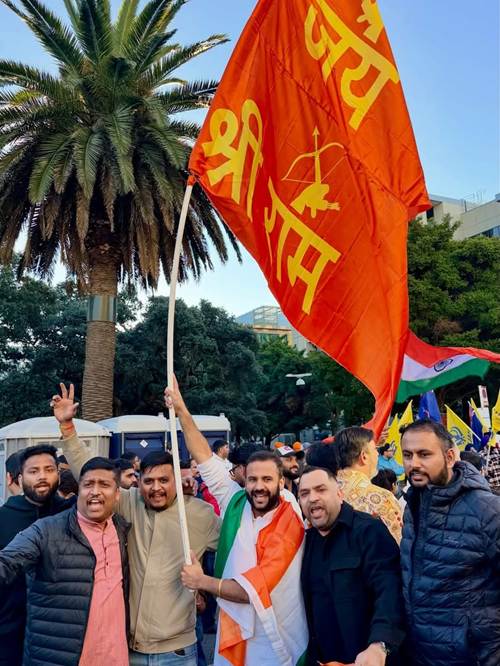 Demonstrators outside the Kia Ora Modi event, Auckland, July 2026, with a saffron Jai Shree Ram flag.
Jai Shree Ram was once a greeting exchanged between pilgrims, and it has been remade into a war cry: the chant that rolled through the streets of Leicester in 2022 as communal violence flared half a world from the quarrels that ignited it, the chant that travels with mobs linked to the RSS and the VHP when they descend on mosques and minority neighbourhoods in India, a devotion hollowed out and refilled with menace. When the slogan flies over an Auckland street it does not fly alone; it arrives in the company of markers the world has learned to recognise, politicians at Hindutva events, saffron scarves on parliamentary shoulders, the image of Bharat Mata borne aloft, and the Kia Ora Modi event gathered a remarkable number of them into a single evening.
The production
Look at the welcome poster the Hindu Council of New Zealand, one of the nodal organisations of Hindutva, sent into the world: a wharenui in one corner, the silver fern, the Southern Alps, the two flags braided together, and over it all the face of Narendra Modi rising like a sun. This is the movement's signature move, the iconography of the host country draped across the iconography of the project, the local greeting stretched over the same travelling production that filled a Houston stadium in 2019 under the name Howdy, Modi.
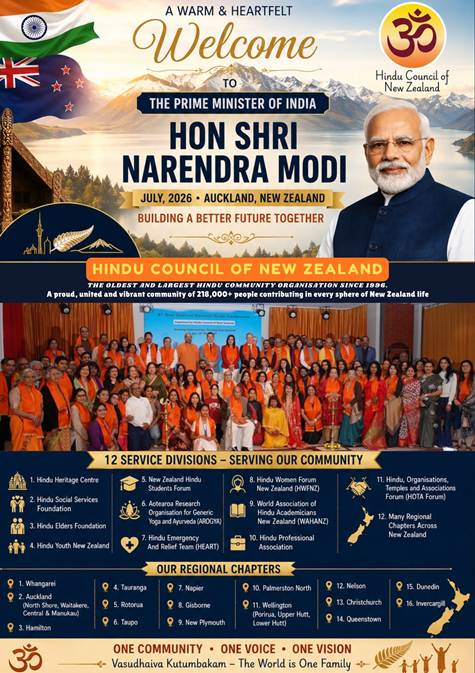 Hindu Council of New Zealand welcome poster for the July 2026 visit.
If the poster supplies the imagery, the Council's Facebook post supplies the theology, extending a sacred Poornakumbh Swaagatam to the Prime Minister of Bharat and hymning the timeless bonds of dharma joining Bharat and Aotearoa, so that a state visit becomes a homecoming of civilisations, a trade mission becomes dharma, and the vocabulary of the Hindutva movement settles in plain sight on a New Zealand feed, tagged to the High Commission and the Consulate.
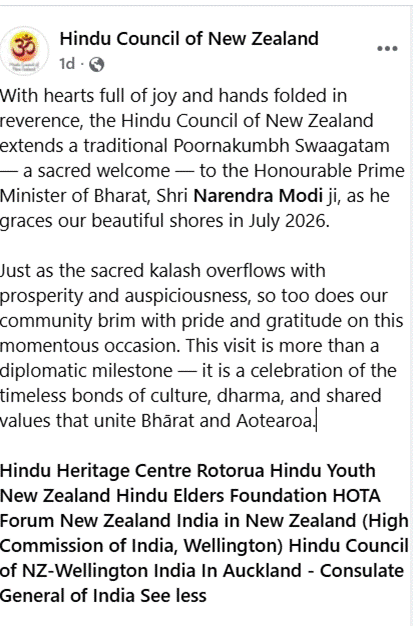 Hindu Council of New Zealand Facebook post framing the visit through Bharat and dharma.
When the Council's president boasted that every volunteer at the event was a woman, he reached for the regime's own phrase, Naari Shakti, woman power, the slogan of a government that garlands womanhood in the abstract while women human rights defenders grow old in its jails, a vocabulary that needed no translation on its journey south.
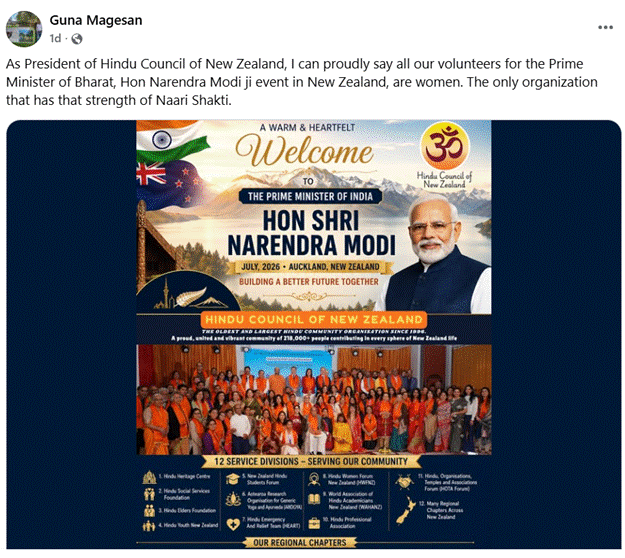 Post by the Hindu Council of New Zealand president on the event's volunteers as Naari Shakti.
The politicians
Into this production walked the political leadership of New Zealand. Prime Minister Christopher Luxon stood on the Spark Arena stage beside Modi, two men waving into a blaze of phone lights, and posted the footage himself, National MPs arrayed behind him. Every second of it will now be clipped, subtitled and pushed through the Hindutva ecosystem as recruitment material, burnishing the image the movement has spent two decades manufacturing: Modi as vishwaguru, teacher of the world, the singular leader on whose shoulders authoritarian populism always rests.
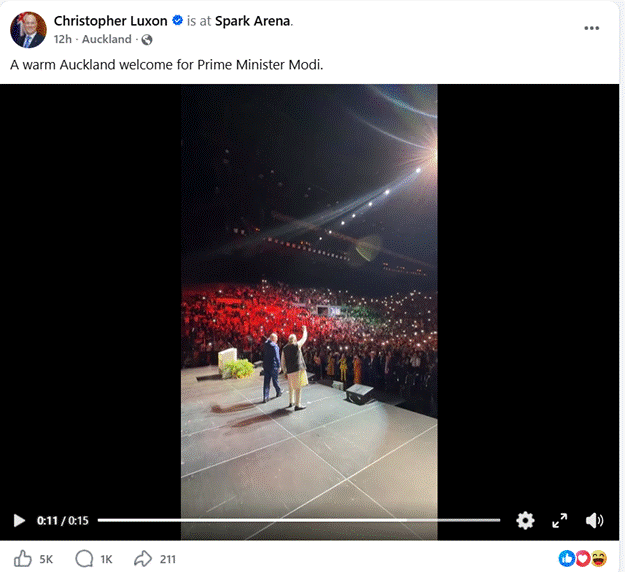 Prime Minister Christopher Luxon's post from the Spark Arena stage.
This is the same country whose own Security Intelligence Service, in the years after the Christchurch terror attack taught it what Islamophobic extremism can do, identified Hindutva as a form of extremism in the Aotearoa context, and it now has a Prime Minister who says he is not worried about Hindutva in New Zealand even as he parades into a Hindutva rally and wakes the next morning on the front pages of the Hindutva-linked media in India.
Labour offered no counterweight: Jenny Salesa filmed the twelve thousand inside the arena and pronounced the vibe amazing, while Chris Hipkins went to meet Modi with Vanushi Walters, who wrote warmly of the growing partnership between our two democracies. The warmth was bipartisan and so was the silence.
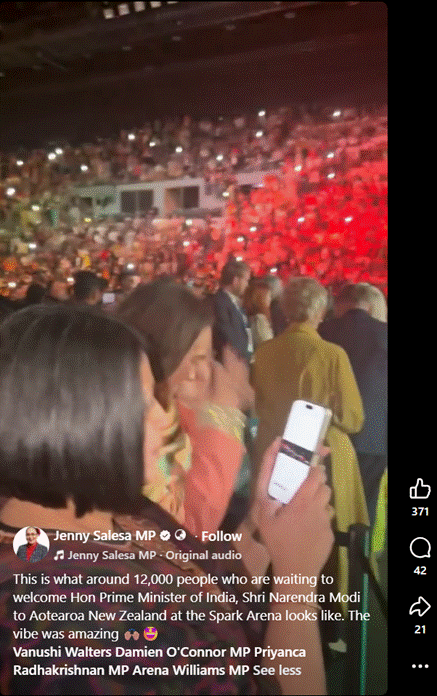 Labour MP Jenny Salesa's post from inside Spark Arena.
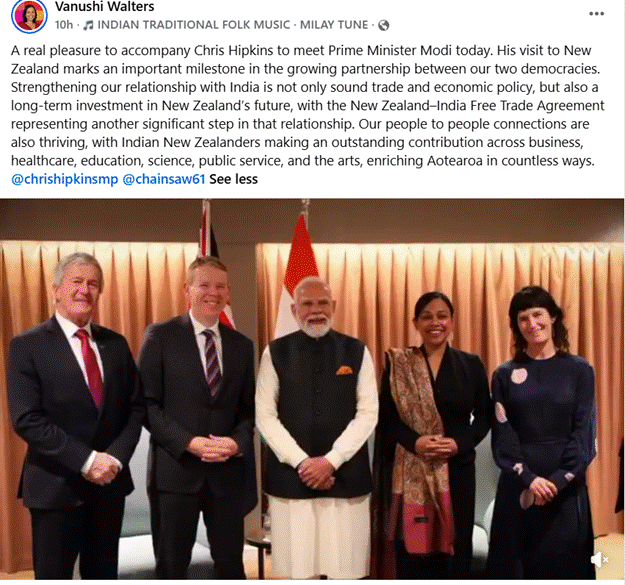 Labour MP Vanushi Walters' post on meeting Modi with Labour leader Chris Hipkins.
The most telling image from Auckland, though, is the one that was never taken, because Modi does not hold press conferences: across more than a decade in office he has not taken unscripted questions from his own country's journalists, years in which the Varieties of Democracy Institute downgraded the world's largest democracy to an electoral autocracy, its newsrooms raided, its scholars jailed, its universities hollowed out. Of the two democracies toasted at Spark Arena, only one still answers to its people, and neither of New Zealand's major parties found a word to say about it.
The cost
None of this is new to these islands. Narendra Modi first came to New Zealand in 2001, as a functionary of the Bharatiya Janata Party and a senior member of the RSS, before his years as Chief Minister of Gujarat, and the mainstream arrival of Hindutva here has been building ever since, in full view of a documentary base assembled with patience and at personal cost: the white papers published by the Center for Culture-Centered Approach to Research and Evaluation, the encyclopedia entries recording the movement's presence in Aotearoa, the organising of activists such as Sapna Samant and Oscar Romero, the sustained work of the Aotearoa Alliance of Progressive Indians, and five years of excellent reporting that traced the evidence and the linkages. The scenes captured in these photographs unfolded with that record open on the table, which makes them a choice rather than an oversight, and the bill for the choice will be presented twice.
It will be presented first in New Zealand, where the arrival of one majoritarian fury summons another: Hindutva hands Destiny Church and Brian Tamaki the enemy their Christian nationalism requires, and receives from them the enemy it requires in return, while Muslims, Sikhs, Dalits, tangata whenua and queer communities are caught in the space between them.
The thousands who streamed into Spark Arena came, most of them, for reasons as old as migration itself: to hear the songs of home in a southern winter, to see the leader of the country they left honoured by the country they chose, to stand for one evening inside a crowd that pronounced their names correctly. There is nothing to apologise for in that longing. But it is precisely this longing that the production harvests: the warmer the welcome and the fuller the arena, the louder the declaration to those trained to hear it.
And it will be presented in India, where every arena filled in a western democracy returns as proof that the world has blessed the project, that the raids and the jailings carry no cost abroad. The applause in Auckland does not stay in Auckland.
A saffron flag with a war cry flew over an Auckland street this week, and the political leadership of this country stood inside the arena it pointed toward. New Zealand should say plainly what it saw.
