The Scapegoat Economy: How Racism in NZ Is Intentional
By Alan John Koshy
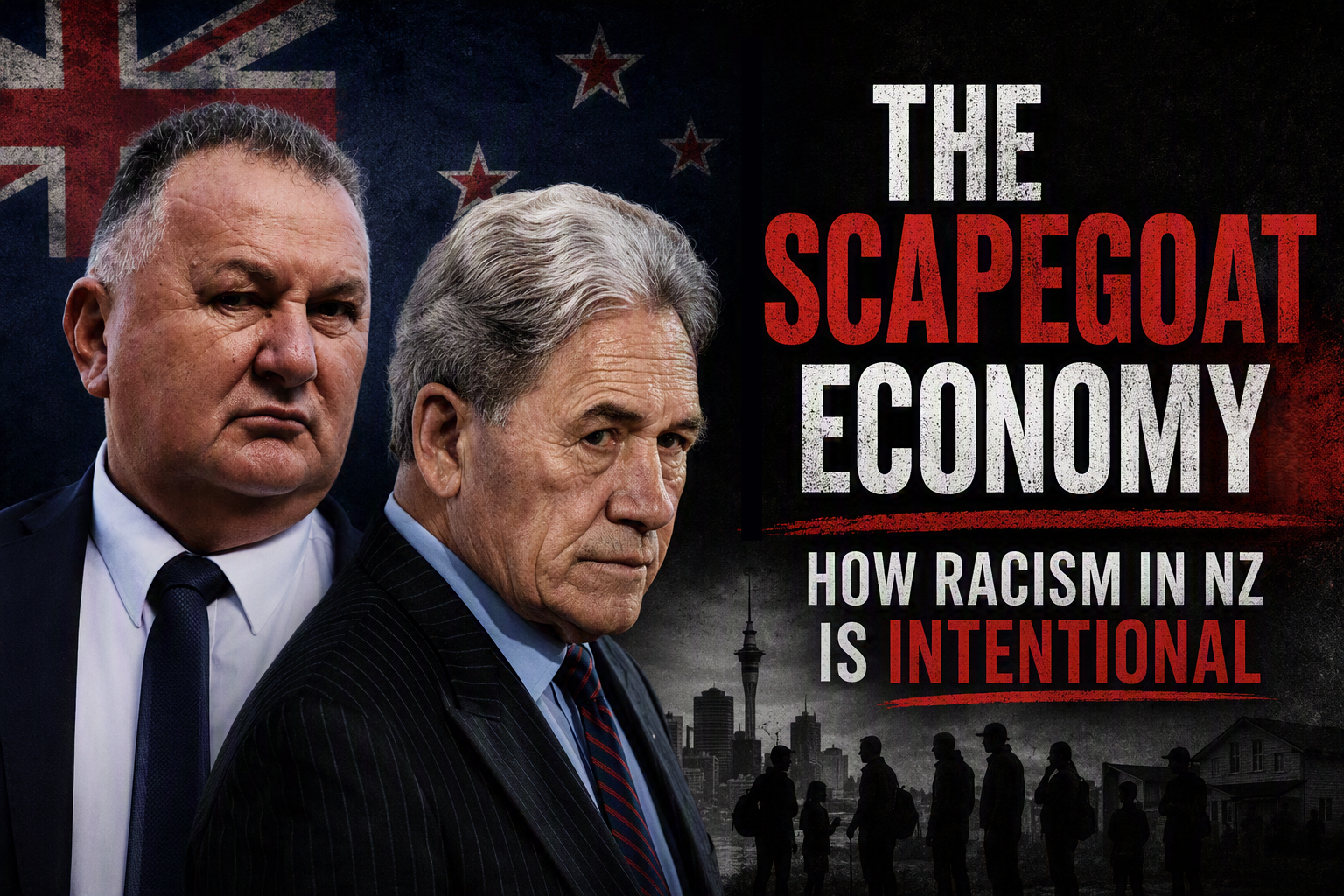
We cannot afford to be distracted by the vitriol. The blatant racism of politicians like Winston Peters and Shane Jones is not an anomaly, nor is it the work of a few "rotten apples."
It is a symptom of a systemic need within capitalism to produce scapegoats, to divert working-class anger away from a failing economic system and toward a fabricated external enemy.
As Dutch sociologist Hein de Haas notes, sowing "suspicion or outright hatred towards migrants” has always been a convenient strategy to divide the working classes. To put it simply, divide and rule.
The Merchants of Hate
The conduct of Winston Peters and his acolyte, Shane Jones, fits this tactic perfectly, especially during periods of economic strain.
In 2024, Jones yelled "send the Mexicans home" at Mexican-born Green MP Ricardo Menéndez March. Earlier this year, he warned that this country would not be "a dumping ground for people trying to come to New Zealand and set up New Delhi," declared "we do not need any more Uber drivers," and capped his anti-Indian rhetoric with criticism that a free trade deal would risk a "butter chicken tsunami."
More recently, Peters, the veteran architect of this political playbook, told Chinese-born Green MP Dr Lawrence Xu-Nan, who has lived in New Zealand for 32 years, to "go back to your own country" multiple times.
As the Union Network of Migrants (UNEMIG) observed, "when language like this comes from the floor of our own Parliament, it gives cover for the same language in workplaces, schools and on the street."
A Decades-Old Lineage of Blame Politics
Winston Peters and Shane Jones belong to a tradition stretching back over half a century. Sir Robert Muldoon from the National Party, Prime Minister from 1975 to 1984, is widely cited as Peters' direct political ancestor, a right-wing populist who promised to lead "a government of the ordinary bloke".
In the 1950s and 1960s, a booming New Zealand had actively encouraged migration from other Pacific nations such as Tonga, Samoa, and Fiji to fill labour shortages.
But by the 1970s, as the OPEC oil price shock and other factors plunged the NZ economy into downturn, these same communities were scapegoated for "taking jobs from New Zealanders."
Muldoon expanded the terrifying Dawn Raids, unleashing police brutality that specifically targeted overstaying Pacific Islander migrants.
Pacific Islanders made up only one-third of overstayers but accounted for 86% of those arrested and prosecuted, while British and American overstayers, who comprised the other third, faced only 5% of prosecutions.
It was during this period that a then 33-year-old Winston Peters first broke into the corridors of power, as a National Party MP for Hunua. He would go on to found New Zealand First in 1993, after being expelled from the National Party for publicly opposing its economic direction.
In true bipartisan tradition, the Dawn Raids policy itself was crafted by a Labour government that preceded Muldoon. Before he joined Peters’ New Zealand First in 2017, Shane Jones was a high-profile MP for the Labour Party.
The Economic Engine of Scapegoating
Over the past 40 years, New Zealand has become a poster child for neoliberal financialisaton, far from any semblance of a real economy.
Investment has been systematically funnelled into property and financial assets, not into the productive enterprise that creates real wealth for the working classes.
The housing market has become a primary vehicle for wealth creation, but this is a "mirage of wealth" backed by massive debt and siphons the wealth of New Zealanders offshore through profits of foreign-owned banks.
In the 1950s, New Zealand was the third richest country in the world by GDP per capita. Today, it languishes in 37th place.
Productivity in the construction sector, the country’s most fundamental economic engine, is the same today as it was in 1985. The result is a housing market so broken that renters now spend nearly 40% of their income on shelter, and homes take 50% longer to build than a decade ago.
The government has run budget deficits for nearly a decade, and a return to surplus is not expected until 2029. Critics have described its fiscal approach as "hold the line and hope for the best."
The recent global energy price shock has laid bare New Zealand's vulnerability. Inflation has surged to a two-year high, driven by imported fuel costs. The Reserve Bank is now considering raising interest rates, which will hit families already stretched by the cost of living.
With an election looming, this is the context in which scapegoating thrives.
No More Scapegoats
In this climate of manufactured crisis, the political demand for a scapegoat is not an anomaly but a predictable survival mechanism for a system that refuses to admit its failures.
Winston Peters is only the latest ambassador of racist rhetoric designed to frame communities as a threat to national identity and resources.
The way forward is not culture wars or migrant-blaming but challenging an economic and political system that funnels wealth to the few while the rest of us fight over scraps.
